Have you ever written a sentence like “I’ll do it someday” and then wondered whether it should be “some day” instead? You are not alone. Someday and some day look almost identical, sound the same, and both can be correct. The difference is mainly about meaning and grammar.
The good news is that the rule is simple. Someday is usually one word when you mean at an unspecified time in the future. For example, “I hope to visit Japan someday.” Some day is usually two words when you mean a particular day or one day among several, often with a specific context. For example, “We should choose some day next week to meet.”
This spelling difference can appear in school assignments, workplace writing, emails, texting, social media posts, blogs, and everyday conversations. It can also confuse English learners because the pronunciation is normally the same.
People usually search for “someday or some day” because they want to know the correct spelling, meaning, pronunciation, examples, usage, definition, and grammar difference. Understanding the distinction can make your writing clearer and help you avoid a very common English mistake.
In this guide, you’ll learn the meaning, pronunciation, examples, usage, grammar rules, common mistakes, expert tips, and simple explanations in easy English.
Someday or Some Day – Quick Answer
Both someday and some day can be correct, but they are used differently.
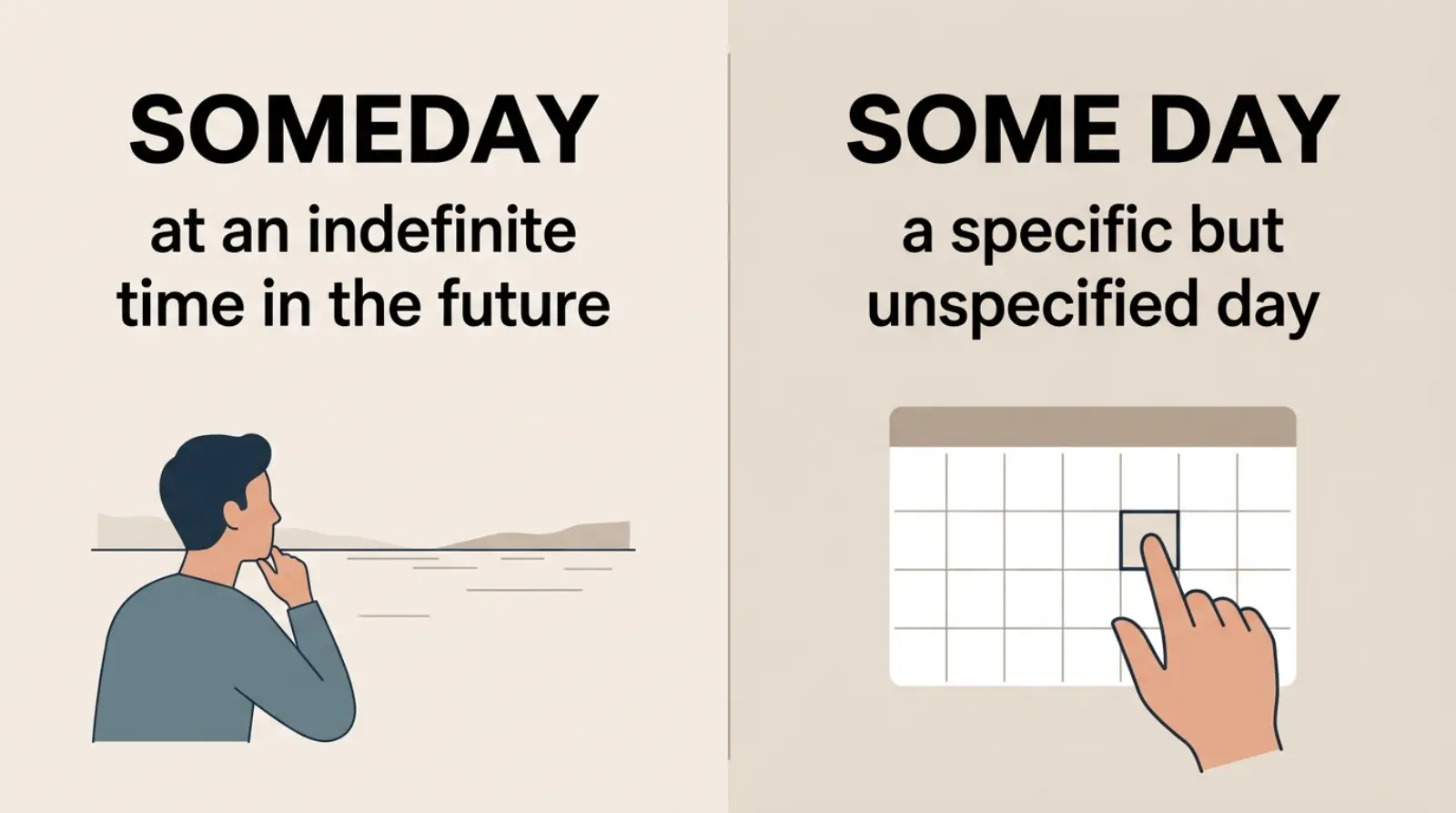
👉 Someday = at an unspecified time in the future
👉 Some day = a particular or unspecified single day, often referring to one day in a specific group or situation
Examples
Someday:
“I want to travel around the world someday.”
Some day:
“We need to choose some day next week for the meeting.”
Someday:
“Someday, I’ll learn to play the guitar.”
Some day:
“Some day in June would be perfect for the event.”
Someday:
“She hopes to become a writer someday.”
Simple Rule
👉 If you mean “at some time in the future,” use someday.
👉 If some describes the noun day, use some day.
Memory trick:
Someday = future time
Some day = one particular day

What Does “Someday or Some Day” Mean?
The difference between someday and some day is small but useful.
What Does “Someday” Mean?
Someday is an adverb. It means at some unknown or unspecified time in the future.
You are talking about the future, but you do not know or do not want to say exactly when.
Examples:
- “I’ll visit you someday.”
- “Someday, I want to own a house.”
- “We should go there someday.”
- “He hopes to write a book someday.”
In each example, the exact day is unknown.
What Does “Some Day” Mean?
Some day is the combination of the determiner some and the noun day.
It can mean one particular but unspecified day.
Examples:
- “We should meet some day next week.”
- “Choose some day that works for everyone.”
- “Some day in July would be better.”
- “I remember some day when everything changed.”
Here, day is functioning as a noun.
A useful test is to see whether you are talking about a day as a specific unit of time.
An Important Usage Note
In many ordinary sentences, some day can sound natural even when the meaning is close to “someday.” Modern English often allows some flexibility, especially when the phrase is followed by additional details.
Compare:
“I hope to visit you someday.”
This clearly means at an unspecified future time.
But:
“We can meet some day next week.”
Here, some day points to one day within next week.
Synonyms for “Someday”
Depending on the sentence:
- one day
- eventually
- at some point
- sometime in the future
- in the future
- sooner or later
Synonyms for “Some Day”
Depending on context:
- one particular day
- one day
- a certain day
- a day
- an unspecified day
Related Terms
Other time expressions that can cause confusion include:
- sometime / some time
- sometimes
- someday / some day
- everyday / every day
- anytime / any time
- awhile / a while
- altogether / all together
These pairs often change meaning when written as one word or two.
Common Variations
You may see:
- someday
- some day
- someday soon
- someday in the future
- some day next week
- some day in the future
- one day
- at some point
The Origin of “Someday” and “Some Day”
The two-word expression some day comes naturally from the combination of some and day.
English has gradually formed many compounds from words that were once written separately. Over time, certain expressions became established as single words because they developed a special meaning or were commonly used together.
Someday developed as an adverb meaning at an unspecified future time.
This is similar to other English words where a combination of words develops a related but distinct grammatical use.
For example:
- every day = each day
- everyday = ordinary or usual
- some time = an amount or period of time
- sometime = at an unspecified time
- some day = some particular day
- someday = at an unspecified future time
The modern distinction is therefore not simply about spelling. It is about how the phrase functions in the sentence.
How to Pronounce “Someday or Some Day”
Someday and some day are normally pronounced the same way.
Pronunciation
Someday: /ˈsʌm.deɪ/
Sounds like: SUM-day
Some day: /sʌm deɪ/
Sounds like: sum day
Both contain two syllables:
some-day
The difference is mainly visible in writing, not in speech.
Easy Speaking Trick
Say:
“Some day.”
Now say:
“Someday.”
You will usually hear little or no difference.
That is why context is so important.
Common Pronunciation Mistake
Do not try to create a strong pause between some and day just because one version has two words. Natural speech usually keeps the expression smooth.
British English vs American English Usage
Both British English and American English use someday and some day.
The main difference is not regional spelling. The distinction is based on meaning and grammatical function.
| Feature | British English | American English | Notes |
|---|---|---|---|
| Someday | Correct | Correct | Future time |
| Some day | Correct | Correct | A particular/unspecified day |
| Pronunciation | Usually the same | Usually the same | Context matters |
| Formal writing | Used | Used | Meaning determines form |
| Texting | Common | Common | Informal contexts allow flexibility |
| Academic writing | Common | Common | Choose based on meaning |
So, whether you are writing for readers in the UK, US, Canada, Australia, India, or Pakistan, the basic rule remains the same.
Which One Should You Use?
Choose based on what you mean.
Use “Someday” When:
- You mean an unknown future time.
- You are talking about a future dream.
- You do not know the exact date.
- You mean “eventually.”
- You mean “at some point in the future.”
Examples:
- “I want to become a doctor someday.”
- “Someday, I’ll visit Paris.”
- “Maybe we’ll work together someday.”
Use “Some Day” When:
- some directly describes day.
- You are choosing one day from a group.
- You add a phrase identifying the possible day.
- The sentence treats “day” as a noun.
Examples:
- “Choose some day next month.”
- “We can meet some day in December.”
- “Pick some day that works for you.”
Mini Usage Table
| Meaning | Correct Form | Example |
|---|---|---|
| At an unknown future time | someday | “I’ll do it someday.” |
| One unspecified day | some day | “Choose some day next week.” |
| Future dream | someday | “Someday, I’ll travel.” |
| A day within a period | some day | “Some day in June works.” |
| Casual future promise | someday | “We’ll meet someday.” |
Common Mistakes With “Someday or Some Day”
Mistake 1: Using “some day” for every future dream
❌ Incorrect:
“I want to travel the world some day.”
✔ Better:
“I want to travel the world someday.”
Here, there is no particular day in mind. The speaker simply means at some point in the future.
Correction tip: If the sentence means “eventually,” use someday.
Mistake 2: Using “someday” when selecting a day
❌ Incorrect:
“Choose someday next week for the meeting.”
✔ Better:
“Choose some day next week for the meeting.”
Here, you are asking someone to choose one day within next week.
Why people make this mistake: The pronunciation is the same.
Mistake 3: Thinking “someday” means a specific date
❌ “Someday means a particular future date.”
✔ “Someday” normally means an unspecified future time.
For example:
“Someday I’ll buy a house.”
The speaker does not say when.
Mistake 4: Assuming “some day” is always wrong
❌ “Some day is never correct.”
✔ “Some day” is correct when some modifies the noun day.
Example:
“Some day next month would be convenient.”
Mistake 5: Confusing “someday” with “sometimes”
❌ “I’ll visit you sometimes.”
This means you may visit on multiple occasions.
✔ “I’ll visit you someday.”
This means you expect to visit at some point in the future.
Correction tip:
Someday = one unknown future time
Sometimes = occasionally
Mistake 6: Confusing “someday” with “some time”
❌ “I want to travel some time.”
This can be correct in a different meaning, but some time is two words when referring to an unspecified amount or period of time.
✔ “I want to travel someday.”
Use someday when you specifically mean at some future time.
Someday or Some Day in Everyday Examples
Work
Someday:
“I hope to lead a team someday.”
Some day:
“Let’s choose some day next week for the training.”
School
Someday:
“Someday, I want to study abroad.”
Some day:
“We need to pick some day for the school event.”
Social Media
Someday:
“Someday, I’ll take this trip.”
This often expresses a dream or goal.
Daily Life
Someday:
“I’ll clean out the garage someday.”
This means the exact time is unknown.
Emails
Someday:
“I hope we can work together someday.”
Some day:
“Please suggest some day next week when you are available.”
Text Messages
“We should hang out someday!”
This is a casual way to express a future intention.
But:
“Can we meet some day this week?”
Here, the person is looking for one day during the week.
Online Content
“Someday, I hope to see the Northern Lights.”
This is a common way to express a dream or future goal.
Conversations
A: “Do you think you’ll visit Italy?”
B: “Someday!”
The answer means at some point in the future.
“Someday or Some Day” in Different Contexts
Education
Students often use someday when writing about goals, dreams, and future plans.
“Someday, I hope to become an engineer.”
Use some day when referring to a day selected for an activity.
“We need to choose some day for the presentation.”
Business
Business writing often requires precision.
“We hope to partner with you someday.”
This is a general future hope.
But:
“Please select some day next week for the meeting.”
This asks for a specific day.
Workplace Communication
In casual workplace communication, both forms may appear naturally.
“Maybe we can discuss this someday.”
versus
“Let’s choose some day this month to review the project.”
Social Media
Someday is common in motivational posts, travel content, and personal goals.
Examples:
- “Someday, this dream will become real.”
- “Someday, I’ll visit every continent.”
- “Someday, I’ll look back and smile.”
Relationships
“Someday” can carry an emotional feeling because it often describes hopes or dreams.
“Someday, we’ll take that trip we always talk about.”
It suggests a future possibility without giving a specific date.
Grammar Learning
The key grammar difference is:
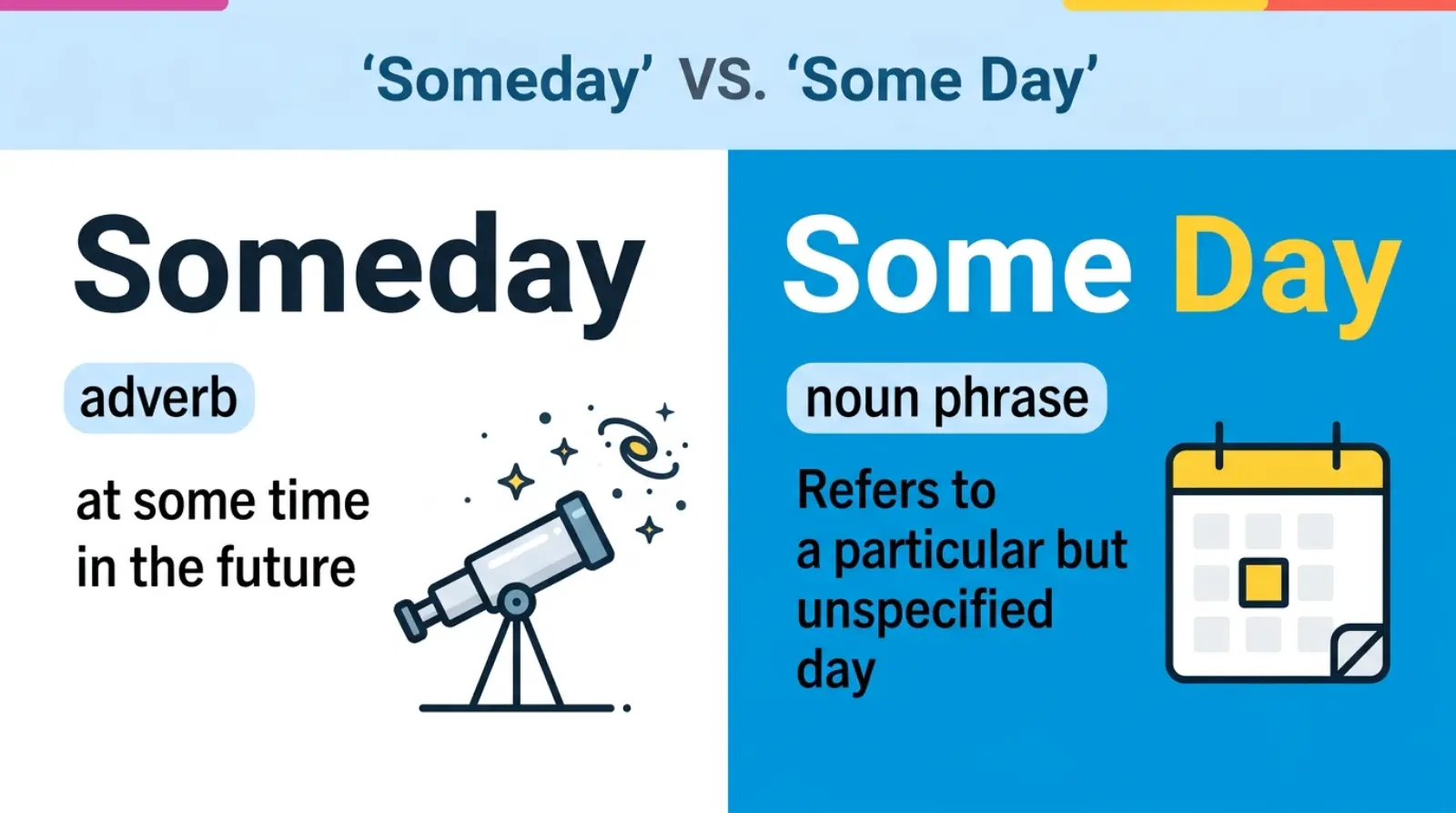
Someday = adverb
Some day = determiner + noun
This is the most useful grammatical distinction to remember.
Writing
If you are editing a sentence, ask:
Am I describing when something will happen generally in the future?
Use someday.
Am I talking about one day?
Use some day.
Someday or Some Day – Google Trends & Usage
People searching for “someday or some day” are usually trying to solve a spelling and grammar problem.
Common search intent includes:
- “someday or some day which is correct”
- “is someday one word”
- “some day or someday grammar”
- “someday meaning”
- “some day meaning”
- “someday examples”
- “how do you use someday”
- “when to use some day”
- “someday vs some day”
- “is someday one word or two”
This type of search is common among students, English learners, writers, bloggers, editors, and people checking a sentence before publishing it.
The same question can appear in the US, UK, India, Pakistan, Canada, and Australia because English learners and native speakers alike encounter compound-word questions.
Voice searches may sound like:
“Is someday one word?”
“Should I write someday or some day?”
“What is the difference between someday and some day?”
These questions all have the same basic answer: look at the intended meaning and grammatical role.
Comparison Table: Someday vs Some Day
| Feature | Someday | Some Day |
|---|---|---|
| Spelling | One word | Two words |
| Main meaning | At an unspecified future time | One particular/unspecified day |
| Grammar role | Adverb | Determiner + noun |
| Pronunciation | SUM-day | SUM day |
| Future dreams | Excellent | Usually not preferred |
| Selecting a day | Usually not | Excellent |
| Formal writing | Correct | Correct |
| Academic writing | Correct | Correct |
| Texting | Very common | Common when referring to a day |
| Social media | Very common | Less common |
| Example | “I’ll travel someday.” | “Choose some day next week.” |
“Someday or Some Day” in Professional Life
In professional communication, the distinction can affect clarity.
Consider:
“We should meet someday.”
This expresses a general idea. There is no planned date.
Now compare:
“We should meet some day next week.”
This suggests the speaker wants to choose one day during next week.
In a formal email, you can make the meaning even clearer:
“I hope we can collaborate in the future.”
or:
“Please let me know which day next week works best for you.”
The best choice depends on whether you are expressing a general future possibility or referring to one day.
“Someday or Some Day” for Students and Beginners
This pair can be confusing because there is no pronunciation clue.
The easiest method is to focus on the meaning rather than the sound.
Beginner Shortcut
Ask yourself:
Can I replace it with “eventually”?
If yes, use someday.
“I’ll learn Spanish someday.”
→ “I’ll learn Spanish eventually.”
That works.
But:
“Choose some day next week.”
You cannot naturally replace some day with “eventually.”
This tells you that the two-word version is being used to describe a day.
Common Uses and Patterns
“Someday” Patterns
- someday I will…
- I hope to… someday
- maybe someday…
- someday soon
- someday in the future
- we’ll do it someday
- I want to… someday
“Some Day” Patterns
- some day next week
- some day this month
- some day in June
- some day that works for you
- choose some day
- pick some day
- on some day
These patterns can make the difference much easier to spot.
Simple Trick to Remember “Someday or Some Day”
Use this rule:
Someday = someday in the future.
If you can add “in the future” without changing the meaning, choose someday.
Example:
“I’ll visit you someday.”
→ “I’ll visit you at some time in the future.”
For some day, think about a calendar.
Imagine seven boxes representing the days of a week.
If you say:
“Choose some day next week.”
you are choosing one box on the calendar.
Think of It This Way:
📅 Some day = one day on the calendar
🔮 Someday = an unknown point in the future
That visual difference is one of the easiest ways to remember the rule.
Expert Tips for “Someday or Some Day”
1. Use the “eventually” test
If eventually fits, someday is usually right.
“I’ll finish it someday.”
→ “I’ll eventually finish it.”
2. Look for a time period
If you see phrases such as next week, this month, or in June, some day may be appropriate when you mean one day within that period.
“Choose some day next week.”
3. Do not rely on pronunciation
Both forms normally sound the same.
4. Think about grammar
Ask whether day is acting as a noun.
If yes, some day may be the better choice.
5. Be consistent
When writing professionally, choose the form that best communicates your intended meaning.
6. Watch for related word pairs
Learning someday vs some day can also help you understand:
- sometime vs some time
- everyday vs every day
- anytime vs any time
Related Searches People Also Ask
“Is someday one word?”
Yes. Someday is one word when it means at an unspecified time in the future.
“Is some day also correct?”
Yes. Some day is correct when some modifies the noun day.
“Is someday one word or two?”
It can be either one or two words depending on meaning.
“What is the difference between someday and some day?”
“Someday” usually means an unspecified future time, while “some day” refers to a day as a noun.
“Can I say someday in a formal essay?”
Yes. It is a standard English word and can be used when its meaning fits.
“Is someday the same as one day?”
They can have similar meanings when “one day” means an unspecified future time.
“What does someday mean?”
It means at some unspecified time in the future.
“What does some day mean?”
It means one day, usually an unspecified day in a particular context.
“Should I write someday soon?”
Yes. “Someday soon” is a common phrase meaning at some unspecified time in the near future.
“Is some day next week correct?”
Yes, when you mean one day within next week.
FAQs About Someday or Some Day
1. Is “someday” one word?
Yes. Someday is one word when it means at an unspecified time in the future.
2. Is “some day” grammatically correct?
Yes. Some day is correct when some describes the noun day.
3. Which is correct: someday or some day?
Both are correct. The choice depends on meaning.
4. What does “someday” mean?
“Someday” means at some unknown or unspecified time in the future.
5. What does “some day” mean?
“Some day” means one day, often one day within a particular period or situation.
6. Do “someday” and “some day” sound different?
Usually, no. They are normally pronounced almost exactly the same.
7. Is “I’ll do it someday” correct?
Yes. This is correct because the sentence means “I’ll do it at some point in the future.”
8. Is “Choose some day next week” correct?
Yes. Here, some day means one day during next week.
9. Can “someday” be used in formal writing?
Yes. It is a standard English word. However, always choose wording that clearly communicates your intended meaning.
10. What is an easy way to remember the difference?
Remember:
Someday = future time
Some day = one day
11. Is “someday” the same as “sometime”?
They can have a similar meaning when talking about an unspecified future time. However, someday specifically contains the idea of a future day or time, while sometime is broader.
12. What is the opposite of “someday”?
There is no exact opposite, but expressions such as today, now, or at a specific time contrast with the idea of an unspecified future time.
Final Verdict
Someday and some day are both correct, but they do not always mean exactly the same thing.
👉 Someday = at an unspecified time in the future.
👉 Some day = one particular or unspecified day.
Use:
“I’ll travel someday.”
when you mean eventually.
Use:
“Choose some day next week.”
when you mean one day within next week.
The easiest rule is:
Future dream → someday
One day on the calendar → some day
Conclusion
The difference between someday or some day is much easier once you stop focusing on spelling and focus on meaning.
When someday is written as one word, it normally works as an adverb meaning at an unspecified time in the future. It is perfect for dreams, hopes, plans, promises, and future possibilities.
When some day is written as two words, some describes the noun day. It is useful when you are talking about one day, especially when that day belongs to a larger period such as next week, next month, or a particular season.
The two forms usually sound the same, so context is your best guide.
Just remember:
Someday = future time 🔮
Some day = one day on the calendar 📅
Once you learn that simple difference, choosing between someday and some day becomes much easier.

Camila Green is an English language writer who specializes in confusing word comparisons and spelling explanations. She creates simple, beginner-friendly guides on topics like “niece or neice” and other common English mistakes. Her writing focuses on clarity, real-life examples, and easy learning. At VerrsaPick, she helps readers improve their English with practical and engaging content.