Imagine someone asks, “Yay or nay?” You may understand that they want an answer, but you might still wonder what the phrase actually means. Is “yay” a word for happiness? Is “nay” an old-fashioned way to say no? And should you use the phrase in a text, at work, or in formal writing?
The phrase “yay or nay” is a simple way to ask someone for a yes-or-no opinion, decision, approval, or vote. It is common in everyday conversations, texting, social media, workplaces, online discussions, and casual group decisions.
For example, if a friend sends you a photo of a new outfit and asks, “Yay or nay?”, they are asking, “Do you like it, or do you think I should not wear it?”
People usually search for “yay or nay meaning” because they want to know the definition, pronunciation, examples, correct usage, and difference between yay, yeah, yea, nay, and no. Beginners can especially find the phrase confusing because “yay” can also express excitement, while “nay” has a more traditional or old-fashioned sound.
You may see “yay or nay” in a social media poll, a text message, a workplace discussion, a meeting, a fashion post, or a casual conversation. It can be playful and friendly, but it is usually informal rather than highly formal.
In this guide, you’ll learn the meaning, pronunciation, examples, usage, grammar rules, common mistakes, expert tips, and simple explanations in easy English.
Yay or Nay Meaning – Quick Answer
“Yay or nay” means “yes or no,” especially when asking for an opinion, approval, or decision.
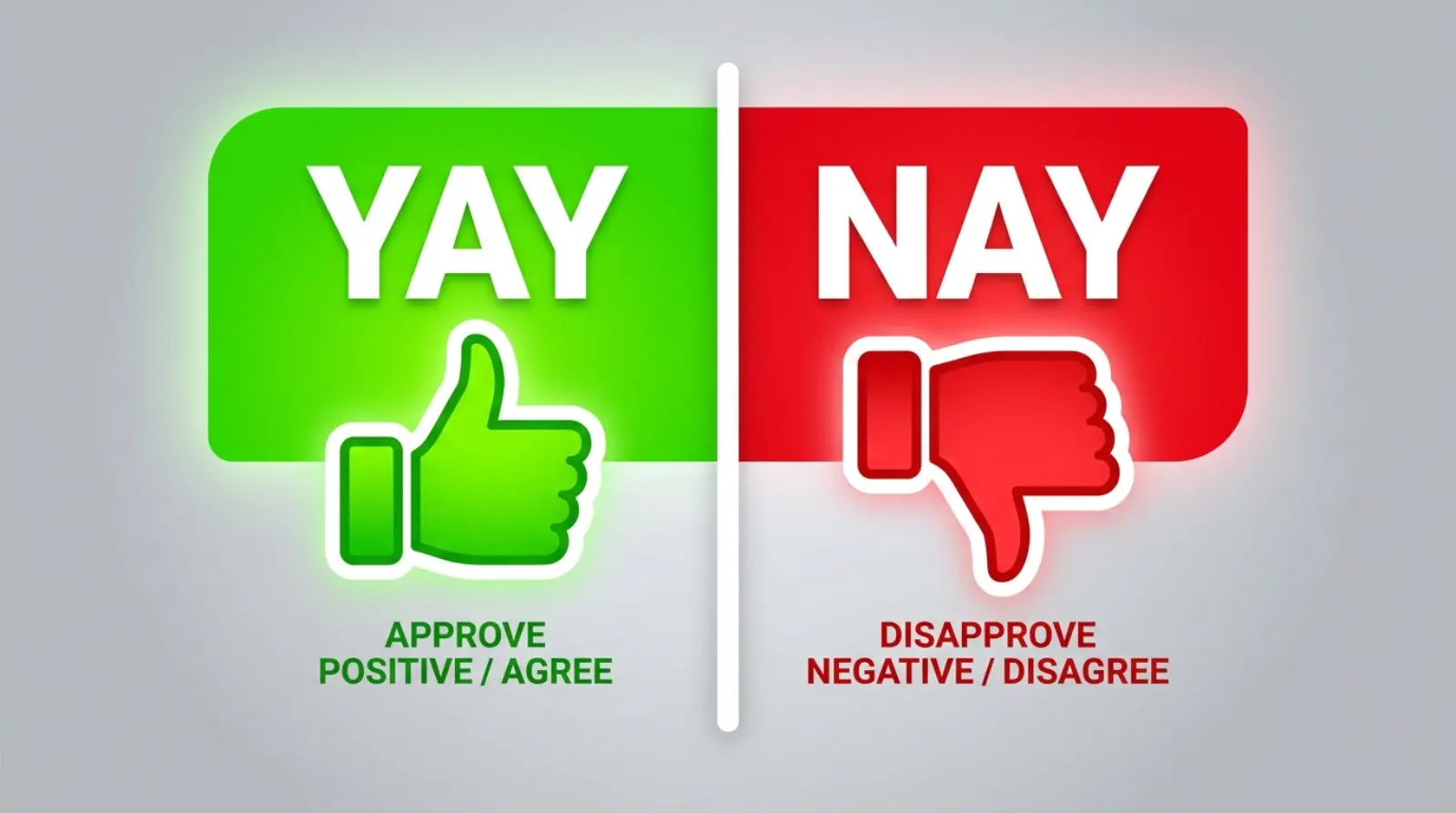
👉 Yay = yes, approval, agreement, or a positive choice
👉 Nay = no, disapproval, disagreement, or a negative choice
Example:
“New logo—yay or nay?”
→ “Do you approve of the new logo?”
More Examples
- “Pizza for dinner, yay or nay?” → Do you want pizza or not?
- “Yay or nay on this dress?” → Do you like this dress?
- “Should we go tonight? Yay or nay?” → Should we go or not?
- “The team voted yay or nay.” → The team voted for or against the idea.
- “Yay or nay on buying this phone?” → Should I buy it or not?
Easy Memory Trick
Think:
YAY = YES 👍
NAY = NO 👎
So, “yay or nay?” = “yes or no?”
What Does “Yay or Nay” Mean?
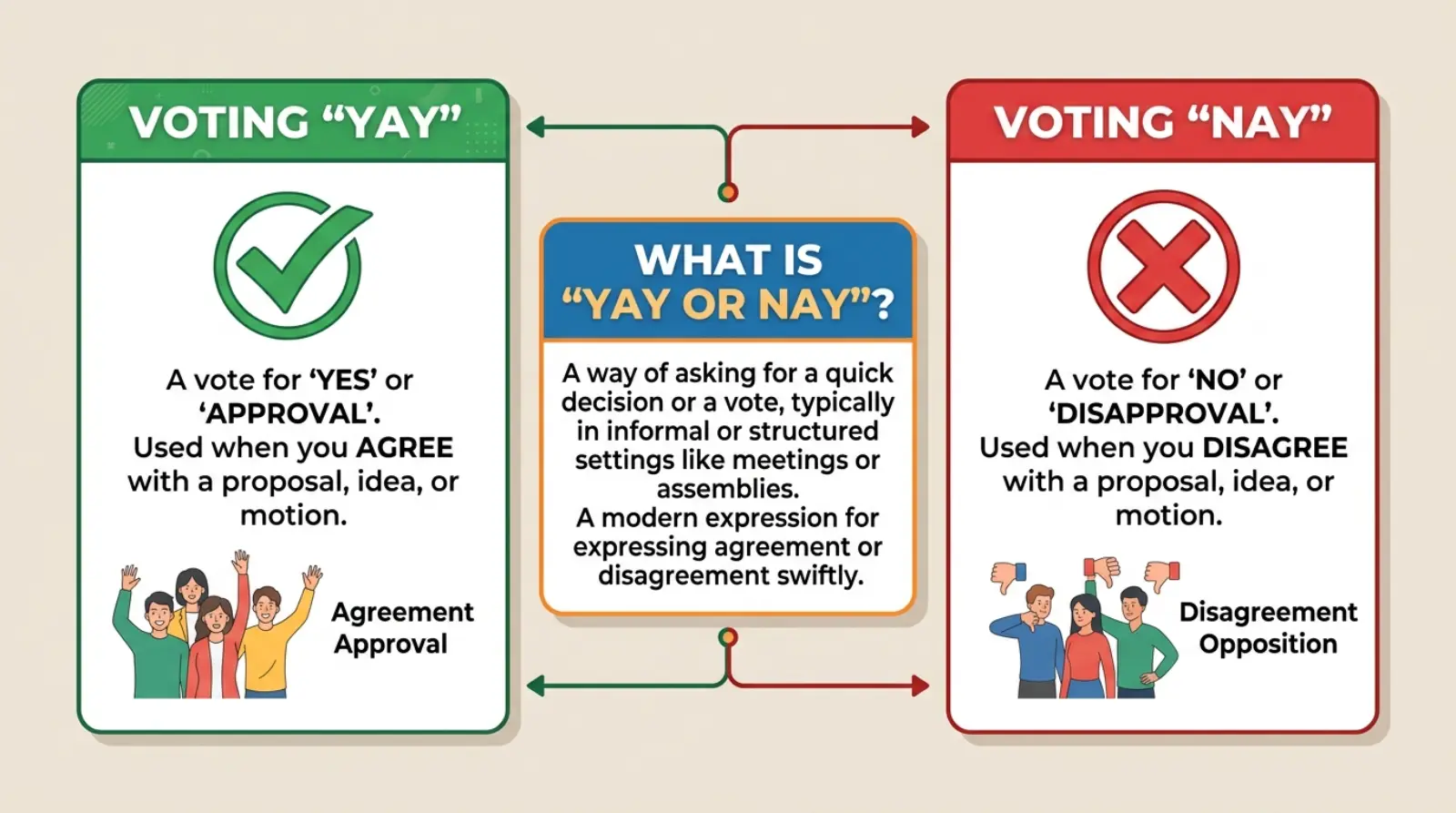
The phrase “yay or nay” asks for a simple decision between two choices: approval or rejection, yes or no, support or opposition.
The exact feeling depends on the situation.
If your friend asks, “Yay or nay on my haircut?” they are asking for your opinion.
If a group votes on a proposal, “yay or nay” can mean whether people support or reject the proposal.
“Yay” Meaning
Yay is commonly used to express happiness, excitement, or approval.
Example:
“Yay! We won the game!”
But in “yay or nay,” yay works as the positive choice.
“Nay” Meaning
Nay means no or a negative vote.
It is more traditional and can sound somewhat old-fashioned in everyday speech.
Example:
“The proposal received 20 yeas and 5 nays.”
In casual conversation, people are much more likely to say yes or no.
Synonyms
Depending on context, “yay or nay” can mean:
- yes or no
- approve or reject
- agree or disagree
- support or oppose
- good or bad
- in favor or against
- thumbs up or thumbs down
- choose or reject
Opposites
The positive and negative sides are:
- yay ↔ nay
- yes ↔ no
- approve ↔ reject
- agree ↔ disagree
- support ↔ oppose
Related Terms
You may also encounter:
- yea — a formal “yes” or affirmative vote
- nay — a formal “no” or negative vote
- yeah — informal “yes”
- nope — informal “no”
- thumbs up — approval
- thumbs down — disapproval
- vote — a formal choice or decision
Common Variations
People use the phrase in several ways:
- “Yay or nay?”
- “Yay or nay on this?”
- “So, yay or nay?”
- “Is this a yay or nay?”
- “Big yay!”
- “Definitely a nay.”
- “I’m voting yay.”
- “I vote nay.”
The Origin of “Yay or Nay”
The two words have different histories.
Nay is an old English word meaning no. It has been used for centuries, especially in voting, formal decisions, and parliamentary language.
Yea, pronounced like “yay,” is also an old word meaning yes or indeed. It has traditionally appeared in voting language, such as “yea or nay.”
This creates an important distinction.
The traditional voting pair is actually:
yea or nay
But in modern casual English, people often write:
yay or nay
Here, yay is associated with approval or enthusiasm, while nay provides the negative choice.
Over time, “yay or nay” became popular in casual speech, internet conversations, social media, fashion discussions, and opinion-based questions.
How to Pronounce “Yay or Nay”
Yay is pronounced like “YAY.”
Nay is pronounced like “NAY.”
Both rhyme with words such as:
- day
- say
- way
- play
Simple Pronunciation
Yay or nay?
→ YAY or NAY?
Both words have one syllable.
Common Pronunciation Mistake
Some beginners may pronounce “nay” like it contains several sounds. It is simply one syllable:
nay → /neɪ/
“Yay” is also one syllable:
yay → /jeɪ/
British English vs American English Usage
The phrase is understood in both British and American English.
There is no major spelling difference in the phrase itself. However, “yea or nay” is more closely connected with formal voting, while “yay or nay” is common in casual modern usage.
| Feature | British English | American English | Notes |
|---|---|---|---|
| Yay | Common | Common | Often informal |
| Nay | Understood | Understood | Can sound traditional |
| Yea | Formal/traditional | Formal/traditional | Used in voting contexts |
| “Yay or nay?” | Common | Common | Casual decision/opinion |
| “Yea or nay?” | Formal/traditional | Formal/traditional | More closely linked to voting |
| Meaning | Yes/no choice | Yes/no choice | Usually understood the same way |
So, if someone in the UK asks “Yay or nay?”, an American reader will normally understand it immediately, and vice versa.
Which One Should You Use?
Use “yay or nay” when you want a quick and friendly opinion or decision.
Use It For:
- casual conversations
- texting
- social media
- fashion opinions
- food choices
- entertainment
- group decisions
- informal workplace conversations
- online polls
Examples
Texting:
“Movie tonight, yay or nay?”
Social media:
“Yay or nay on this outfit?”
Friends:
“Should we order dessert? Yay or nay?”
Workplace:
“Yay or nay on moving the meeting to Friday?”
For formal documents, however, clearer wording is often better.
Instead of:
“Yay or nay on the proposal?”
Use:
“Do you approve the proposal?”
or:
“Please indicate whether you approve or reject the proposal.”
Mini Usage Table
| Situation | Best wording |
|---|---|
| Text to a friend | “Yay or nay?” |
| Instagram post | “Yay or nay?” |
| Casual group chat | “Yay or nay?” |
| Formal email | “Do you approve?” |
| Academic writing | “Approve or reject” |
| Official voting | “Yea or nay” may be appropriate |
| Business report | “In favor or against” |
Common Mistakes With “Yay or Nay”
Mistake 1: Thinking “yay” always means “yes”
❌ Incorrect idea:
“Yay” can only mean yes.
✔ Correct explanation:
“Yay” can express excitement or happiness as well as approval.
Example:
“Yay! My vacation starts tomorrow.”
Here, “yay” is an expression of excitement, not a simple answer to a question.
Correction tip: Look at the context.
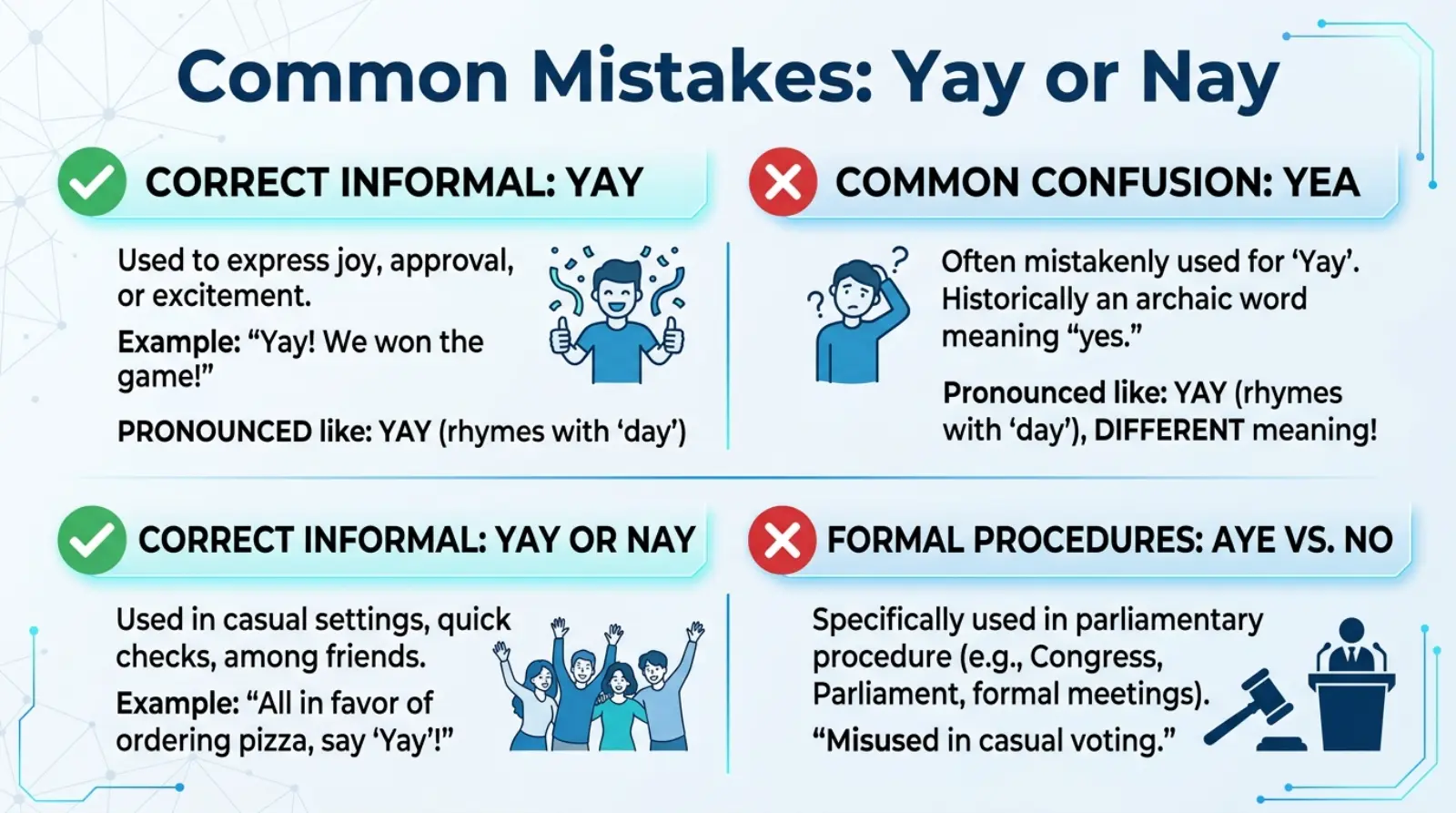
Mistake 2: Confusing “yay” with “yea”
These words sound similar but can have different uses.
Yay usually expresses excitement or approval.
Yea traditionally means yes or is used for an affirmative vote.
Example:
“Yay! We finished the project.”
But:
“The vote was 12 yeas and 3 nays.”
Why people make this mistake: The words are pronounced similarly.
Mistake 3: Thinking “nay” means only an old-fashioned “no”
❌ Incorrect:
“Nay” can never be used today.
✔ Correct:
“Nay” is still used, especially in voting, formal/traditional expressions, and playful language.
Example:
“The final vote was 8 yeas and 2 nays.”
Mistake 4: Using “yay or nay” in every formal situation
❌ Too casual:
“Yay or nay on this legal agreement?”
✔ Better:
“Do you approve the agreement?”
Correction tip: Match your language to your audience.
Mistake 5: Assuming “yay or nay” asks for detailed feedback
The phrase usually asks for a quick decision.
If you want a detailed opinion, ask:
“What do you think about this?”
or:
“What would you change?”
Mistake 6: Thinking “nay” means “neigh”
These words sound alike but have different meanings.
Nay = no or negative vote.
Neigh = the sound made by a horse.
Example:
“The proposal received a nay.”
But:
“The horse began to neigh.”
Mistake 7: Treating “yay or nay” as highly formal
The phrase is generally casual.
For professional or official communication, approve/reject, yes/no, or in favor/against may be clearer.
“Yay or Nay” in Everyday Examples
At Work
“Yay or nay on starting the meeting at 9?”
This asks coworkers whether they agree with the suggested time.
At School
“Group presentation on Friday—yay or nay?”
This asks students whether they support the idea.
On Social Media
“Yay or nay on this new hairstyle?”
The poster wants opinions from followers.
In Daily Life
“Yay or nay for pizza tonight?”
The speaker wants a quick decision about dinner.
In Emails
A casual workplace email might say:
“Yay or nay on the proposed schedule?”
A formal email would usually say:
“Please let me know whether you approve the proposed schedule.”
In Text Messages
“Coffee after work? Yay or nay?”
This sounds friendly and natural.
Online Content
A creator might post:
“Yay or nay on this new design?”
This encourages readers to interact.
Conversations
Person A: “Should we take a road trip this weekend?”
Person B: “Yay!”
Person A: “So that’s a yay?”
Person B: “Absolutely!”
“Yay or Nay” in Different Contexts
Social Media
“Yay or nay?” works especially well on social media because users can answer quickly.
Examples include:
- outfit choices
- hairstyles
- home decoration
- recipes
- travel plans
- product designs
- photos
It can also encourage comments and engagement.
Relationships
Friends or couples may use the phrase playfully.
“Matching outfits—yay or nay?”
Here, the phrase creates a lighthearted choice rather than a serious vote.
Business
In business, “yay or nay” may be used informally among coworkers.
“Yay or nay on launching the campaign next week?”
For external clients or formal documents, more precise wording is usually better.
Marketing
Marketers may use the phrase to invite quick reactions.
“New packaging: yay or nay?”
It can make a question feel less formal and more conversational.
Education
Teachers and students might use it for informal classroom decisions.
“Extra practice quiz today—yay or nay?”
Gaming
Gamers may use it to discuss updates, characters, features, or strategies.
“New character design: yay or nay?”
Writing and Grammar Learning
When learning English, understanding “yay or nay” also helps learners recognize the difference between similar-looking words such as yay, yea, yeah, nay, and neigh.
Google Trends and Usage Data
Searches for “yay or nay meaning” are usually driven by people who encounter the phrase online or in conversation and want a quick explanation.
The search intent is mainly informational.
People may type questions such as:
- What does yay or nay mean?
- What does yay or nay mean in texting?
- Is yay or nay slang?
- What does nay mean?
- Is yay the same as yes?
- What is the difference between yea and yay?
- How do you use yay or nay in a sentence?
The phrase is especially easy to encounter online because social media often uses short questions designed to get fast reactions.
In the US, UK, Canada, Australia, India, and Pakistan, English speakers can generally understand “yay or nay” from context.
However, the exact level of familiarity can vary. Learners of English may be more likely to search for the phrase because nay is less common in ordinary modern conversation than no.
Long-tail searches often focus on the difference between yay vs yea, yay vs yeah, and yea vs nay.
Comparison Table: Yay or Nay
| Feature | Yay | Nay |
|---|---|---|
| Basic meaning | Yes/approval or excitement | No/disapproval |
| Tone | Positive, cheerful | Negative, traditional |
| Pronunciation | “yay” | “nay” |
| Syllables | 1 | 1 |
| Common online use | Very common | Common in the phrase |
| Texting | Common | Less common alone |
| Social media | Very common | Common in polls |
| Formal writing | Usually informal | Can be traditional/formal |
| Voting | Positive choice | Negative choice |
| Emotional feeling | Excitement/approval | Rejection/disapproval |
| Opposite | Nay | Yay |
Yay vs Yea vs Yeah vs Nay
These four words are easy to confuse.
Yay usually expresses excitement or approval.
Yea traditionally means yes or an affirmative vote.
Yeah is an informal form of yes.
Nay means no or a negative vote.
Simple Examples
- Yay! We won!
- Yea — I vote in favor.
- Yeah, that sounds good.
- Nay — I vote against it.
This distinction is useful because “yay or nay” is often written casually, while “yea or nay” is more closely tied to traditional voting language.
“Yay or Nay” in Professional Life
In the workplace, the phrase can make communication feel friendly and relaxed.
For example:
“Yay or nay on the new presentation design?”
This is understandable among coworkers.
However, professional communication should consider the audience.
If you are emailing a manager, client, customer, or executive, a clearer phrase may be better:
“Do you approve the new presentation design?”
Instead of:
“Yay or nay?”
Use more formal alternatives when you need precision:
- “Please approve or reject this proposal.”
- “Are you in favor of this change?”
- “Please let me know if you agree.”
- “Do you support this approach?”
The key is not that “yay or nay” is wrong. It is simply more casual.
“Yay or Nay” for Students and Beginners
English learners often struggle with this phrase because the words have several related meanings.
The easiest approach is to remember the basic idea:
Yay = positive
Nay = negative
Then learn the common related words separately.
Beginner Shortcut
If someone asks:
“Yay or nay?”
You can answer:
“Yay!”
if you support the idea.
Or:
“Nay.”
if you do not support it.
You can also simply say:
“Yes.”
or:
“No.”
You do not have to use “yay” or “nay” yourself to understand the phrase.
Common Uses of “Yay or Nay”
You will most often see the phrase when someone wants a quick reaction.
Common patterns include:
- [Idea], yay or nay?
- [Product], yay or nay?
- [Outfit], yay or nay?
- [Plan], yay or nay?
- Is this a yay or nay?
- Definitely yay.
- Definitely nay.
- I vote yay.
- I vote nay.
It is especially common when the decision is simple and does not require a long explanation.
Simple Trick to Remember “Yay or Nay”
Here is the easiest memory rule:
YAY = You approve 👍
NAY = No, you don’t 👎
Think of a friend showing you two choices.
They ask:
“New shoes—yay or nay?”
If you like the shoes:
“Yay!”
If you do not:
“Nay!”
Think of It This Way:
Imagine a thumbs-up and thumbs-down button.
Yay = 👍
Nay = 👎
That is the simplest way to remember the phrase.
Expert Tips for Using “Yay or Nay”
1. Check the context
“Yay!” can express excitement, while “yay” in “yay or nay” means the positive choice.
2. Know your audience
Use “yay or nay” freely in casual chats, but consider more formal wording in professional documents.
3. Do not confuse yay and yea
If you are discussing traditional voting, yea or nay may be the more historically accurate expression.
4. Remember that nay is not always negative in tone
It can simply mean a negative vote. Its tone depends on context.
5. Use a clearer question when necessary
If you need a detailed answer, “What do you think?” is better than “Yay or nay?”
6. Keep it short when asking for a quick choice
“Yay or nay?” works because it immediately tells the other person that you want a simple decision.
Related Searches People Also Ask
What does “yay or nay” mean?
It means yes or no, usually asking whether someone approves, agrees with, or supports something.
Is “yay or nay” slang?
It is generally an informal expression, especially common in conversation, texting, and social media. It is not necessarily slang.
What does “yay” mean?
“Yay” can express excitement, happiness, or approval.
What does “nay” mean?
“Nay” means no, disagreement, rejection, or a negative vote.
Is “yay or nay” correct?
Yes. “Yay or nay” is a common informal expression. In traditional voting language, “yea or nay” is also used.
What is the difference between “yay” and “yea”?
“Yay” usually expresses excitement or approval. “Yea” traditionally means yes or an affirmative vote.
What is the difference between “yay” and “yeah”?
“Yay” expresses excitement or approval, while “yeah” is an informal way of saying yes.
What does “yea or nay” mean?
It means yes or no, especially in a voting or formal decision-making context.
Can I use “yay or nay” in a text?
Yes. It sounds natural in casual texting.
Can I use “yay or nay” in a formal email?
You can, but clearer wording such as “Do you approve?” is usually more professional.
What is another way to say “yay or nay”?
You can say “yes or no,” “approve or reject,” “in favor or against,” or “thumbs up or thumbs down.”
Is “nay” the same as “no”?
In many contexts, yes. “Nay” is a more traditional word for no or a negative vote.
FAQs About Yay or Nay Meaning
1. What does “yay or nay” mean in texting?
In texting, “yay or nay?” means “Do you agree, approve, or like this, or not?” It asks for a quick response.
2. What does “yay or nay” mean on social media?
It usually asks followers to give a quick opinion. For example, someone may post a photo and ask, “Yay or nay?”
3. Is “yay” positive or negative?
Yay is positive. It can show excitement, happiness, agreement, or approval.
4. Is “nay” positive or negative?
Nay is negative. It usually means no, disagreement, rejection, or opposition.
5. Is “yay or nay” formal English?
It is generally informal English. It is common in casual conversations and online communication.
6. Should I write “yay or nay” or “yea or nay”?
Both can appear, but they have different histories. “Yea or nay” is the traditional voting expression, while “yay or nay” is common in modern informal language.
7. What is a simple synonym for “yay or nay”?
The simplest synonym is “yes or no.”
8. Can “yay” mean more than yes?
Yes. “Yay” can also express excitement or happiness.
Example:
“Yay! The weekend is here!”
9. How do you answer “yay or nay?”
Say “yay” if you approve or support the idea, and “nay” if you do not.
10. Is “nay” still used today?
Yes. It appears in voting language, formal or traditional expressions, and casual phrases such as “yay or nay.”
Final Verdict
“Yay or nay” means “yes or no,” usually when asking for an opinion, approval, or quick decision.
- Yay = yes, positive, approval
- Nay = no, negative, disapproval
- Yay or nay? = Do you approve or not?
For casual conversations, texting, and social media, “yay or nay” sounds natural and friendly.
For formal writing, choose clearer phrases such as “approve or reject” or “in favor or against.”
Conclusion
Understanding “yay or nay meaning” is easier once you connect the phrase with a simple choice: positive or negative.
When someone asks, “Yay or nay?”, they normally want to know whether you support, like, approve, or agree with something. Yay represents the positive choice, while nay represents the negative choice.
Remember that yay can also show excitement, such as “Yay! We won!” Meanwhile, nay can sound traditional, especially when used alone or in formal voting language. You may also encounter “yea or nay,” which has a stronger connection to traditional voting.
The easiest memory trick is simple:
Yay = 👍 Yes
Nay = 👎 No
So whenever you see “yay or nay?”, think “yes or no?” and the meaning becomes clear.

Camila Green is an English language writer who specializes in confusing word comparisons and spelling explanations. She creates simple, beginner-friendly guides on topics like “niece or neice” and other common English mistakes. Her writing focuses on clarity, real-life examples, and easy learning. At VerrsaPick, she helps readers improve their English with practical and engaging content.