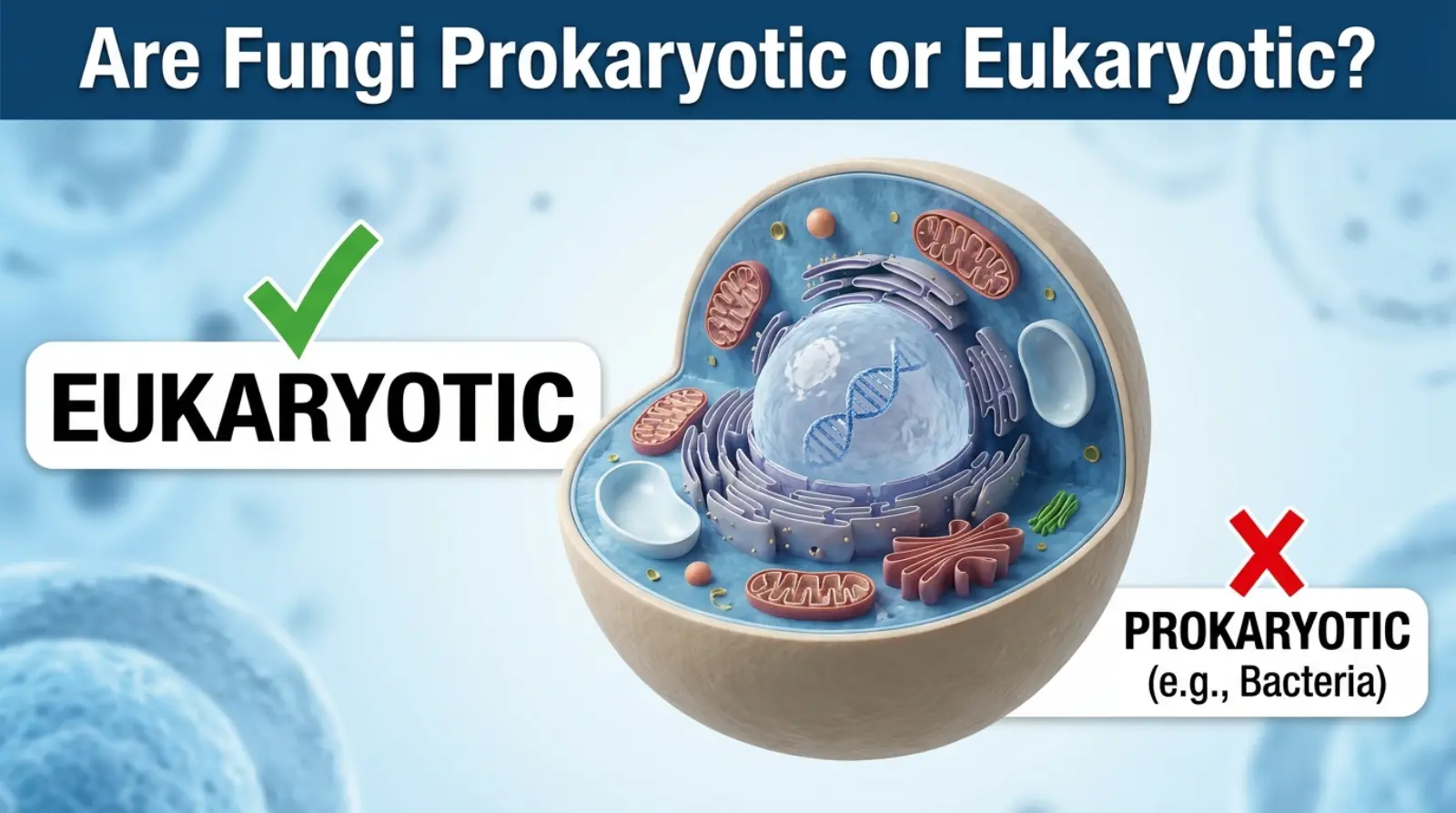
Imagine looking at a mushroom growing in a forest. It may look simple from the outside, but inside its cells is a surprisingly complex system. If you are studying biology, you may eventually ask: are fungi prokaryotic or eukaryotic?
The answer is clear: fungi are eukaryotic organisms.
This means fungal cells have a true nucleus surrounded by a membrane. They also contain membrane-bound organelles, such as mitochondria, that help the cell perform different jobs. Fungi are therefore very different from prokaryotes such as bacteria and archaea.
The question can be confusing because fungi, bacteria, and some other microorganisms can all be very small. Also, not all fungi look like the familiar mushrooms we see in forests or grocery stores. Yeasts and molds are fungi too.
You may see this question in school biology, college courses, homework, quizzes, science websites, or online searches. Students commonly want to know whether fungi have a nucleus, whether fungal cells contain organelles, and how fungi compare with bacteria and plants.
People usually search for:
- Are fungi prokaryotic or eukaryotic?
- Are fungi prokaryotes or eukaryotes?
- Is a fungus a prokaryote?
- Do fungi have a nucleus?
- Do fungal cells have membrane-bound organelles?
- Why are fungi eukaryotic?
- Are mushrooms prokaryotic or eukaryotic?
- Are yeast cells prokaryotic or eukaryotic?
- What is the difference between fungal and bacterial cells?
- Do fungi have DNA?
In this guide, you’ll learn the meaning, pronunciation, examples, usage, grammar rules, common mistakes, expert tips, and simple explanations in easy English.
Are Fungi Prokaryotic or Eukaryotic – QUICK ANSWER
👉 Fungi = Eukaryotic
Fungi are eukaryotic organisms because their cells contain a membrane-bound nucleus and other membrane-bound organelles.
👉 Prokaryotes = Bacteria and Archaea
Prokaryotic cells do not have a membrane-bound nucleus.
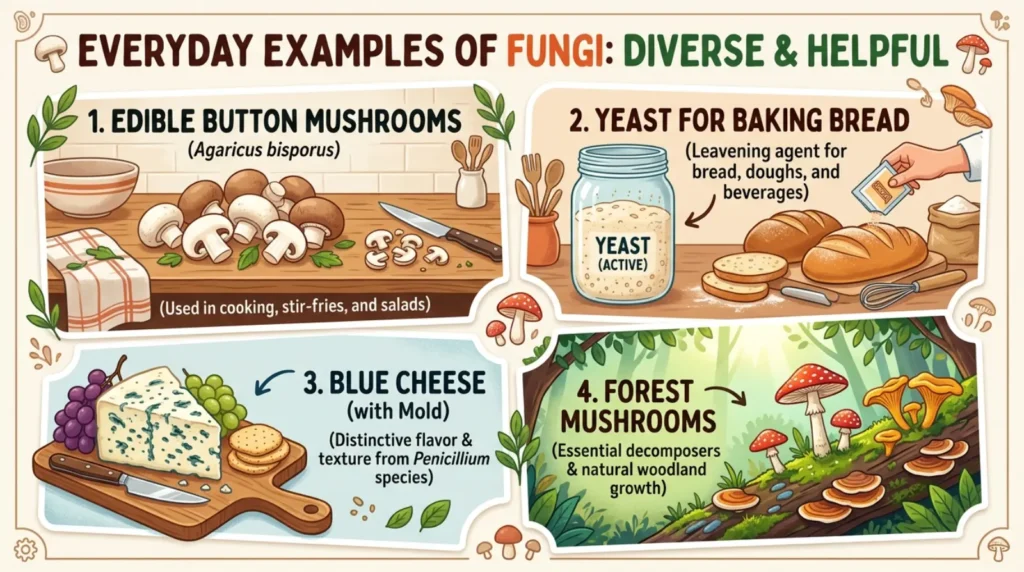
Examples of fungi
- Mushrooms
- Yeasts
- Molds
- Many microscopic fungi
Example
A mushroom is eukaryotic because its cells contain a nucleus. ✅
Yeast is also eukaryotic. ✅
Simple Rule
👉 Fungi have a nucleus → fungi are eukaryotic.
A useful memory trick is:
Fungi = Eukaryotes
Bacteria = Prokaryotes
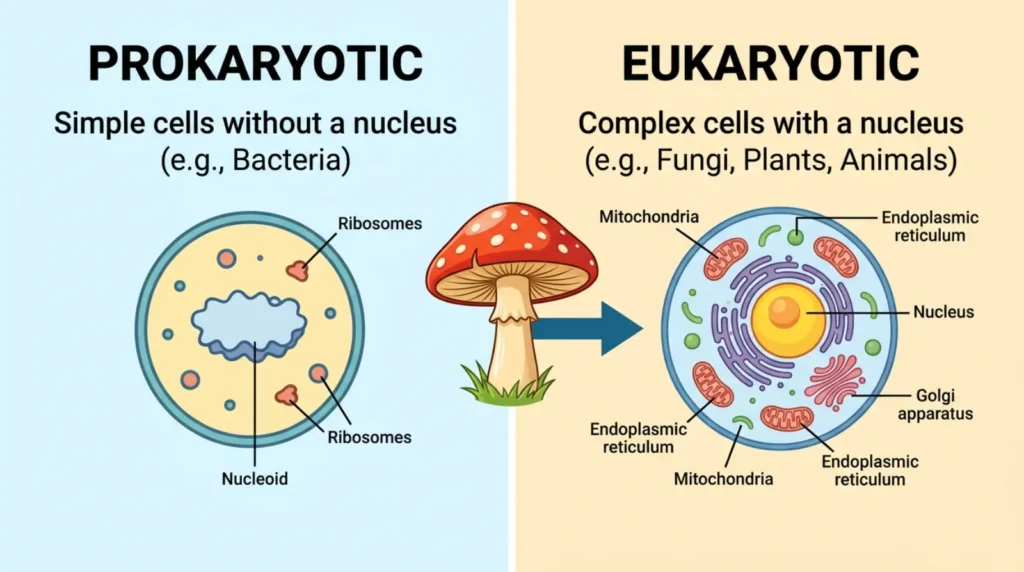
What Does “Are Fungi Prokaryotic or Eukaryotic” Mean?
The question asks which major type of cell organization fungi have.
There are two basic cell categories:
Prokaryotic cells are simpler cells that do not contain a membrane-bound nucleus.
Eukaryotic cells contain a membrane-bound nucleus and usually have several membrane-bound organelles.
Because fungal cells have a nucleus, fungi belong to the Eukarya domain.
Fungi include organisms that range from single-celled yeasts to large multicellular mushrooms. Despite their different appearances, their cells share the basic eukaryotic organization.
Important fungal cell features
Fungal cells generally contain:
- A nucleus
- Mitochondria
- Ribosomes
- Endoplasmic reticulum
- Golgi apparatus
- Cytoplasm
- A cell membrane
- A cell wall
The fungal cell wall is mainly made of chitin, which is one feature that helps distinguish fungi from plants.
Related Terms
- Eukaryote
- Prokaryote
- Fungal cell
- Nucleus
- Organelle
- Cell membrane
- Cell wall
- Chitin
- Mitochondria
- DNA
- Bacteria
- Archaea
Why Are Fungi Eukaryotic?
The main reason fungi are classified as eukaryotic is simple:
Fungal cells have a membrane-bound nucleus.
The nucleus stores most of the cell’s genetic material, including DNA.
Fungal cells also have specialized structures called organelles. These structures carry out different tasks inside the cell.
For example, mitochondria help release usable energy from nutrients.
This internal organization is a major feature of eukaryotic cells.
Do fungi have DNA?
Yes. Fungi have DNA, just as other living organisms do.
Their DNA is primarily located inside the nucleus, although mitochondria also contain their own genetic material.
Do fungi have a cell wall?
Yes. Fungal cells have cell walls, and the wall contains chitin.
This is an important difference from animal cells, which do not have cell walls.
The Origin of the Terms Prokaryotic and Eukaryotic
The words prokaryotic and eukaryotic come from Greek roots.
Prokaryote comes from terms meaning roughly “before nucleus.”
Eukaryote comes from terms meaning roughly “true nucleus.”
These names describe a major difference in cell organization.
Scientists use these categories to help explain how cells are structured.
Fungi were historically grouped with plants because they often have cell walls and do not move around like animals. Modern biology recognizes fungi as a separate major group of organisms with their own evolutionary history.
Today, fungi are placed in the Eukarya domain.
How to Pronounce Prokaryotic and Eukaryotic
Prokaryotic
Pronounced roughly:
proh-KAIR-ee-OT-ik
Break it into:
pro-kary-o-tic
Eukaryotic
Pronounced roughly:
yoo-KAIR-ee-OT-ik
Break it into:
eu-kary-o-tic
Fungi
The plural fungi is commonly pronounced:
FUN-jy or FUN-jee
Both pronunciations are heard in English.
The singular form is fungus.
British English vs American English Usage
There is no major spelling difference between British and American English for these scientific terms.
| Feature | British English | American English | Notes |
|---|---|---|---|
| Fungi | Fungi | Fungi | Same spelling |
| Fungus | Fungus | Fungus | Same spelling |
| Prokaryotic | Prokaryotic | Prokaryotic | Same spelling |
| Eukaryotic | Eukaryotic | Eukaryotic | Same spelling |
| Nucleus | Nucleus | Nucleus | Same spelling |
| Cell | Cell | Cell | Same spelling |
Scientific terminology is generally used consistently in biology textbooks worldwide.
Which One Should You Use?
If the question is “Are fungi prokaryotic or eukaryotic?”, the correct answer is:
Fungi are eukaryotic.
Use eukaryotic when explaining organisms whose cells contain a membrane-bound nucleus.
Academic example
“Fungi are eukaryotic organisms with cells containing membrane-bound nuclei.”
Simple example
“Fungi are eukaryotes because their cells have nuclei.”
Quick usage table
| Question | Correct answer |
|---|---|
| Are fungi prokaryotic? | ❌ No |
| Are fungi eukaryotic? | ✅ Yes |
| Do fungi have nuclei? | ✅ Yes |
| Are bacteria eukaryotic? | ❌ No |
| Are bacteria prokaryotic? | ✅ Yes |
| Are mushrooms eukaryotic? | ✅ Yes |
| Is yeast eukaryotic? | ✅ Yes |
Common Mistakes About Are Fungi Prokaryotic or Eukaryotic
Mistake 1: Thinking fungi are bacteria
❌ “Fungi are a type of bacteria.”
✔ Fungi and bacteria are different groups of organisms.
Why the mistake happens: Both can include microscopic organisms.
Correction tip: Remember that fungi have eukaryotic cells, while bacteria are prokaryotic.
Mistake 2: Thinking mushrooms are prokaryotic
❌ “Mushrooms are prokaryotes because they are simple organisms.”
✔ Mushrooms are multicellular fungi and are eukaryotic.
A mushroom’s cells have nuclei.
Mistake 3: Thinking microscopic means prokaryotic
❌ “If an organism is microscopic, it must be prokaryotic.”
✔ Microscopic organisms can be either prokaryotic or eukaryotic.
Example: Bacteria are microscopic prokaryotes, while yeast is a microscopic eukaryote.
Mistake 4: Thinking fungi are plants
❌ “Fungi are plants because both have cell walls.”
✔ Fungi are their own major group of organisms.
Fungal cell walls contain chitin, while plant cell walls are mainly made of cellulose.
Mistake 5: Forgetting that yeast is a fungus
❌ “Yeast is a bacterium.”
✔ Yeast is a type of fungus.
Yeast cells are eukaryotic.
Mistake 6: Confusing nucleus with DNA
❌ “Prokaryotes have no DNA.”
✔ Prokaryotes have DNA, but they do not have a membrane-bound nucleus.
This is a very important biology distinction.
Fungi in Everyday Examples
At school
“Are fungi prokaryotic or eukaryotic?”
A correct answer is:
“Fungi are eukaryotic because their cells contain membrane-bound nuclei.”
In a biology exam
Question: Which type of cell do fungi have?
Answer: Eukaryotic cells.
In a conversation
“Is yeast a prokaryote?”
“No. Yeast is a eukaryotic fungus.”
In online content
You may see questions such as:
- Are mushrooms eukaryotic?
- Is yeast prokaryotic?
- Do fungi have nuclei?
- Do fungi have mitochondria?
All of these questions relate to fungal cell structure.
Fungi in Different Biology Contexts
Fungi and bacteria
The biggest cellular difference is that fungi are eukaryotic while bacteria are prokaryotic.
Fungal cells have a membrane-bound nucleus. Bacterial cells do not.
Fungi and plants
Both fungi and plants have cell walls, but they are not the same type of organism.
Fungal walls mainly contain chitin, while plant walls mainly contain cellulose.
Fungi also obtain nutrients differently. Most fungi absorb nutrients from their surroundings rather than making food through photosynthesis.
Fungi and animals
Fungi and animals are both eukaryotic.
However, fungi have cell walls, while animal cells do not.
Fungi generally obtain nutrients by secreting enzymes into their surroundings and absorbing the resulting nutrients.
Yeast
Yeast is a useful example because it shows that an organism does not need to be large to be eukaryotic.
Many yeasts are single-celled fungi, but their cells still have a nucleus and other eukaryotic structures.
Mushrooms
A mushroom is the visible reproductive structure of certain fungi.
The fungus itself consists of a larger network of microscopic structures called hyphae, which can form a mycelium.
The cells within these fungal structures are eukaryotic.
Molds
Molds are also fungi.
They may appear as fuzzy growths on food or other surfaces, but their cells are eukaryotic.
Are Fungi Prokaryotic or Eukaryotic? Comparison Table
| Feature | Fungi | Bacteria |
|---|---|---|
| Cell type | Eukaryotic | Prokaryotic |
| Nucleus | Present | No membrane-bound nucleus |
| DNA | Present | Present |
| Membrane-bound organelles | Present | Generally absent |
| Mitochondria | Present | Absent |
| Cell wall | Usually present | Usually present |
| Main cell-wall material | Chitin | Usually peptidoglycan |
| Examples | Yeast, molds, mushrooms | E. coli, many other bacteria |
| Domain | Eukarya | Bacteria |
| Cell complexity | More complex | Simpler |
Are Fungi Prokaryotic or Eukaryotic in Professional Science?
Understanding this distinction is important in microbiology, medicine, biotechnology, agriculture, environmental science, and food science.
Scientists may study fungi because they can:
- Break down organic material
- Form partnerships with plants
- Produce useful compounds
- Affect crops
- Spoil food
- Cause fungal infections
- Help produce foods and beverages
- Contribute to ecosystems
Knowing that fungi are eukaryotic helps scientists understand how fungal cells behave and how they differ from bacterial cells.
For example, a treatment that affects bacteria may not work against fungi because fungal cells have a different cellular structure.
Fungi for Students and Beginners
Students often remember the answer but forget why it is correct.
The easiest method is to focus on the nucleus.
Ask:
Does the cell have a membrane-bound nucleus?
If yes → eukaryotic
If no → prokaryotic
For fungi:
Do fungal cells have a nucleus?
Yes.
Therefore:
Fungi → eukaryotic.
Beginner shortcut
Remember these three examples:
Fungi → eukaryotic
Animals → eukaryotic
Plants → eukaryotic
Then remember:
Bacteria → prokaryotic
Archaea → prokaryotic
This makes many biology questions much easier.
Common Characteristics of Fungi
Fungi commonly have these characteristics:
- They are eukaryotic.
- Many are multicellular.
- Some, such as many yeasts, are single-celled.
- Their cell walls contain chitin.
- They do not use photosynthesis like plants.
- They absorb nutrients from their surroundings.
- Many reproduce using spores.
- Their cells contain nuclei.
- They have membrane-bound organelles.
Not every fungus looks like a mushroom. That is one of the most important beginner lessons.
Simple Trick to Remember Are Fungi Prokaryotic or Eukaryotic
Here is the easiest rule:
Fungi have a nucleus → fungi are eukaryotic.
Think of it this way:
Imagine the nucleus as a private room inside a cell.
Eukaryotic cells have that private room.
Prokaryotic cells do not have a membrane-bound private room.
Fungi have the room.
So:
👉 Fungi = Eukaryotic
A second shortcut is:
Mushroom → nucleus → eukaryote.
Expert Tips for Remembering Fungal Cell Biology
- Do not judge by size. A tiny yeast cell can still be eukaryotic.
- Look for the nucleus. It is the fastest clue.
- Remember the domains. Fungi belong to Eukarya.
- Do not call fungi plants. They are a separate group.
- Remember chitin. Fungal cell walls contain chitin.
- Remember yeast. Yeast is a fungus and therefore eukaryotic.
- Remember bacteria separately. Bacteria are prokaryotic.
- Learn the reason, not just the answer. “Fungi are eukaryotic because they have membrane-bound nuclei” is stronger than simply memorizing “fungi = eukaryotic.”
Related Searches People Also Ask
Are mushrooms prokaryotic or eukaryotic?
Mushrooms are fungi, so they are eukaryotic.
Is yeast prokaryotic or eukaryotic?
Yeast is a fungus and therefore has eukaryotic cells.
Do fungi have a nucleus?
Yes. Fungal cells contain membrane-bound nuclei.
Do fungi have mitochondria?
Yes. Fungal cells have mitochondria and other membrane-bound organelles.
Are fungi bacteria?
No. Fungi and bacteria are separate groups of organisms.
Are fungi plants?
No. Fungi are not plants. They belong to the kingdom Fungi.
Are fungi multicellular?
Many fungi are multicellular, but some fungi, such as many yeasts, are single-celled.
Are fungi microorganisms?
Some fungi are microorganisms, including many yeasts and molds. Other fungi, such as many mushrooms, are large enough to see easily.
Why are fungi eukaryotic?
Fungi are eukaryotic because their cells contain membrane-bound nuclei and other membrane-bound organelles.
Do prokaryotes have DNA?
Yes. Prokaryotes have DNA, but they do not keep it inside a membrane-bound nucleus.
What is the main difference between fungi and bacteria?
Fungi have eukaryotic cells with membrane-bound nuclei. Bacteria have prokaryotic cells without membrane-bound nuclei.
Are fungal cells similar to animal cells?
Both are eukaryotic, but fungal cells have cell walls, while animal cells do not.
FAQs
Are fungi prokaryotic or eukaryotic?
Fungi are eukaryotic. Their cells contain membrane-bound nuclei and other membrane-bound organelles.
Why are fungi eukaryotic?
Fungi are eukaryotic because their cells have a true, membrane-bound nucleus.
Are mushrooms eukaryotic?
Yes. Mushrooms are fungi, and fungi are eukaryotic organisms.
Is yeast a prokaryote?
No. Yeast is a eukaryotic fungus.
Do fungi have a nucleus?
Yes. Fungal cells contain a membrane-bound nucleus.
Do fungi have cell walls?
Yes. Fungal cell walls contain chitin.
Are bacteria eukaryotic?
No. Bacteria are prokaryotic organisms.
Are fungi more like plants or animals?
Fungi share some features with both, but they form their own major biological group. Like animals, fungi are heterotrophs, and like plants, they have cell walls. Their cell walls, however, contain chitin rather than cellulose.
Are all fungi multicellular?
No. Many fungi are multicellular, but some, such as many yeasts, are single-celled.
What is the easiest way to remember fungal cells?
Remember: fungi have a nucleus, so fungi are eukaryotic.
Final Verdict
Are fungi prokaryotic or eukaryotic?
👉 Fungi are eukaryotic.
The reason is simple: fungal cells have a membrane-bound nucleus and other membrane-bound organelles.
The easiest comparison is:
Fungi → Eukaryotic
Bacteria → Prokaryotic
Plants → Eukaryotic
Animals → Eukaryotic
Conclusion
If you only remember one fact from this article, remember this:
Fungi are eukaryotic organisms.
Mushrooms, molds, and yeasts belong to the fungal group, and their cells contain a membrane-bound nucleus. This makes them different from bacteria and archaea, which are prokaryotic.
The question “are fungi prokaryotic or eukaryotic” becomes much easier when you stop thinking about the organism’s size or appearance and look at its cells.
Tiny does not automatically mean prokaryotic. Yeast is a perfect example: it can be microscopic, yet it is a eukaryote.
Final memory trick: If fungi have a nucleus, fungi are eukaryotic.

Camila Green is an English language writer who specializes in confusing word comparisons and spelling explanations. She creates simple, beginner-friendly guides on topics like “niece or neice” and other common English mistakes. Her writing focuses on clarity, real-life examples, and easy learning. At VerrsaPick, she helps readers improve their English with practical and engaging content.