Imagine you are writing an email at work and want to say, “Please finish the project within this ___.” You type time frame, then wonder whether it should actually be timeframe.
This is a common English spelling and grammar question. You may see both time frame and timeframe online, in business documents, school assignments, project plans, schedules, and everyday conversations. That can make it difficult to know which form is correct.
People usually search for: time frame or timeframe meaning, correct spelling, pronunciation, examples, usage, definition, grammar difference, and whether one form is more appropriate in professional writing.
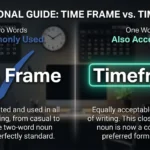
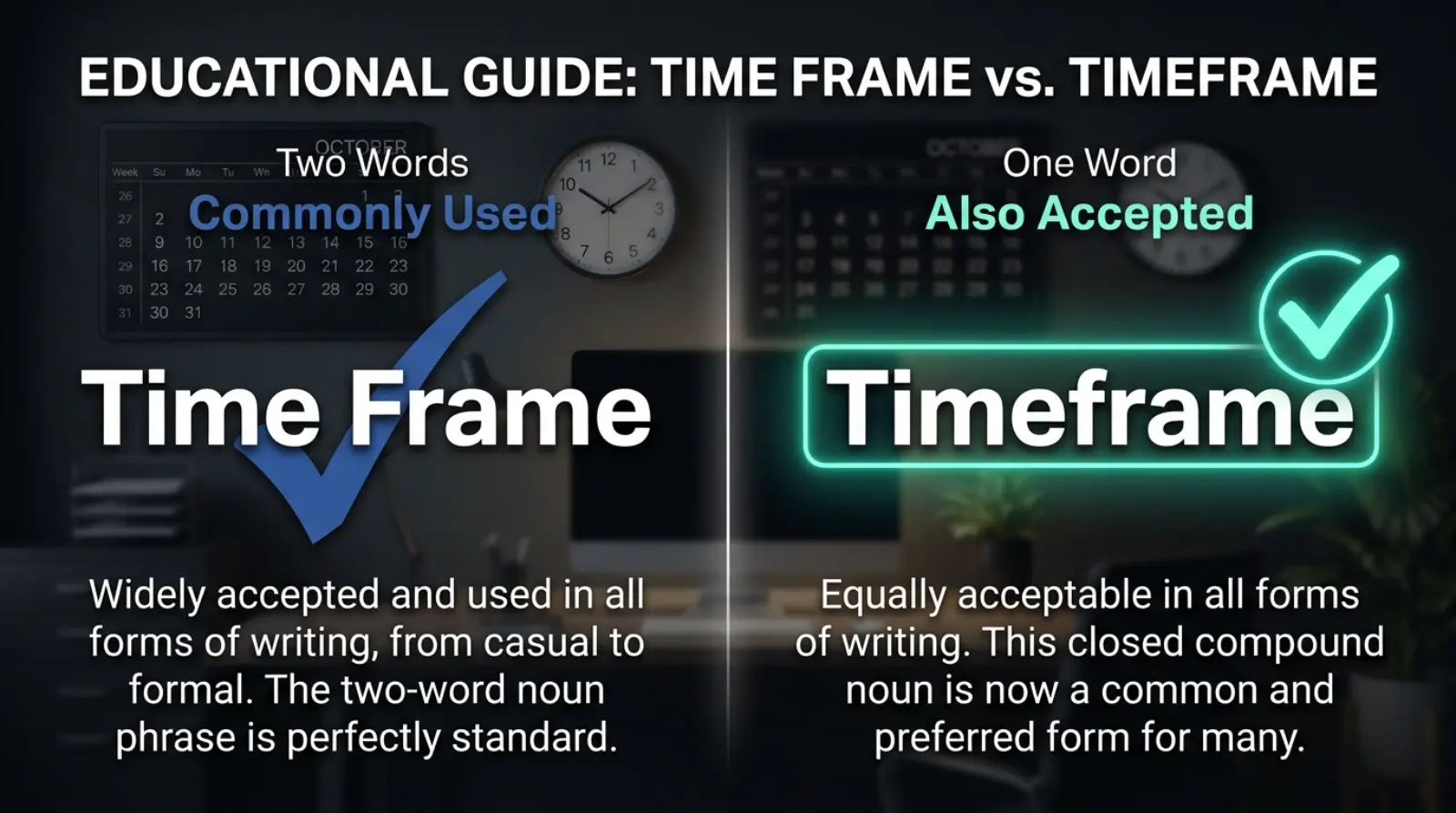
The good news is that the difference is simple. Time frame is traditionally written as two words, while timeframe is also widely used as a closed compound noun in modern English. Both forms can refer to a period of time during which something happens or should happen.
In this guide, you’ll learn the meaning, pronunciation, examples, usage, grammar rules, common mistakes, expert tips, and simple explanations in easy English.
Time Frame or Timeframe – Quick Answer
👉 Time frame = a period or range of time during which something happens.
👉 Timeframe = the same meaning, written as one word.
Both forms are used in English, but time frame is a safe choice in formal and careful writing, while timeframe is extremely common in modern business and general English.
Examples:
- We need to complete the project within this time frame. ✅
- We need to complete the project within this timeframe. ✅
- What is the expected time frame for delivery? ✅
- What is the expected timeframe for delivery? ✅
- The doctor gave me a two-week timeframe for recovery. ✅
Simple Rule:
👉 Think of time frame/timeframe as “a period of time.”
If you are unsure which spelling to use, time frame is a clear and traditionally accepted choice. However, timeframe is not automatically wrong.
What Does Time Frame or Timeframe Mean?
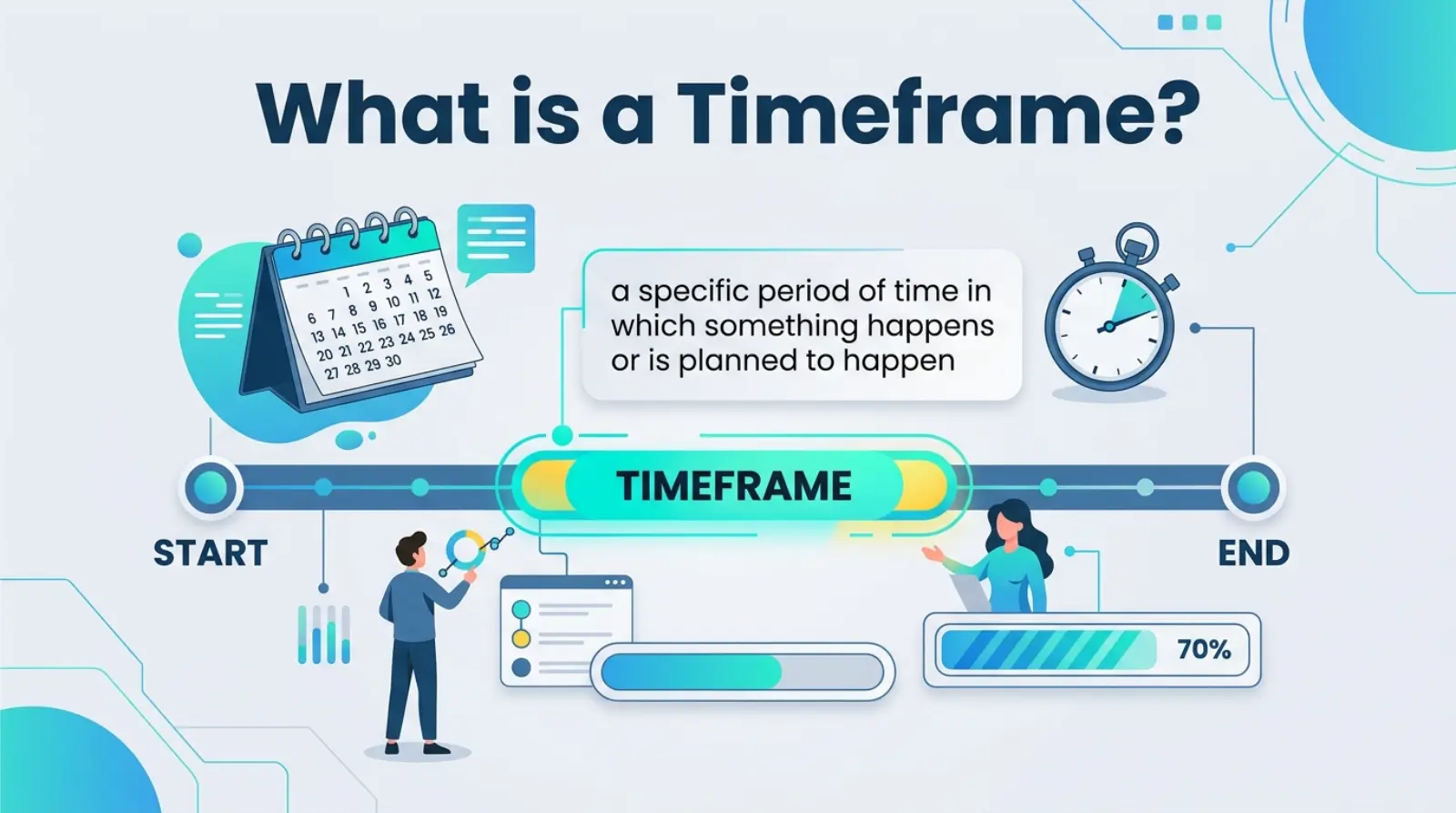
Time frame and timeframe mean a specific period, range, or window of time in which an activity is expected to happen.
For example:
The project has a six-month timeframe.
This means the project is expected to take place within six months.
The term can describe a very short or very long period:
- a 24-hour time frame
- a two-week timeframe
- a three-month time frame
- a five-year timeframe
- a historical time frame
It is especially common when discussing deadlines, schedules, projects, planning, delivery dates, research, business goals, and historical periods.
Synonyms
Depending on context, related words include:
- period
- duration
- span
- interval
- window
- schedule
- deadline
- range
- period of time
These words are not always exact replacements. For example, a deadline is a specific final point, while a timeframe usually describes a broader period.
Opposites
There is no perfect opposite, but ideas such as these can contrast with a timeframe:
- indefinite period
- unlimited time
- no fixed period
- unspecified duration
Related Terms
You may also encounter:
- time limit
- time period
- deadline
- schedule
- duration
- timeline
- turnaround time
- delivery window
- estimated completion time
Common Variations
Common expressions include:
- within the timeframe
- within the time frame
- estimated timeframe
- expected timeframe
- reasonable timeframe
- specific timeframe
- short timeframe
- long timeframe
- time frame for completion
- time frame for delivery
The Origin of Time Frame or Timeframe
The expression comes from combining the ideas of time and frame.
A frame can mean a boundary or structure that defines something. When used with time, the phrase developed the idea of a defined boundary or period in which something takes place.
English frequently turns combinations of words into compound nouns. Some remain open as two words, such as time frame, while others become closed compounds, such as timeframe.
This explains why you may find both spellings in dictionaries, style guides, professional documents, and online writing.
Compound-word spelling can change over time. English has many words that began as separate expressions and later became hyphenated or closed compounds.
How to Pronounce Time Frame or Timeframe
Both forms have the same pronunciation.
Time frame: /ˈtaɪm freɪm/
Timeframe: /ˈtaɪmfreɪm/
Easy pronunciation:
👉 TIME-FRAYM
It has two main spoken parts:
- time
- frame
There is no meaningful pronunciation difference between the two spellings.
Common Pronunciation Mistake
Do not pronounce it as though it were three separate words.
Say:
TIME-FRAME ✅
rather than giving unnecessary stress to each individual word.
British English vs American English Usage
Both time frame and timeframe can be found in British and American English.
| Feature | British English | American English | Notes |
|---|---|---|---|
| Time frame | Common | Common | Traditional open form |
| Timeframe | Common | Common | Modern closed form |
| Meaning | Same | Same | No major meaning difference |
| Pronunciation | Same | Same | Essentially identical |
| Formal writing | Accepted | Accepted | Style preference may vary |
| Business writing | Common | Very common | Both appear frequently |
Unlike words such as colour/color, this is not mainly a British-versus-American spelling issue.
The choice is more about style, editorial preference, and compound-word usage.
Which One Should You Use?
If you want a simple answer, use time frame when you want the most conservative spelling.
However, timeframe is also widely used and natural, especially in:
- business writing
- project management
- technology
- marketing
- workplace communication
- online articles
- planning documents
For academic or professional writing, the most important thing is consistency. If you choose one form, use that form consistently throughout your document.
Quick Usage Table
| Situation | Recommended form |
|---|---|
| Formal writing | Time frame |
| Academic writing | Time frame or your style guide’s preference |
| Business writing | Timeframe / time frame |
| Emails | Either |
| Text messages | Either |
| Social media | Either |
| General writing | Either |
| SEO content | Either, but stay consistent |
Common Mistakes With Time Frame or Timeframe
Mistake 1: Thinking “timeframe” is always wrong
❌ Incorrect idea: “Timeframe is never a correct word.”
✔ Correction: Timeframe is widely used as a compound noun.
Tip: Do not automatically mark it as a spelling error.
Mistake 2: Thinking “time frame” is outdated
❌ “Time frame is an old spelling and should never be used.”
✔ Correct: Time frame remains a valid and widely understood form.
Why people get confused: Modern English often closes compound nouns, so both forms appear in real-world writing.
Mistake 3: Confusing a timeframe with a deadline
❌ “The deadline is three months.”
✔ “The timeframe is three months.”
✔ “The deadline is June 30.”
A timeframe describes a period. A deadline identifies a final point.
Mistake 4: Using “timeframe” when you mean “timeline”
A timeline usually shows events in chronological order.
A timeframe describes the period in which something happens.
✔ The project has a six-month timeframe.
✔ The project timeline shows when each task begins and ends.
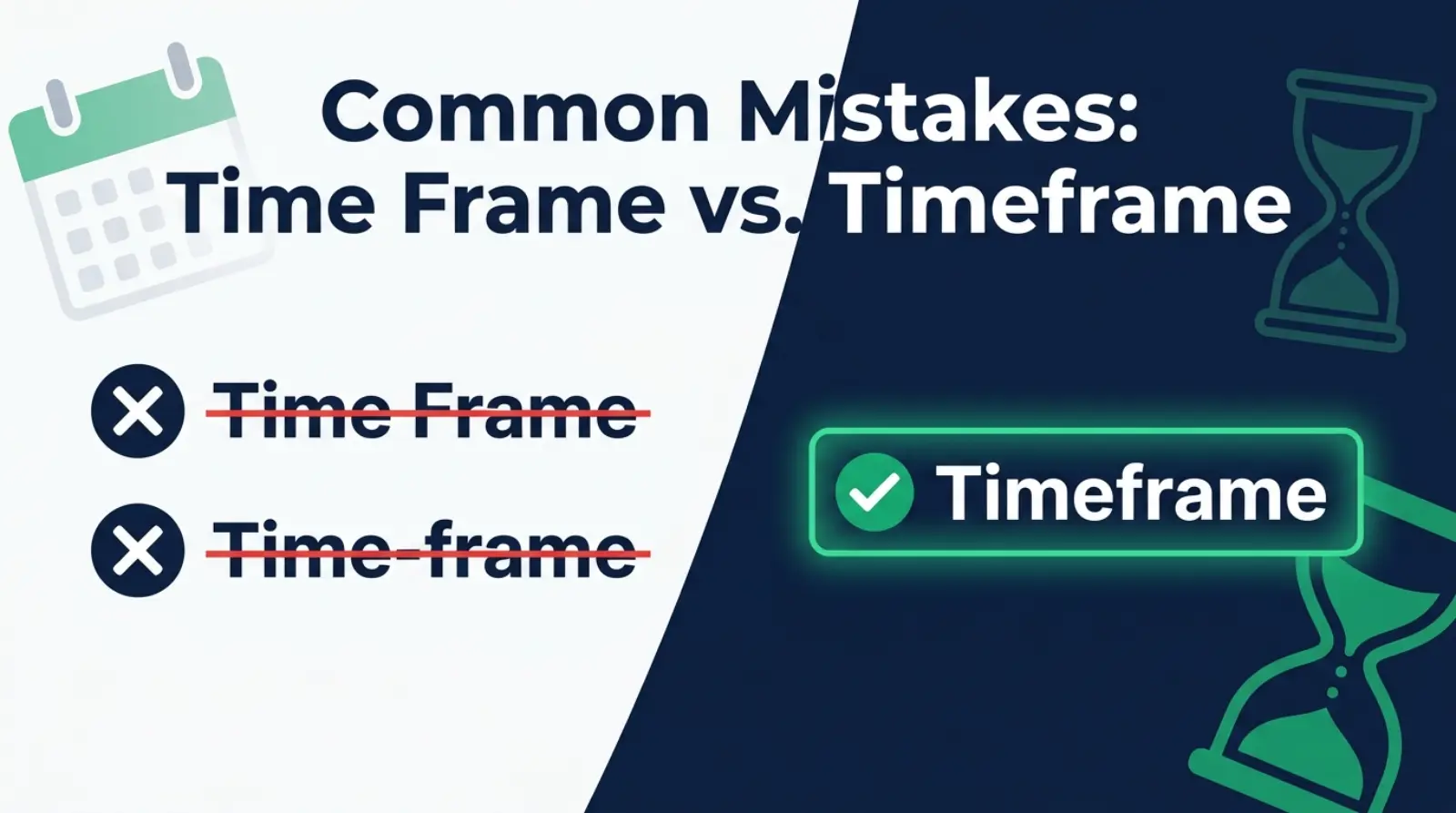
Mistake 5: Adding an unnecessary hyphen
❌ “We have a time-frame of two weeks.”
✔ “We have a time frame of two weeks.”
✔ “We have a two-week timeframe.”
The hyphen may be appropriate in some compound constructions, but it is not normally needed simply because the phrase contains two words.
Time Frame or Timeframe in Everyday Examples
At Work
We need to finish the report within the agreed timeframe.
At School
The research must be completed within a three-week time frame.
In an Email
Could you please confirm the expected timeframe for delivery?
In a Text Message
What’s the time frame for getting this done?
On Social Media
The whole project was completed in a very short timeframe.
Daily Life
What is the usual time frame for receiving a passport?
Online Content
The article explains the typical timeframe for the application process.
Conversation
How long is the expected timeframe?
Time Frame or Timeframe in Different Contexts
Education
Students may use the term when discussing assignments, exams, research, or academic projects.
Students have a two-week timeframe to submit their essays.
Business
Businesses frequently use it for deadlines, contracts, sales goals, and project planning.
We expect the work to be completed within the agreed timeframe.
Workplace
It can help make expectations clear.
Can you give me a realistic time frame for completion?
Technology
Technology companies often discuss development and release periods.
The software update should be ready within a few weeks.
Marketing
Marketers may use timeframe when discussing campaigns and results.
We measured website traffic over a six-month timeframe.
Historical Writing
The phrase can also refer to a period in history.
The novel is set in a Victorian time frame.
In historical writing, period or era may sometimes sound more natural.
Communication
Using a clear timeframe can prevent confusion.
Compare:
“I’ll finish it soon.”
with:
“I’ll finish it within a two-day timeframe.”
The second sentence gives the listener a much clearer expectation.
Time Frame vs Timeframe: Detailed Comparison
| Feature | Time frame | Timeframe |
|---|---|---|
| Spelling | Two words | One word |
| Meaning | Period of time | Period of time |
| Pronunciation | Same | Same |
| Grammar role | Noun phrase | Compound noun |
| Professional use | Common | Common |
| Academic use | Common | Common |
| Online use | Common | Very common |
| Meaning difference | Usually none | Usually none |
| Best advice | Safe traditional choice | Widely accepted modern choice |
The biggest point is simple: there is usually no difference in meaning.
Time Frame or Timeframe in Professional Life
Clear time language matters at work because vague timing can create misunderstandings.
Consider:
“We should finish soon.”
That does not tell anyone much.
Now compare:
“We expect to finish within a two-week timeframe.”
The second sentence gives a useful planning window.
You may see the word in:
- project management
- customer service
- contracts
- sales
- logistics
- software development
- human resources
- construction
- healthcare administration
- marketing
Examples:
The estimated delivery timeframe is five business days.
Please provide a realistic time frame for completion.
The team is working within a tight timeframe.
Time Frame or Timeframe for Students and Beginners
Beginners often struggle because English compound words do not follow one simple rule.
ome combinations stay open:
- time frame
- school bus
- coffee shop
ome become closed:
- notebook
- bedroom
- football
ome are hyphenated:
- well-known
- part-time
- two-week
That is why guessing from other words can be confusing.
Easy Beginner Trick
When you see timeframe, read it as:
time + frame = a period of time
If you see time frame, the meaning is normally the same.
Do not worry about the spelling so much that you forget the meaning.
Signs and Common Uses Related to Time Frame or Timeframe
You are likely to see the term when:
- someone gives an estimated completion period
- a project has a planned duration
- a customer asks about delivery
- a company discusses deadlines
- a researcher describes a study period
- a student receives a submission period
- a website explains processing times
- a business sets a target period
- someone asks “How long will it take?”
- a team needs to set expectations
Common patterns include:
- within a timeframe
- within the time frame
- a short timeframe
- a reasonable timeframe
- a specific timeframe
- an estimated timeframe
- a two-week time frame
- a long-term timeframe
Simple Trick to Remember Time Frame or Timeframe
Think of a picture frame.
A picture frame creates a boundary around a picture.
A time frame creates a boundary around a period of time.
So:
👉 Frame = boundary
👉 Time frame = boundary or range of time
Think of it this way: If someone asks, “How much time are we talking about?” the answer may be the timeframe.
For example:
“When will it be ready?”
“Within a two-week timeframe.”
That is your easy memory shortcut.
Expert Tips for Using Time Frame or Timeframe
- Focus on clarity first. Both forms are understandable.
- Follow your style guide. A school, company, or publication may prefer one spelling.
- Be consistent. Do not switch randomly between forms in the same document.
- Do not confuse timeframe with deadline. One describes a period; the other usually identifies a final date.
- Use exact numbers when possible. “Within two weeks” is often clearer than “within a reasonable timeframe.”
- Use “timeline” when discussing a sequence of events.
- Proofread compound words carefully. English compound spelling is not always predictable.
Related Searches People Also Ask
People searching for this topic may ask:
- Is time frame one word or two?
Both time frame and timeframe are used; the open form is a safe traditional choice. - Is timeframe grammatically correct?
Yes. Timeframe is widely used as a compound noun. - What does time frame mean?
It means a period or range of time during which something happens. - What is the difference between timeframe and timeline?
A timeframe is a period of time; a timeline usually organizes events by when they happen. - Is time frame formal?
Yes. It can be used in professional and formal writing. - Should I write time frame or timeframe in an email?
Either is normally fine. Choose one and use it consistently. - What is another word for timeframe?
Depending on context, you can use period, duration, window, span, or range. - Is “within the timeframe” correct?
Yes. It means within the specified period. - Is “time-frame” correct?
It is generally unnecessary in ordinary use. The open or closed forms are more common. - Does timeframe mean deadline?
No. A timeframe is a period; a deadline is a specific final point.
FAQs
Is “time frame” one word or two?
Both time frame and timeframe are used in English. Time frame is the traditional two-word form, while timeframe is a common closed compound.
Which is more correct, time frame or timeframe?
Neither is universally wrong. Time frame is a safe traditional choice, while timeframe is widely accepted in modern English.
Is timeframe formal or informal?
Timeframe can be used in both formal and informal writing, including professional communication.
What does timeframe mean?
It means a period or range of time in which something is expected to happen.
What is an example of timeframe?
“The expected timeframe for delivery is five business days.”
Is time frame the same as timeline?
No. A timeframe is a period of time. A timeline usually shows the order and timing of different events.
Is time frame the same as deadline?
No. A timeframe covers a period, while a deadline usually marks the final date or time by which something must be completed.
Can I use timeframe in academic writing?
Yes, but always follow the spelling preference of your university, instructor, journal, or style guide.
How do you pronounce timeframe?
It is pronounced TIME-FRAYM.
Should I use time frame in professional emails?
Yes. Time frame is clear and professional. Timeframe is also widely used in workplace emails.
Final Verdict
Time frame and timeframe generally have the same meaning: a period or range of time.
👉 Time frame = traditional two-word form
👉 Timeframe = common one-word compound
If you want the safest conservative choice, use time frame. If you see timeframe in modern business, technology, or online writing, do not assume it is incorrect.
Easy Memory Rule
Time frame = a period of time.
Whether you write it as time frame or timeframe, the meaning is usually the same. The most important thing is to follow your preferred style guide and stay consistent.
Conclusion
The confusion over time frame or timeframe is understandable because English has many compound words with changing spelling patterns. Fortunately, this one is easy once you know the basic rule.
Both forms refer to a period or range of time. Time frame is the traditional open form, while timeframe is a widely used closed compound in modern English.
In everyday writing, emails, workplace communication, education, business, technology, and online content, you will encounter both.
So, if you write:
“What is the expected time frame?”
or:
“What is the expected timeframe?”
your meaning is clear in both cases.
Final memory trick: A time frame puts boundaries around time—just like a picture frame puts boundaries around a picture.

Camila Green is an English language writer who specializes in confusing word comparisons and spelling explanations. She creates simple, beginner-friendly guides on topics like “niece or neice” and other common English mistakes. Her writing focuses on clarity, real-life examples, and easy learning. At VerrsaPick, she helps readers improve their English with practical and engaging content.