Have you ever typed “wierd” and then wondered if something looked wrong? You are not alone. “Wierd” is a very common spelling mistake, especially because the word does not follow the spelling pattern many people expect.
The correct spelling is “weird,” not “wierd.” The word means something strange, unusual, unexpected, or different from what is normal. You may see it in school writing, workplace messages, social media posts, text messages, online comments, and everyday conversations.
People usually search for wierd because they want to know the correct spelling, meaning, pronunciation, examples, or the difference between wierd and weird. The confusion is easy to understand because the letters i and e appear in an order that feels unusual.
The good news is that you only need one simple memory trick to remember it.
In this guide, you’ll learn the meaning, pronunciation, examples, usage, grammar rules, common mistakes, expert tips, and simple explanations in easy English.
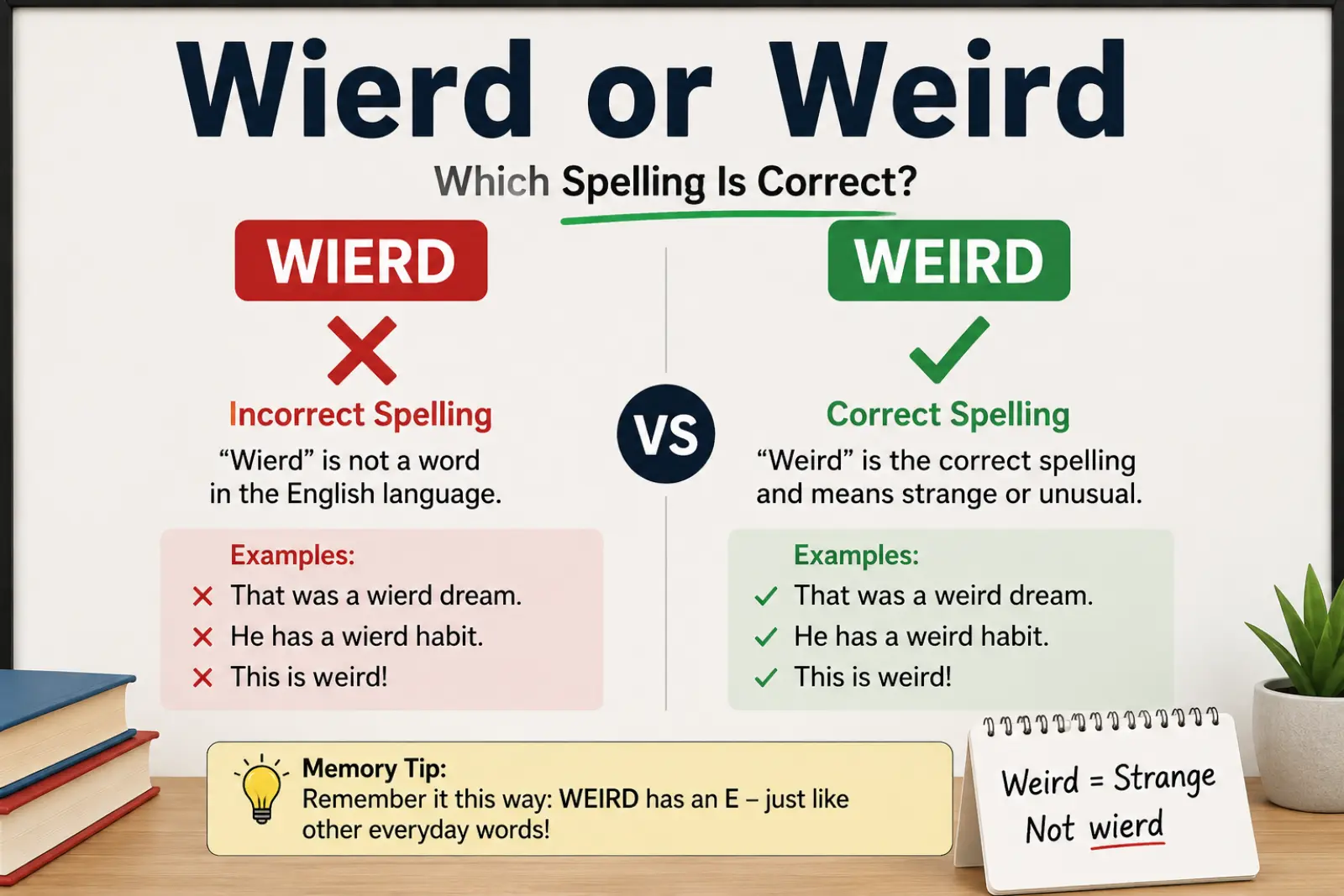
Wierd or Weird Quick Answer
👉 Wierd = incorrect spelling
👉 Weird = correct spelling
Weird means strange, unusual, or different from what you normally expect.
Examples
- That movie was weird.
- I had a weird dream last night.
- He made a weird noise.
- This situation feels weird.
- It is weird to see snow in such warm weather.
Simple Rule
👉 Remember: WEIRD has “EI,” not “IE.”
A helpful trick is:
“Weird is weird because the spelling is weird.”
What Does Weird Mean?
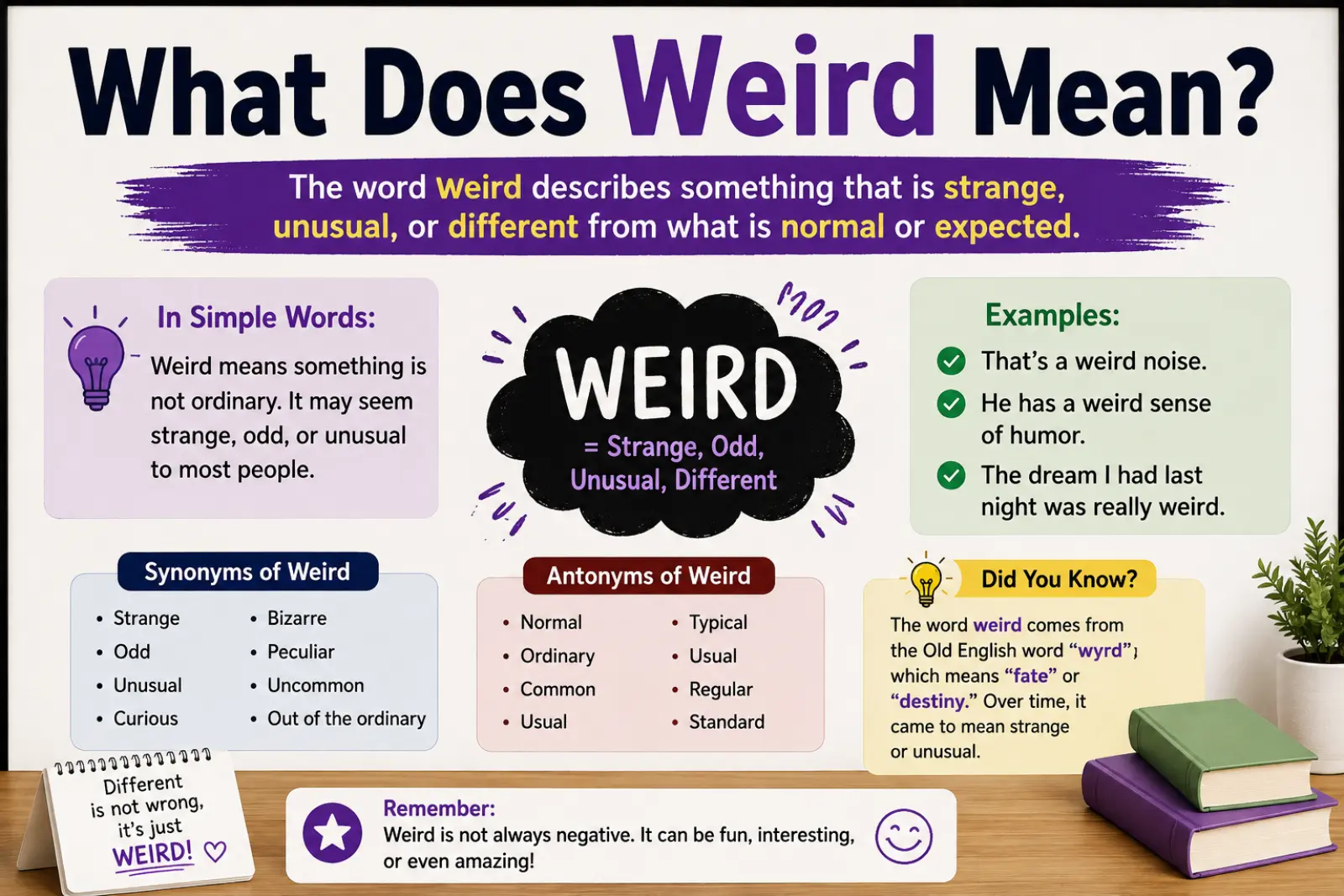
Weird is an adjective used to describe something that is strange, unusual, unexpected, or not normal.
For example:
“That was a weird experience.”
This means the experience was unusual or strange.
The word can describe people, behavior, situations, sounds, dreams, feelings, objects, places, or events.
Weird Can Be Positive, Negative, or Neutral
The meaning depends on the situation.
- Negative: “That person is acting weird.”
- Neutral: “I had a weird dream.”
- Playful: “You have a weird sense of humor.”
- Positive: “The movie was weird, but I loved it.”
Synonyms of Weird
Some common synonyms include:
- Strange
- Unusual
- Odd
- Bizarre
- Peculiar
- Uncommon
- Mysterious
- Unnatural
Opposites of Weird
The opposite can include:
- Normal
- Ordinary
- Typical
- Usual
- Familiar
- Common
Related Terms
You may also see:
- Weirdness
- Weirdly
- Weirded out
- Weirdo
- Strange
- Odd
The Origin of Weird
The word weird has a long history. It comes from an old English word connected with the idea of fate or destiny.
In Old English, related forms referred to what was connected with fate. Over time, the meaning changed. In modern English, weird is mainly used to describe something strange, unusual, or unexpected.
Today, the word is very common in everyday English. It appears in conversations, books, movies, social media, gaming, texting, and online discussions.
The spelling weird has remained important even though many learners naturally want to write wierd.
How to Pronounce Weird
Weird is usually pronounced like:
👉 weerd
It has one syllable.
A simple pronunciation guide is:
weird → WEERD
It sounds similar to the word “feared,” although the spelling and meaning are different.
Common Pronunciation Mistake
Some learners try to pronounce every letter separately because the spelling looks unusual. Instead, say it as one smooth syllable:
WEERD
Easy Speaking Trick
Say:
“That is weird.”
Practice the whole phrase instead of saying the word by itself.
British English vs American English Usage
There is no major spelling difference between British and American English for weird.
| Feature | British English | American English | Notes |
|---|---|---|---|
| Spelling | Weird | Weird | Same |
| Meaning | Strange or unusual | Strange or unusual | Same |
| Pronunciation | Similar | Similar | Minor accent differences |
| Grammar | Adjective | Adjective | Same |
| Formal writing | Used | Used | Correct in both |
| Informal writing | Common | Common | Very common |
So whether you are writing in the UK, US, Canada, Australia, India, or Pakistan, use weird.
Which One Should You Use?
Use weird whenever you mean something strange or unusual.
Formal Writing
Correct:
“The results were unusual and unexpected.”
You can also use weird in less formal professional writing, but words such as unusual or unexpected may sound more professional.
Informal Writing
Correct:
“That was a weird conversation.”
Texting
Correct:
“Why are you being weird?”
Social Media
Correct:
“That was the weirdest video I have ever seen!”
Academic Writing
In formal academic writing, unusual, atypical, or unexpected may be better choices depending on the subject.
Common Mistakes With Wierd
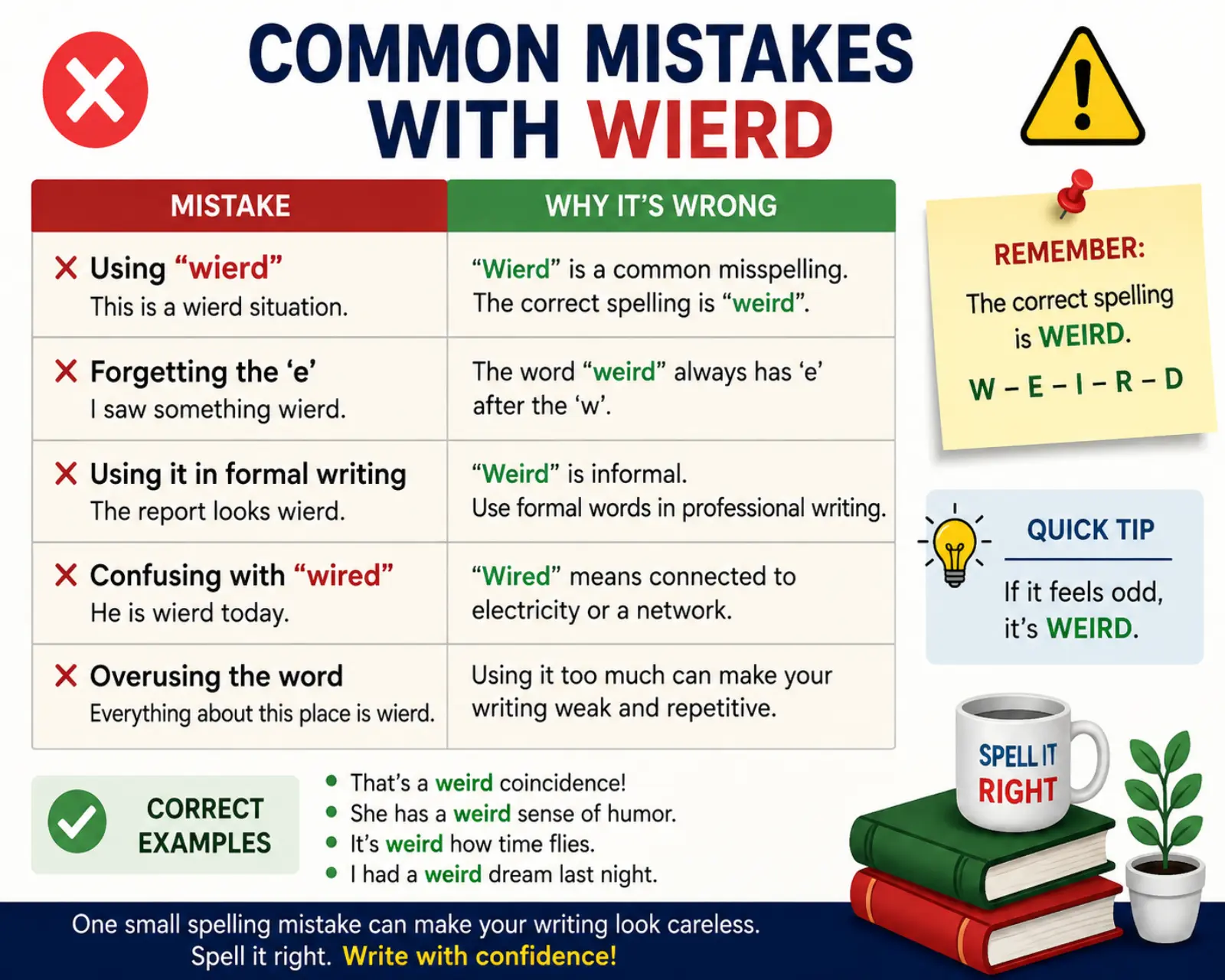
Mistake 1: Writing “wierd”
❌ That is wierd.
✔ That is weird.
Why? The correct spelling is w-e-i-r-d.
Correction tip: Remember EI in weird.
Mistake 2: Using “wierd” in formal writing
❌ “The results were wierd.”
✔ “The results were weird.”
Even when you choose an informal word, its spelling still needs to be correct.
Mistake 3: Confusing “weird” with “wired”
❌ “I had a wired dream.”
✔ “I had a weird dream.”
Wired has a different meaning. It can refer to electrical connections or, informally, feeling very energetic or alert.
Mistake 4: Writing “weard”
❌ “That looks weard.”
✔ “That looks weird.”
The ending is -ird, not -ard.
Mistake 5: Forgetting the “i”
❌ “Werd”
✔ “Weird”
The correct spelling contains both i and e.
Mistake 6: Assuming “I before E” always works
Many learners remember the rule “I before E except after C.” However, English has many exceptions, and weird is one of them.
✔ weird
The word uses ei, so do not rely on the basic rhyme alone.
Weird in Everyday Examples
At Work
“The software gave me a weird error message.”
At School
“Our teacher asked a weird question.”
On Social Media
“That is such a weird photo!”
In Daily Life
“I heard a weird sound outside.”
“There seems to be a weird issue with the file.”
“Why is he acting weird?”
“This is one of the weirdest videos online.”
“That sounds weird to me.”
Weird in Different Contexts
Weird in Education
Students often use weird when talking about something unusual.
“That was a weird question on the test.”
For formal school essays, however, unusual or unexpected may sometimes be a better choice.
Weird in the Workplace
People may use weird in casual workplace conversations.
“There is a weird problem with my computer.”
For a formal report, you might write:
“There is an unusual problem with the system.”
Weird in Relationships
The word can describe behavior that feels unusual.
“He started acting weird after the conversation.”
Here, weird may mean different, uncomfortable, or suspicious depending on context.
Weird on Social Media
On social media, weird is often used casually and humorously.
“This trend is weird, but I can’t stop watching it.”
Weird in Gaming
Gamers may describe an unusual game event, character, glitch, or strategy as weird.
“That was a weird glitch!”
Google Trends and Usage Data
The spelling wierd is popular mainly because people make the same spelling mistake repeatedly. When someone hears the word or types it quickly, wierd can feel more natural than weird.
Common searches include:
- “wierd or weird”
- “is wierd correct?”
- “how do you spell weird?”
- “wierd meaning”
- “weird meaning”
- “correct spelling of weird”
- “how to spell weird”
- “weird pronunciation”
- “weird examples”
Searchers from the US, UK, India, Pakistan, Canada, and Australia may encounter this spelling confusion because weird is widely used in English worldwide.
The mistake is especially common among beginners because the spelling does not match the simple “i before e” memory rule.
Comparison Table: Wierd vs Weird
| Feature | Wierd | Weird |
|---|---|---|
| Correct spelling | ❌ No | ✅ Yes |
| Meaning | None as standard spelling | Strange or unusual |
| Pronunciation | Not standard | Weerd |
| Grammar role | Incorrect form | Adjective |
| Professional usage | ❌ Avoid | ✅ Correct |
| Academic usage | ❌ Incorrect | ✅ Correct |
| Texting usage | Common typo | ✅ Correct |
| Social media | Often accidental | ✅ Correct |
| Main problem | Letter order | None |
| Memory | Easy to confuse | Remember “EI” |
Weird in Professional Life
Correct spelling matters in workplace communication because spelling mistakes can make your writing look rushed or careless.
Compare:
❌ “I noticed a wierd issue with the report.”
✅ “I noticed a weird issue with the report.”
For casual communication, weird is perfectly understandable. However, in highly formal writing, you may prefer:
- unusual
- unexpected
- irregular
- atypical
- uncommon
For example:
“The system showed an unexpected result.”
This sounds more professional than:
“The system showed a weird result.”
Weird for Students and Beginners
Beginners often struggle with weird because of its unusual letter order.
The common mistake is:
W + I + E + R + D
instead of:
W + E + I + R + D
Easy Learning Tip
Write the correct spelling three times:
weird
weird
weird
Then use it in a sentence:
“That is a weird story.”
Using the word in a sentence helps your brain remember the spelling more naturally.
Signs and Common Uses Related to Weird
You will commonly use weird when something is:
- Strange
- Unexpected
- Unusual
- Difficult to explain
- Different from normal
- Funny in an unusual way
- Uncomfortable
- Surprising
- Hard to understand
- Outside what you normally expect
The word can describe:
People: “He is acting weird.”
Things: “That is a weird object.”
Events: “Something weird happened.”
Feelings: “I feel weird today.”
Sounds: “I heard a weird noise.”
Dreams: “I had a weird dream.”
Simple Trick to Remember Weird
Here is the easiest trick:
Think: “WEIRD looks weird.”
The spelling itself is unusual, so connect the unusual spelling with the meaning.
WEIRD = W-E-I-R-D
Do not write:
W-I-E-R-D
Think of It This Way
Imagine your friend asks:
“How do you spell weird?”
You can answer:
“It looks weird, so remember the weird spelling: WEIRD.”
Visual Memory
Break it into:
WEI + RD
The important part is:
👉 WEI
Not:
❌ WIE
Expert Tips for Remembering Weird
- Ignore the “I before E” rule. English has exceptions.
- Memorize WEI as a group.
- Write the word in sentences.
- Read it often. Seeing the correct form helps.
- Use spell-check, but learn the word too.
- Connect the spelling with its meaning: “Weird is spelled in a weird way.”
- Watch for the common typo “wierd.”
A useful proofreading trick is to search your document for “wierd.” If you find it, change it to “weird.”
Related Searches People Also Ask
How do you spell weird correctly?
The correct spelling is weird: W-E-I-R-D.
Why do people spell weird as wierd?
The mistake happens because many people expect ie instead of ei, especially because of the common “i before e” spelling rule.
Is wierd a word?
Wierd is not the standard English spelling of the word meaning strange. The correct spelling is weird.
What does weird mean?
Weird means strange, unusual, unexpected, or different from normal.
How do you pronounce weird?
Weird is pronounced approximately “weerd” and has one syllable.
Is weird formal or informal?
Weird can be used in everyday English, but in very formal writing, words such as unusual or unexpected may be more suitable.
What is the opposite of weird?
Common opposites include normal, ordinary, usual, typical, and common.
Is weird an adjective?
Yes. Weird is an adjective because it describes a person, thing, situation, behavior, or experience.
Is “wired” the same as “weird”?
No. Wired and weird have different meanings and pronunciations.
What is the easiest way to remember weird?
Remember: “Weird is weird because its spelling is weird.” The correct spelling contains EI.
FAQs
1. Is “wierd” or “weird” correct?
Weird is correct. Wierd is a common spelling mistake.
2. What is the correct spelling of weird?
The correct spelling is W-E-I-R-D: weird.
3. What does weird mean in simple English?
It means strange, unusual, or not normal.
4. How do you pronounce weird?
It is pronounced “weerd” and has one syllable.
5. Why is weird so commonly misspelled?
Its ei spelling is easy to mix up, especially because learners may remember the “i before e” rule.
6. Can I use weird in a text message?
Yes. Weird is very common in texting and casual conversations.
7. Can I use weird in professional writing?
Yes, especially in casual workplace communication. In formal writing, unusual or unexpected may be better.
8. Is weird a noun or adjective?
Weird is normally an adjective. For example: “That is a weird idea.”
9. What is the opposite of weird?
The opposite can be normal, ordinary, usual, or typical.
10. Is “wierd” an acceptable spelling?
No. Wierd is generally considered a misspelling of weird.
Final Verdict
👉 Correct: WEIRD
👉 Incorrect: WIERD
Weird means strange, unusual, or unexpected.
The easiest memory rule is:
WEIRD = W-E-I-R-D
Remember the EI. If you are unsure, think:
“Weird is weird because its spelling is weird.”
Conclusion
The spelling wierd is a very common mistake, but the correct form is simple once you remember the letter order.
Always write:
✅ weird
Not:
❌ wierd
The word weird is an adjective meaning strange, unusual, or unexpected. You can use it when talking about people, situations, dreams, sounds, behavior, social media content, or everyday experiences.
The biggest spelling challenge is the EI combination. Instead of relying on the “i before e” rule, memorize WEI as a small spelling unit.
Final memory trick: WEIRD looks weird—so remember its weird spelling: W-E-I-R-D.

Camila Green is an English language writer who specializes in confusing word comparisons and spelling explanations. She creates simple, beginner-friendly guides on topics like “niece or neice” and other common English mistakes. Her writing focuses on clarity, real-life examples, and easy learning. At VerrsaPick, she helps readers improve their English with practical and engaging content.