When you see today’s in a sentence, you may wonder why it has an apostrophe. Is it simply another form of “today”? Does it mean something belongs to today? These questions are common for English learners because today’s can look like a spelling variation, but its grammar role is different.
The word today’s is commonly used in school writing, workplace messages, emails, news, social media posts, and everyday conversations. You may see phrases such as “today’s weather,” “today’s meeting,” or “today’s news.”
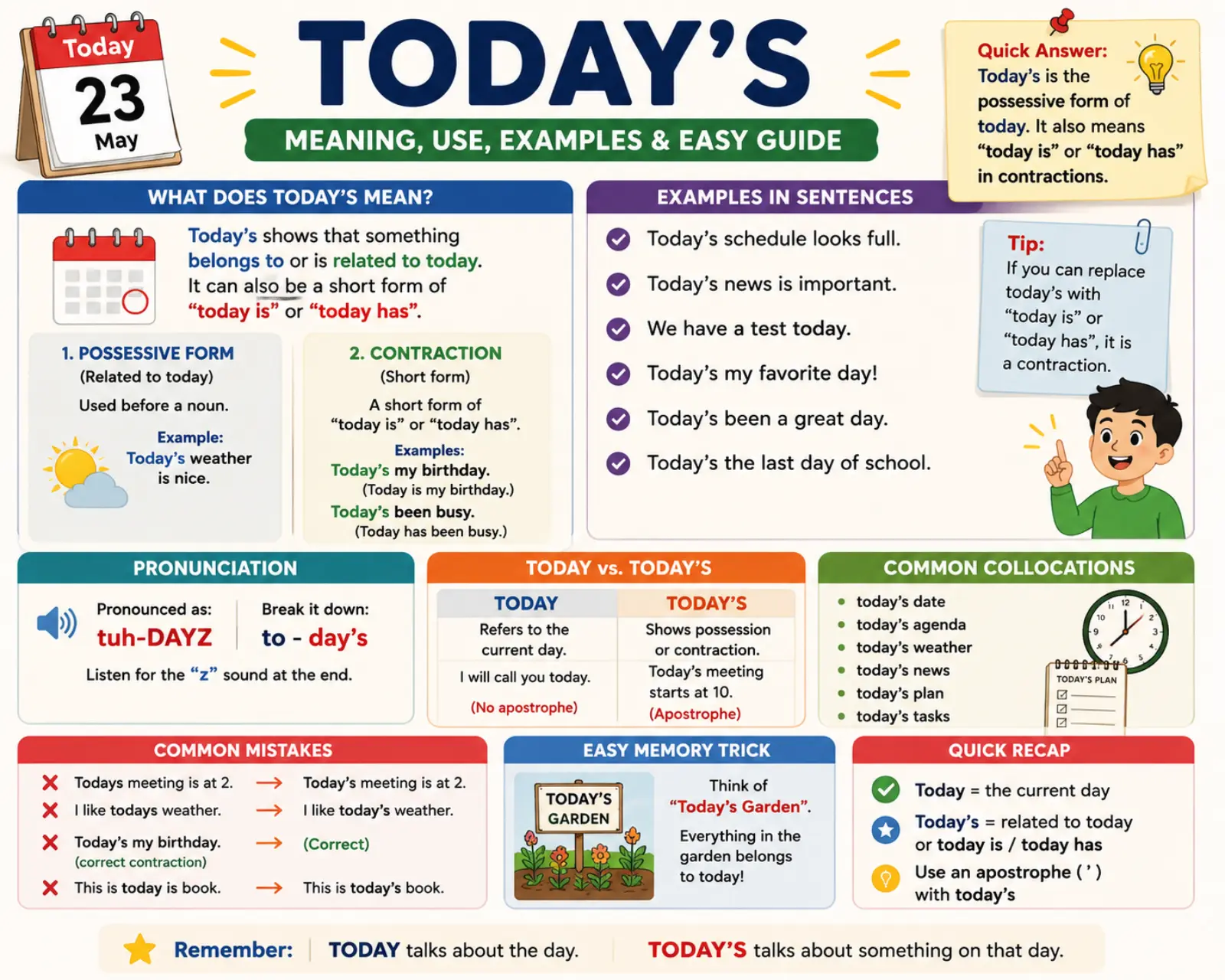
People usually search for today’s meaning, today’s definition, today’s pronunciation, how to use today’s, and today’s examples because the apostrophe can be confusing. The important point is that today’s usually shows that something is connected to or belongs to today. It can also be a contraction of “today is” or “today has.”
For example, “Today’s meeting starts at 10” means “The meeting for today starts at 10.” But “Today’s Friday” means “Today is Friday.”
In this guide, you’ll learn the meaning, pronunciation, examples, usage, grammar rules, common mistakes, expert tips, and simple explanations in easy English.
Today’s Quick Answer
Today’s has two main uses in English.
👉 today’s = belonging to or connected with today
Example: Today’s weather is beautiful.
Here, “today’s” means the weather of today.
👉 today’s = today is
Example: Today’s my birthday.
Here, “today’s” is a short form of today is.
👉 today’s = today has
Example: Today’s been a busy day.
Here, “today’s” means today has been.
Easy Examples
- Today’s class starts at 9 a.m.
- I like today’s weather.
- Today’s news is surprising.
- Today’s my first day at work.
- Today’s been very busy.
Simple Rule
Think of the apostrophe as a small shortcut.
Today’s + noun usually means something connected to today.
Today’s + adjective/noun phrase can sometimes mean today is.
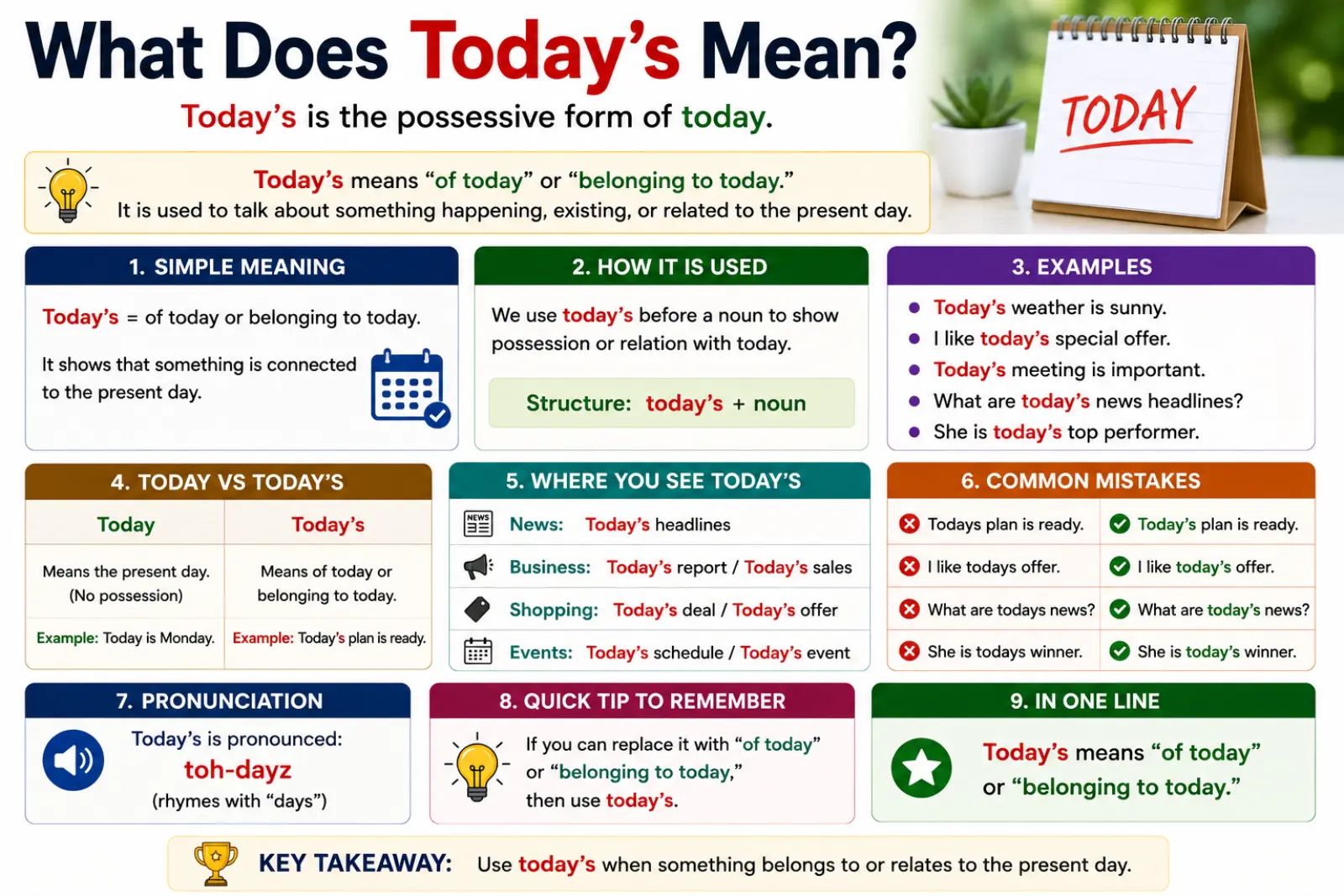
What Does Today’s Mean?
Today’s is the possessive form of today, but it can also be a contraction.
The meaning depends on the words that come after it.
Today’s Meaning as a Possessive
When today’s comes before a noun, it usually means “related to today.”
For example:
Today’s lesson is easy.
This means:
The lesson for today is easy.
Another example:
Today’s meeting was canceled.
This means:
The meeting scheduled for today was canceled.
This use is very common in everyday English.
Today’s as a Contraction
Today’s can also shorten today is.
For example:
Today’s a special day.
means:
Today is a special day.
It can also shorten today has.
For example:
Today’s been stressful.
means:
Today has been stressful.
The surrounding sentence tells you which meaning is intended.
Synonyms and Related Expressions
Depending on the sentence, related expressions include:
- this day’s
- for today
- happening today
- occurring today
- scheduled for today
- related to today
- today is
- today has
These are not always exact replacements, but they can help explain the meaning.
Opposite or Contrasting Expressions
Some useful contrasts include:
- yesterday’s
- tomorrow’s
- last week’s
- next week’s
- last month’s
- next month’s
For example:
Today’s meeting = the meeting happening today.
Tomorrow’s meeting = the meeting happening tomorrow.
The Origin of Today’s
The word today comes from Old English. It developed from an expression meaning roughly on this day.
Over time, the expression became the single word today.
English later began using apostrophe forms to show possession. This is why we can write:
- today’s weather
- today’s lesson
- today’s schedule
- today’s market
- today’s news
The apostrophe shows a relationship between today and another noun.
The contraction today’s developed from the same apostrophe idea used in English contractions. In this case, the apostrophe replaces missing letters in expressions such as today is and today has.
How to Pronounce Today’s
Today’s is pronounced approximately:
tuh-DAYZ
It has two main parts:
to-day’s
The strongest sound is usually on day.
Pronunciation Tip
Say:
today
Then add a z sound at the end:
today + z = today’s
The final sound is normally pronounced like z, not a separate “s” sound.
Common Pronunciation Mistake
Some learners may pronounce it like:
❌ “today-es”
A more natural pronunciation is:
✔ tuh-DAYZ
You do not need to make the apostrophe audible. The apostrophe only shows the grammatical form.
British English vs American English Usage
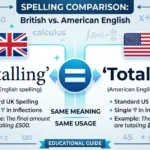
There is no major spelling difference between British and American English for today’s.
| Feature | British English | American English | Notes |
|---|---|---|---|
| Spelling | today’s | today’s | Same |
| Possessive use | Common | Common | Same |
| Contraction | Common | Common | Same |
| Pronunciation | Similar | Similar | Minor accent differences |
| Formal writing | Accepted | Accepted | Same |
| Everyday speech | Very common | Very common | Same |
So, if you are writing for a US audience, today’s is completely standard.
Which One Should You Use?
Use today’s when you want to show that something is connected with today.
Use Today’s Before a Noun
- today’s weather
- today’s class
- today’s schedule
- today’s meeting
- today’s homework
- today’s announcement
- today’s prices
You can use it in conversational writing and speech.
Today’s my birthday.
= Today is my birthday.
Today’s been amazing.
= Today has been amazing.
For very formal writing, you may choose the full forms when clarity matters.
Quick Usage Table
| Sentence | Meaning |
|---|---|
| Today’s lesson is easy. | The lesson for today |
| Today’s my birthday. | Today is my birthday |
| Today’s been difficult. | Today has been difficult |
| Today’s news is important. | News from today |
| Today’s schedule changed. | The schedule for today |
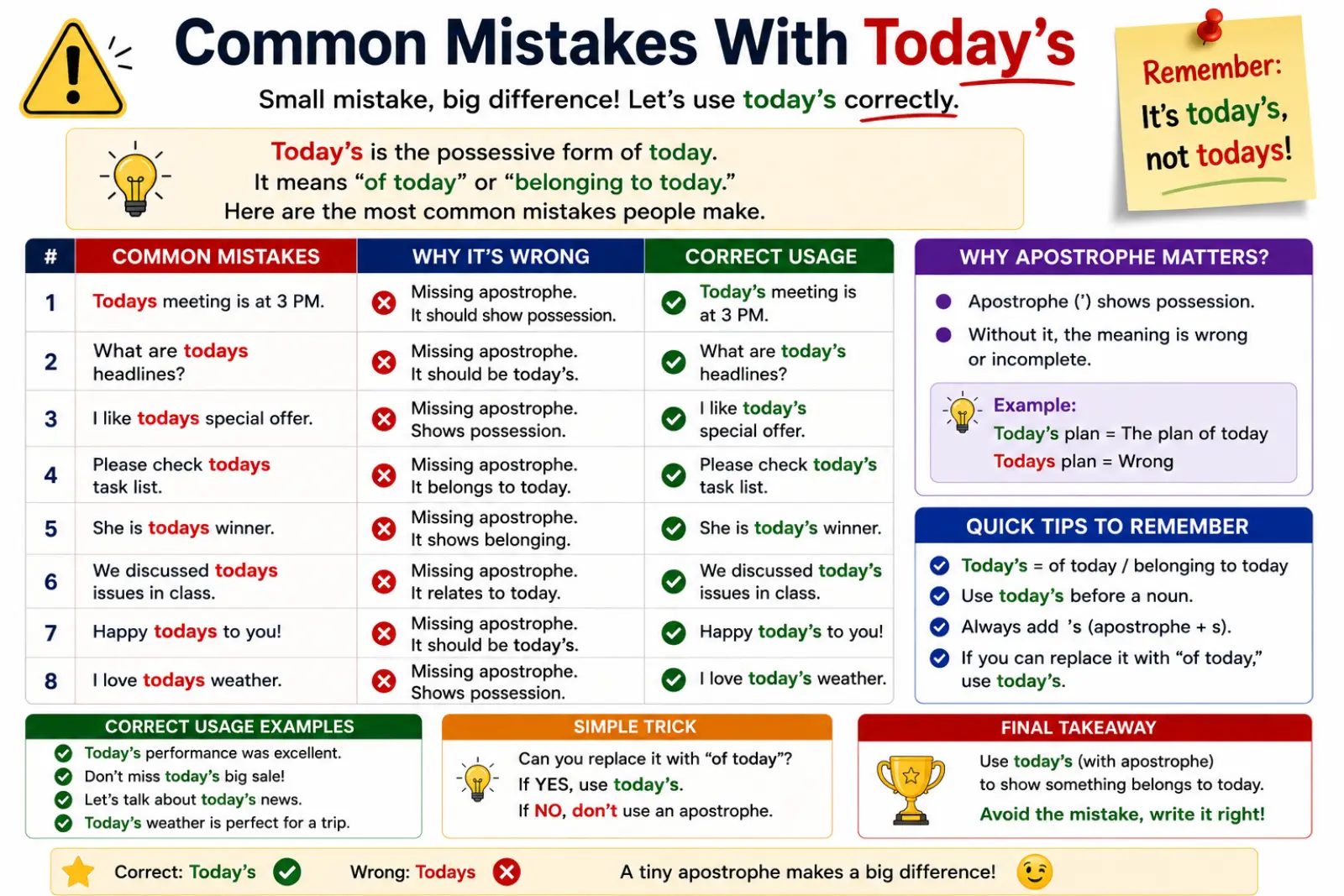
Common Mistakes With Today’s
Mistake 1: Writing Today’s Without Understanding the Meaning
❌ Today’s means only “today.”
✔ Today’s usually shows a connection with today or shortens “today is” or “today has.”
The apostrophe changes the grammar role.
Mistake 2: Confusing Today and Today’s
❌ I will finish today’s.
✔ I will finish today.
When you mean the current day itself, use today.
Use today’s when it modifies something or forms a contraction.
Mistake 3: Using an Apostrophe for a Simple Plural
The apostrophe in today’s does not simply make a word plural.
❌ There are many today’s in the calendar.
✔ There are many days in the calendar.
English apostrophes often show possession or missing letters.
Mistake 4: Confusing Today’s With Todays
❌ Todays meeting starts at noon.
✔ Today’s meeting starts at noon.
The apostrophe is needed when today has a possessive relationship with the following noun.
Mistake 5: Using Today’s When You Mean Tomorrow’s
❌ Tomorrow’s meeting is today’s meeting.
✔ Tomorrow’s meeting is scheduled for Friday.
Today’s refers to the current day.
Tomorrow’s refers to the following day.
Mistake 6: Misreading Today’s as “Today Is”
Not every use of today’s means “today is.”
For example:
Today’s weather is cold.
This does not mean:
Today is weather is cold.
Here, today’s is possessive.
Mistake 7: Forgetting the Apostrophe
❌ Todays class was fun.
✔ Today’s class was fun.
A quick proofreading check can catch this mistake.
Today’s in Everyday Examples
At Work
- Today’s meeting starts at 2 p.m.
- Today’s deadline is important.
- Today’s report needs one more review.
At School
- Today’s homework is easy.
- Today’s lesson was interesting.
- Today’s test starts after lunch.
On Social Media
- Today’s mood is completely different.
- Today’s goal is simple.
- Today’s photo turned out great.
In Daily Life
- Today’s weather is perfect for a walk.
- I need to check today’s schedule.
- Today’s dinner was delicious.
In Emails
Hi Sarah,
Today’s meeting has been moved to 3 p.m.
This is natural and professional.
In Text Messages
Today’s been crazy busy!
Here, today’s means today has.
In Online Content
- today’s trends
- today’s top stories
- today’s best deals
- today’s popular topics
- today’s latest updates
In Conversations
“How was your day?”
“Today’s been pretty good.”
Here, today’s means today has.
Today’s in Different Contexts
Today’s in Education
Teachers and students use today’s to describe lessons, assignments, tests, and classroom activities.
Examples:
- Today’s lesson covers adjectives.
- Today’s assignment is due tomorrow.
- Today’s class starts at 8:30.
It is useful because it clearly connects an activity with the current day.
Today’s in Business
Businesses frequently use today’s in schedules, reports, announcements, and customer communication.
Examples:
- Today’s sales are higher than expected.
- Today’s meeting has been postponed.
- Today’s market update is available online.
The expression is short and easy to understand.
Today’s in News
News websites often use phrases such as:
- today’s headlines
- today’s news
- today’s top stories
- today’s latest updates
These phrases tell readers that the information relates to the current day.
Today’s in Social Media
Social media users often use today’s in captions and short posts.
Examples:
Today’s vibe: coffee and quiet.
Today’s goal: finish everything early.
Today’s outfit is my favorite.
This use is usually casual and expressive.
Today’s in Marketing
Marketers use today’s to create a sense of freshness.
Examples include:
- today’s special offer
- today’s featured product
- today’s deal
- today’s top choice
These phrases can make content feel current.
Today’s in Technology
Technology websites may use phrases such as:
- today’s technology
- today’s software tools
- today’s digital trends
- today’s AI developments
The meaning is usually “current” or “related to the present day.”
Today’s Google Trends and Usage Data
People search for today’s for many different reasons. Some users want a grammar explanation, while others are looking for the meaning of a sentence.
Common search intentions include:
- today’s meaning
- what does today’s mean
- today’s definition
- today’s pronunciation
- today’s grammar
- how to use today’s
- today’s examples
- today vs today’s
- today’s or todays
- meaning of today’s in English
The keyword can also appear in many real-world searches.
Someone may search for today’s weather, today’s news, today’s date, today’s horoscope, or today’s schedule.
Search behavior can vary across countries such as the US, UK, India, Pakistan, Canada, and Australia. English learners may be especially interested in the apostrophe because possessive forms and contractions can be difficult at first.
The important SEO point is that today’s has several search intents. A useful explanation should cover grammar, meaning, pronunciation, examples, and real-world usage rather than giving only one definition.
Comparison Table for Today’s
| Feature | Today | Today’s |
|---|---|---|
| Basic meaning | The current day | Connected with today |
| Grammar role | Adverb or noun | Possessive form or contraction |
| Apostrophe | No | Yes |
| Example | I am busy today. | Today’s meeting is important. |
| Contraction | No | Can mean today is or today has |
| Common use | Time reference | Possession, connection, contraction |
| Formal writing | Correct | Correct |
| Everyday speech | Very common | Very common |
The Key Difference
Today usually tells you when something happens.
I am working today.
Today’s usually connects today with something else.
Today’s work is difficult.
That small apostrophe makes a real grammatical difference.
Today’s in Professional Life
In professional communication, today’s is common and natural.
You can use it in:
- emails
- reports
- meeting notices
- schedules
- presentations
- business updates
- customer messages
- workplace chats
For example:
Today’s meeting will begin at 10 a.m.
This sounds clear and professional.
Another example:
Please review today’s report before the meeting.
The expression is especially useful when several dates are involved.
Compare:
Please review the report.
with:
Please review today’s report.
The second sentence gives more specific information.
Today’s for Students and Beginners
Many beginners struggle with today’s because they see the apostrophe and assume it is a spelling issue.
It is mainly a grammar issue.
Remember these three patterns:
Today = the current day
Today’s + noun = something connected with today
Today’s = today is / today has when used as a contraction
Easy Examples
I am studying today.
Here, “today” tells us when.
Today’s lesson is about verbs.
Here, “today’s” describes the lesson.
Today’s my last class.
Here, “today’s” means “today is.”
Learning these three patterns makes the word much easier.
Common Uses and Patterns Related to Today’s
Look for these common patterns:
- today’s + noun
- today’s weather
- today’s news
- today’s meeting
- today’s class
- today’s schedule
- today’s work
- today’s date
- today’s event
- today’s results
- today’s update
- today’s market
- today’s topic
You may also see contractions:
- today’s my…
- today’s a…
- today’s been…
The surrounding words help you identify the correct meaning.
Simple Trick to Remember Today’s
Here is an easy memory trick:
Today = when
Today’s = connected to today
Think of it like this:
Today points to the day.
Today’s points from the day to something related to it.
For example:
I have a meeting today.
“Today” tells you when.
Today’s meeting is important.
“Today’s” tells you which meeting.
Think of It This Way
Imagine a calendar page marked TODAY.
Anything connected to that page can be called today’s.
- today’s class
- today’s lunch
- today’s weather
- today’s meeting
- today’s news
This simple visual idea can help you remember the difference.
Expert Tips for Using Today’s Correctly
Check What Comes After It
If a noun comes after today’s, it often shows a connection with today.
Today’s game
Today’s meeting
Today’s weather
Test the Contraction
If you see today’s, try replacing it with today is or today has.
Today’s a great day.
→ Today is a great day.
It works.
Today’s been busy.
→ Today has been busy.
It works.
But:
Today’s weather is hot.
→ Today is weather is hot.
It does not work.
So here, today’s is possessive.
Do Not Remove the Apostrophe
In standard English, write:
✔ today’s
not:
❌ todays
Compare It With Similar Words
The same idea appears in:
- yesterday’s news
- tomorrow’s meeting
- Monday’s schedule
- Friday’s event
These forms help you understand how possessive time expressions work.
Related Searches People Also Ask
What is the meaning of today’s?
Today’s usually means something connected with the current day. It can also mean today is or today has.
Is today’s grammatically correct?
Yes. Today’s is a standard and correct English form.
What is the difference between today and today’s?
Today refers to the current day. Today’s usually describes something connected with today or forms a contraction.
Is todays correct without an apostrophe?
Usually no when you mean the possessive form. Write today’s.
How do you pronounce today’s?
It is commonly pronounced tuh-DAYZ.
Is today’s a possessive word?
Yes, when it shows a relationship between today and a noun, such as today’s weather.
Can today’s mean today is?
Yes. For example, Today’s my birthday means Today is my birthday.
Can today’s mean today has?
Yes. Today’s been great can mean Today has been great.
Is today’s formal English?
Yes. Today’s is acceptable in both formal and informal English.
What are common examples of today’s?
Common phrases include today’s weather, today’s news, today’s meeting, today’s class, and today’s schedule.
Why does today’s have an apostrophe?
The apostrophe shows possession or replaces letters in a contraction.
Is today’s used in American English?
Yes. Today’s is completely normal in American English.
FAQs About Today’s
What does today’s mean in simple English?
Today’s means “connected with today.” It can also mean “today is” or “today has.”
Is today’s the same as today?
No. Today refers to the current day. Today’s usually connects the current day with another word.
What is an example of today’s?
Today’s weather is warm. Here, today’s means the weather for today.
Can I use today’s in an email?
Yes. It is common and professional.
Today’s meeting starts at 3 p.m.
Is “today’s meeting” correct?
Yes. It means the meeting scheduled for today.
Is “today’s my birthday” correct?
Yes. It is a contraction of today is my birthday.
Is “today’s been busy” correct?
Yes. It is a contraction of today has been busy.
Should today’s always have an apostrophe?
When you are using the possessive form or contraction today’s, yes. The apostrophe is part of the standard spelling.
What is the difference between today’s and tomorrow’s?
Today’s refers to the current day. Tomorrow’s refers to the next day.
What is the easiest way to remember today’s?
Remember: today = current day, while today’s = connected to today.
Final Verdict
Today’s is correct standard English.
I will call you today.
Today’s meeting is important.
Today’s my birthday.
Today’s been wonderful.
Final Memory Rule
👉 Today = the day
👉 Today’s = something connected to the day, or today is/has
Conclusion
Understanding today’s becomes easy once you know what the apostrophe is doing. It does not simply change the spelling of today. It shows either a relationship with something or missing letters in a contraction.
The easiest trick is to look at the words around today’s. If a noun follows it, it often means something connected with today. If it can be expanded to today is or today has, it is a contraction.
Remember: Today tells you when. Today’s connects something to today.

Camila Green is an English language writer who specializes in confusing word comparisons and spelling explanations. She creates simple, beginner-friendly guides on topics like “niece or neice” and other common English mistakes. Her writing focuses on clarity, real-life examples, and easy learning. At VerrsaPick, she helps readers improve their English with practical and engaging content.