
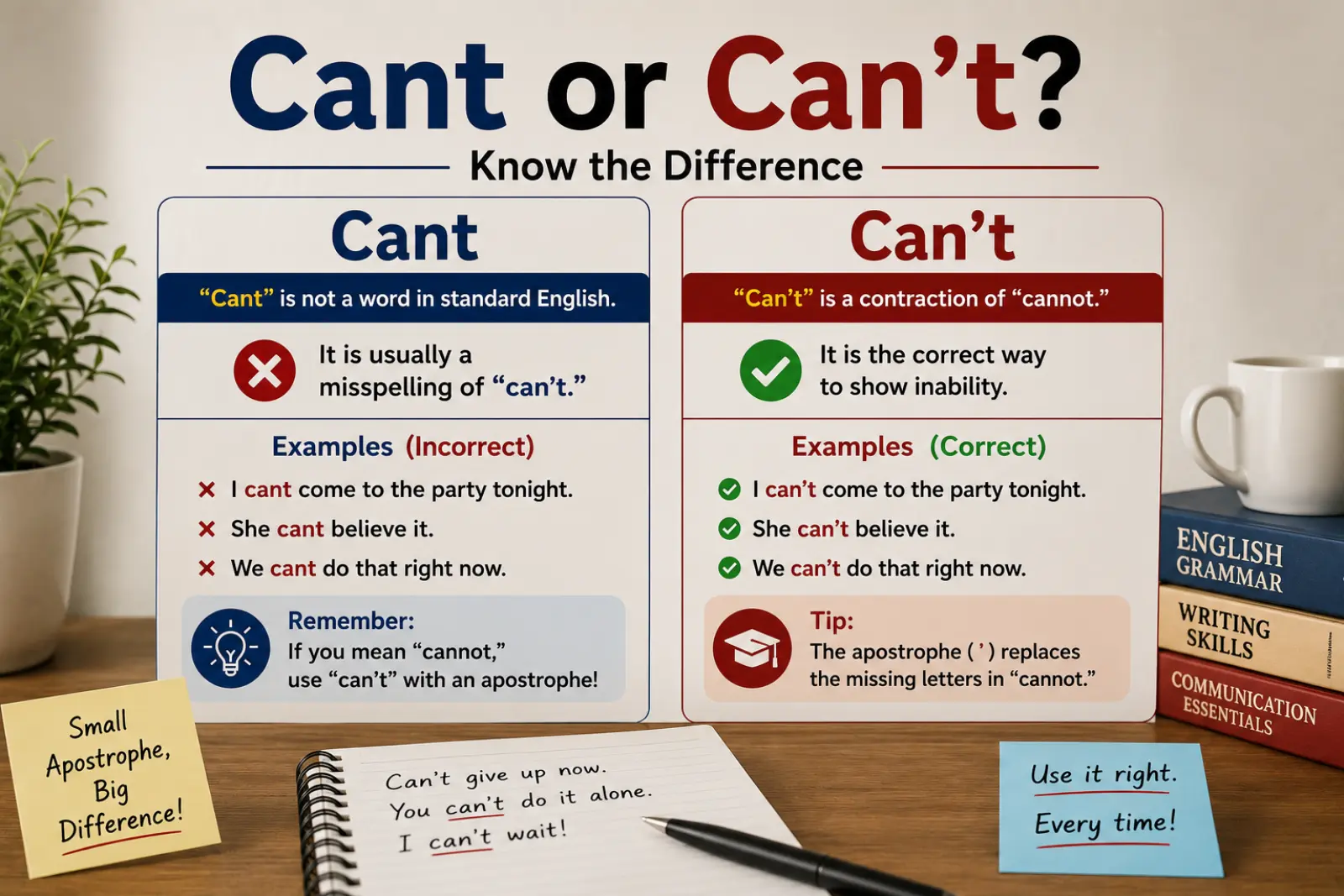
Have you ever paused while typing a message and wondered if you should write cant or can’t? You’re not alone. This is one of the most common spelling and punctuation questions for English learners and even native speakers.
The confusion usually happens because the two words look almost identical. However, they have very different meanings. Can’t is a common contraction that means cannot, while cant is a real English word with a completely different meaning that most people rarely use.
People usually search for:
- cant or can’t
- can’t meaning
- cant meaning
- correct spelling
- examples of can’t
- grammar difference
You may see these words in school assignments, emails, text messages, social media posts, books, and everyday conversations. Knowing the difference will help you avoid common grammar mistakes and improve your writing.
In this guide, you’ll learn the meaning, pronunciation, examples, usage, grammar rules, common mistakes, expert tips, and simple explanations in easy English.
Cant or Can’t – Quick Answer
👉 Can’t = Correct (when you mean cannot)
👉 Cant = A different noun meaning insincere talk, specialised language, or a tilted angle.
Examples
- ✅ I can’t swim.
- ✅ She can’t come today.
- ✅ We can’t find the keys.
- ✅ The road has a slight cant.
Simple Rule
If you mean “cannot,” always use “can’t” with an apostrophe.
What Does Cant or Can’t Mean?
Can’t
Can’t is the short form of cannot. It expresses inability, impossibility, or refusal.
Examples:
- I can’t drive.
- He can’t hear you.
- They can’t attend the meeting.
Cant
Cant is a noun with several meanings:
- Insincere or empty talk
- Special language used by a particular group
- A slope or tilted position
It is much less common than can’t.
Synonyms
Can’t
- Cannot
- Unable to
- Not able to
Cant
- Jargon
- Slang
- Tilt
- Incline
Related Terms
- Cannot
- Contraction
- Apostrophe
- Grammar
- Punctuation
The Origin of Cant or Can’t
Can’t developed as a contraction of cannot in English writing hundreds of years ago. It became popular because it makes speaking and writing more natural.
Cant comes from older European languages and has been used to describe secret language, repetitive speech, or something that leans at an angle.
How to Pronounce Cant and Can’t
Can’t
Pronunciation: /kɑːnt/ or /kænt/
Sounds like:
kant
Cant
Pronunciation: Almost identical to can’t.
Speaking Tip
The pronunciation is nearly the same. The meaning depends on the context and the apostrophe in writing.
British English vs American English Usage
| Feature | British English | American English | Notes |
|---|---|---|---|
| Can’t | ✅ Common | ✅ Common | Same meaning |
| Cant | ✅ Correct but rare | ✅ Correct but rare | Different meaning |
| Apostrophe | Required | Required | Important for grammar |
Which One Should You Use?
Use can’t when you mean cannot.
Use cant only when discussing language, insincere speech, or a tilted surface.
Quick Guide
| Situation | Correct Word |
|---|---|
| Text message | Can’t |
| School essay | Can’t |
| Can’t | |
| Road engineering | Cant |
| Language studies | Cant |
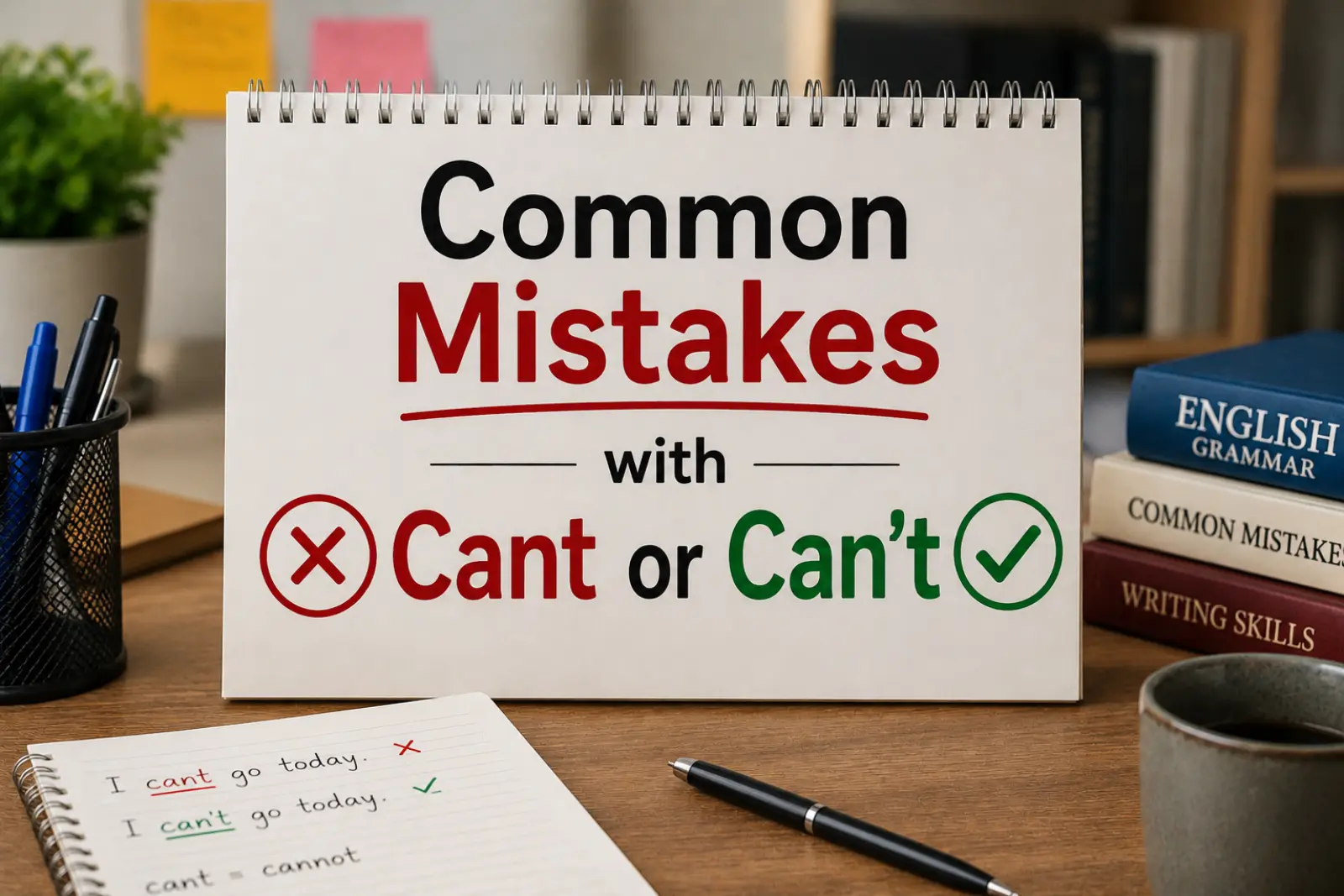
Common Mistakes with Cant or Can’t
Mistake 1
❌ I cant swim.
✔ I can’t swim.
Why? The apostrophe is needed because can’t is a contraction.
Mistake 2
❌ She cant come today.
✔ She can’t come today.
Mistake 3
❌ We cant understand.
✔ We can’t understand.
Mistake 4
❌ Cant is always wrong.
✔ Cant is a real word, but it has a different meaning.
Mistake 5
❌ The road can’t sharply.
✔ The road has a slight cant.
Cant or Can’t in Everyday Examples
Work
“I can’t attend today’s meeting.”
School
“I can’t solve this maths problem.”
Social Media
“I can’t stop laughing at this video.”
Daily Life
“We can’t find the remote.”
“I can’t join the call this afternoon.”
Text Message
“Sorry, I can’t make it today.”
Cant or Can’t in Different Contexts
Grammar
Can’t is one of the most common English contractions.
Writing
Always include the apostrophe when shortening cannot.
Engineering
Cant describes a slope or angled surface, such as a railway track.
Language Studies
Cant can also describe specialised vocabulary used by a particular group.
Google Trends & Usage Data
Many people search cant or can’t because they accidentally leave out the apostrophe while typing.
This question is popular in the US, UK, Canada, Australia, India, and Pakistan, especially among English learners.
Common searches include:
- can’t vs cannot
- cant meaning
- apostrophe in can’t
- grammar rules for contractions
Comparison Table
| Feature | Cant | Can’t |
|---|---|---|
| Correct word | ✅ Yes | ✅ Yes |
| Common meaning | Special term or slope | Cannot |
| Everyday use | Rare | Very common |
| Apostrophe | No | Yes |
| Grammar role | Noun | Contraction |
| Academic writing | Limited | Common |
Cant or Can’t in Professional Life
Using can’t correctly makes your emails and reports look more professional.
Leaving out the apostrophe can appear as a typing mistake.
Example:
- ✅ I can’t attend the meeting.
- ❌ I cant attend the meeting.
Cant or Can’t for Students or Beginners
Many learners forget the apostrophe because they type quickly.
Remember:
Can’t = Cannot
Cant = A different dictionary word.
Common Uses
- School writing
- Emails
- Text messages
- Social media
- Workplace communication
- Grammar lessons
- English learning
Simple Trick to Remember Cant or Can’t
Remember:
The apostrophe replaces the missing letters in “cannot.”
Think of it this way:
If you can replace the word with cannot, write can’t.
Example:
“I can’t go.”
“I cannot go.”
Both sentences mean the same thing.
Expert Tips
- Proofread your writing before sending messages.
- Don’t rely only on autocorrect.
- Learn common contractions such as can’t, won’t, don’t, and isn’t.
- Remember that cant is a real but uncommon word.
Related Searches People Also Ask
- Is cant a real word?
- What is the difference between cant and can’t?
- Why does can’t need an apostrophe?
- Is cant wrong in English?
- How do you use can’t in a sentence?
- What does cant mean in engineering?
- Is can’t formal English?
- Can I use cannot instead of can’t?
- How do contractions work?
- What are common apostrophe mistakes?
FAQs
Is cant a real word?
Yes. It has meanings different from can’t.
Is can’t short for cannot?
Yes.
Which spelling is correct?
If you mean cannot, use can’t.
Why is the apostrophe important?
It shows that letters have been removed from cannot.
Can I write cant instead of can’t?
Not if you mean cannot.
Is can’t informal?
It is common in everyday writing. In very formal writing, cannot is often preferred.
Do British and American English use can’t?
Yes. Both use it in the same way.
What is the easiest way to remember?
If cannot fits the sentence, write can’t.
Final Verdict
If you’re talking about not being able to do something, the correct word is can’t.
Cant is also a correct English word, but it has a completely different meaning and is rarely used in everyday conversation.
Easy Memory Rule:
Can’t = Cannot.
Cant = A rare noun with different meanings.
Conclusion
The difference between cant and can’t is simple once you know the role of the apostrophe. Can’t is the everyday contraction of cannot, while cant is an uncommon noun used in specialised contexts such as engineering or linguistics.
Whenever you’re unsure, try replacing the word with cannot. If the sentence still makes sense, can’t is the correct choice. This easy trick will help you write confidently and avoid one of the most common English punctuation mistakes.

Camila Green is an English language writer who specializes in confusing word comparisons and spelling explanations. She creates simple, beginner-friendly guides on topics like “niece or neice” and other common English mistakes. Her writing focuses on clarity, real-life examples, and easy learning. At VerrsaPick, she helps readers improve their English with practical and engaging content.