Have you ever written recognise in an email and wondered if it should be recognize instead? Or maybe your spell checker changed one spelling to the other. This is a very common question for English learners, students, writers, and professionals.
People usually search for recognise or recognize because both spellings appear in books, websites, business documents, and social media. The good news is that both words are correct. The difference depends on the type of English you are using.
You may see these spellings in school assignments, workplace emails, newspapers, websites, online articles, and everyday conversations. Knowing which version to use helps your writing stay consistent and professional.
People usually search for:
- Recognise or recognize
- Correct spelling of recognize
- Recognise meaning
- Recognize pronunciation
- British vs American English
- Recognise vs recognize examples
In this guide, you’ll learn the meaning, pronunciation, examples, usage, grammar rules, common mistakes, expert tips, and simple explanations in easy English.
Recognise or Recognize – Quick Answer
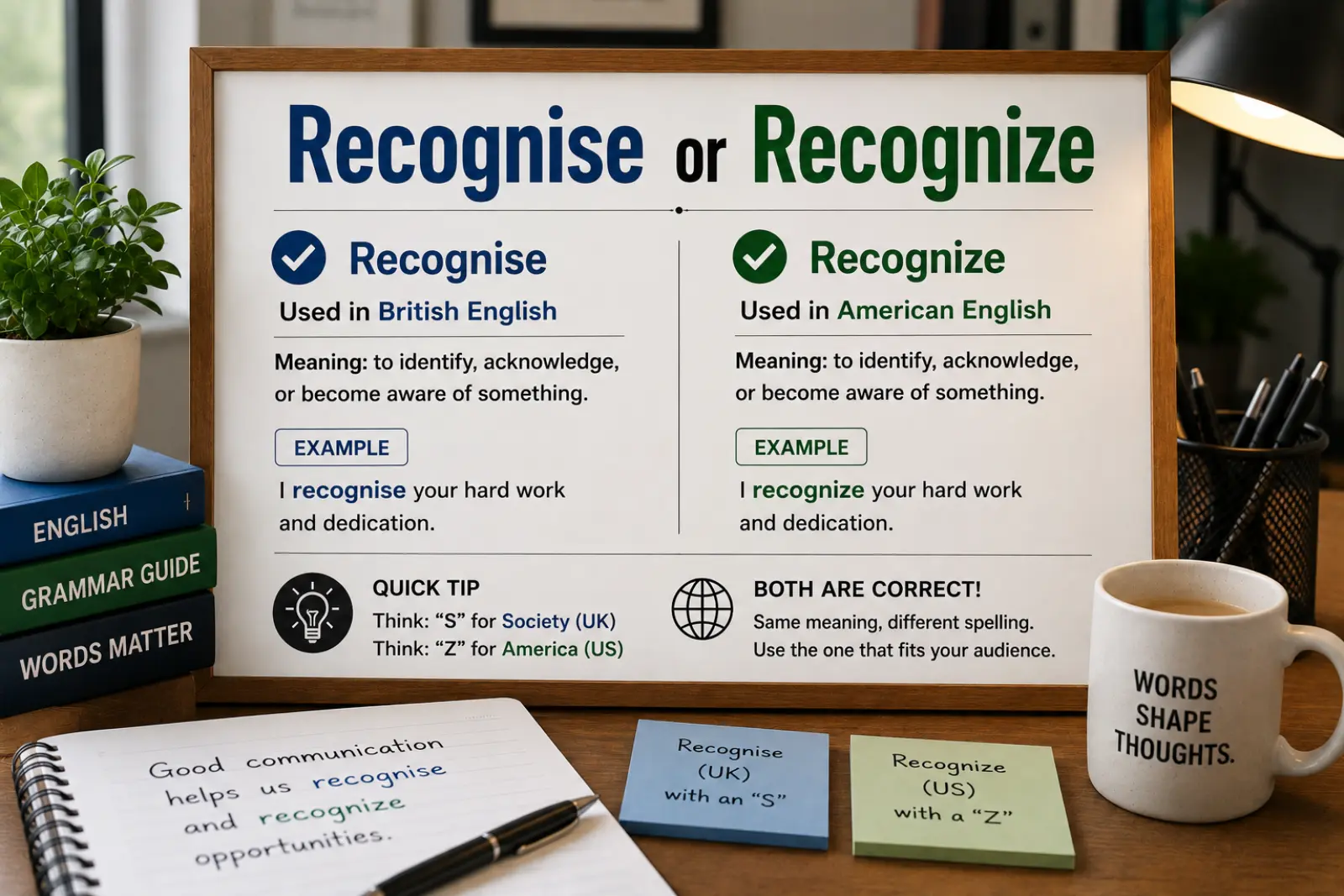
👉 Recognise = Correct in British English
👉 Recognize = Correct in American English (and also accepted by many British publishers)
Both words have exactly the same meaning. Only the spelling changes.
Examples
I recognize your voice.
I recognise your handwriting.
She didn’t recognize me.
We recognise good work.
Simple Memory Trick
- American English → Recognize (z)
- British English → Recognise (s)
What Does Recognise or Recognize Mean?
Recognise and recognize mean to know or identify someone or something because you have seen, heard, or experienced it before.
The word can also mean:
- To accept something as true
- To appreciate someone’s work
- To officially acknowledge a person or organization
Synonyms
- Identify
- Notice
- Acknowledge
- Remember
- Detect
Opposites
- Ignore
- Miss
- Overlook
- Forget
- Deny
Related Terms
- Recognition
- Recognizable
- Recognized
- Recognition award
Common Variations
- Recognise
- Recognize
- Recognised
- Recognized
- Recognising
- Recognizing
The Origin of Recognise or Recognize
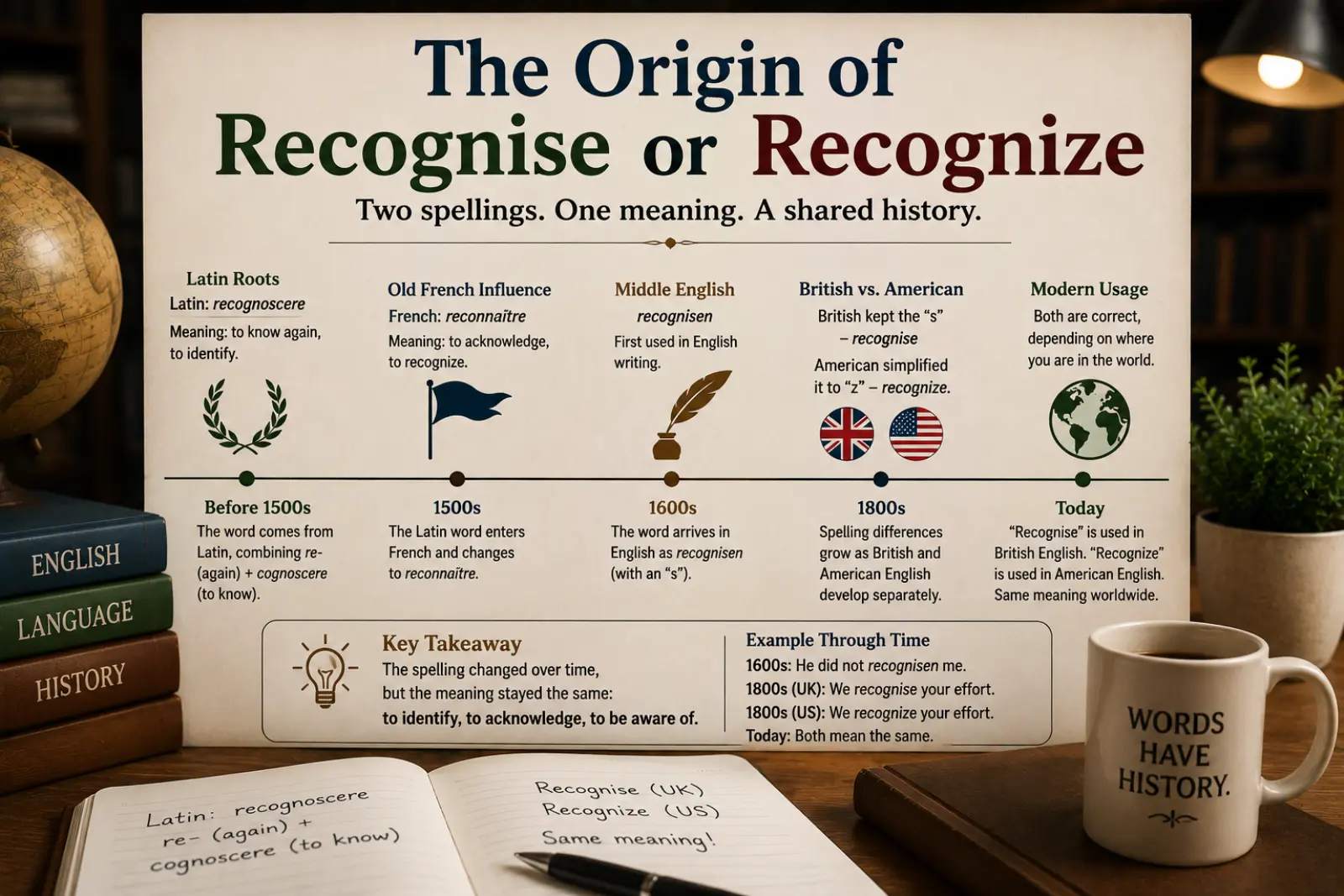
The word comes from the Latin word recognoscere, which means to know again.
Later, it entered French and then English. Over time, English developed two common spelling styles:
- British English usually uses -ise
- American English usually uses -ize
Today, both spellings are accepted depending on the style guide you follow.
How to Pronounce Recognise or Recognize
Pronunciation:
REK-ug-nize
Phonetic: /ˈrek.əɡ.naɪz/
The pronunciation is the same for both spellings.
Easy Speaking Tip
Break the word into four parts:
Rec + og + nize
Do not pronounce the g strongly.
British English vs American English Usage
| Feature | British English | American English | Notes |
|---|---|---|---|
| Preferred Spelling | Recognise | Recognize | Both are correct |
| Pronunciation | Same | Same | No difference |
| Meaning | Same | Same | Identical meaning |
| Professional Writing | Yes | Yes | Match your audience |
Which One Should You Use?
Choose one spelling and stay consistent.
Use Recognise if you write for:
- UK readers
- British schools
- UK businesses
- British newspapers
Use Recognize if you write for:
- US readers
- American companies
- International technology websites
- Most online audiences
| Situation | Recommended |
|---|---|
| UK School | Recognise |
| US School | Recognize |
| International Business | Recognize |
| Academic Writing | Follow your style guide |
Common Mistakes with Recognise or Recognize
Mistake 1
❌ Mixing both spellings in one article.
✔ Use one spelling consistently.
Mistake 2
❌ Thinking one spelling is wrong.
✔ Both are correct.
Mistake 3
❌ Using British spelling for American assignments.
✔ Match the required English style.
Mistake 4
❌ Believing pronunciation changes.
✔ Both words sound exactly the same.
Mistake 5
❌ Assuming grammar is different.
✔ Grammar and meaning stay the same.
Recognise or Recognize in Everyday Examples
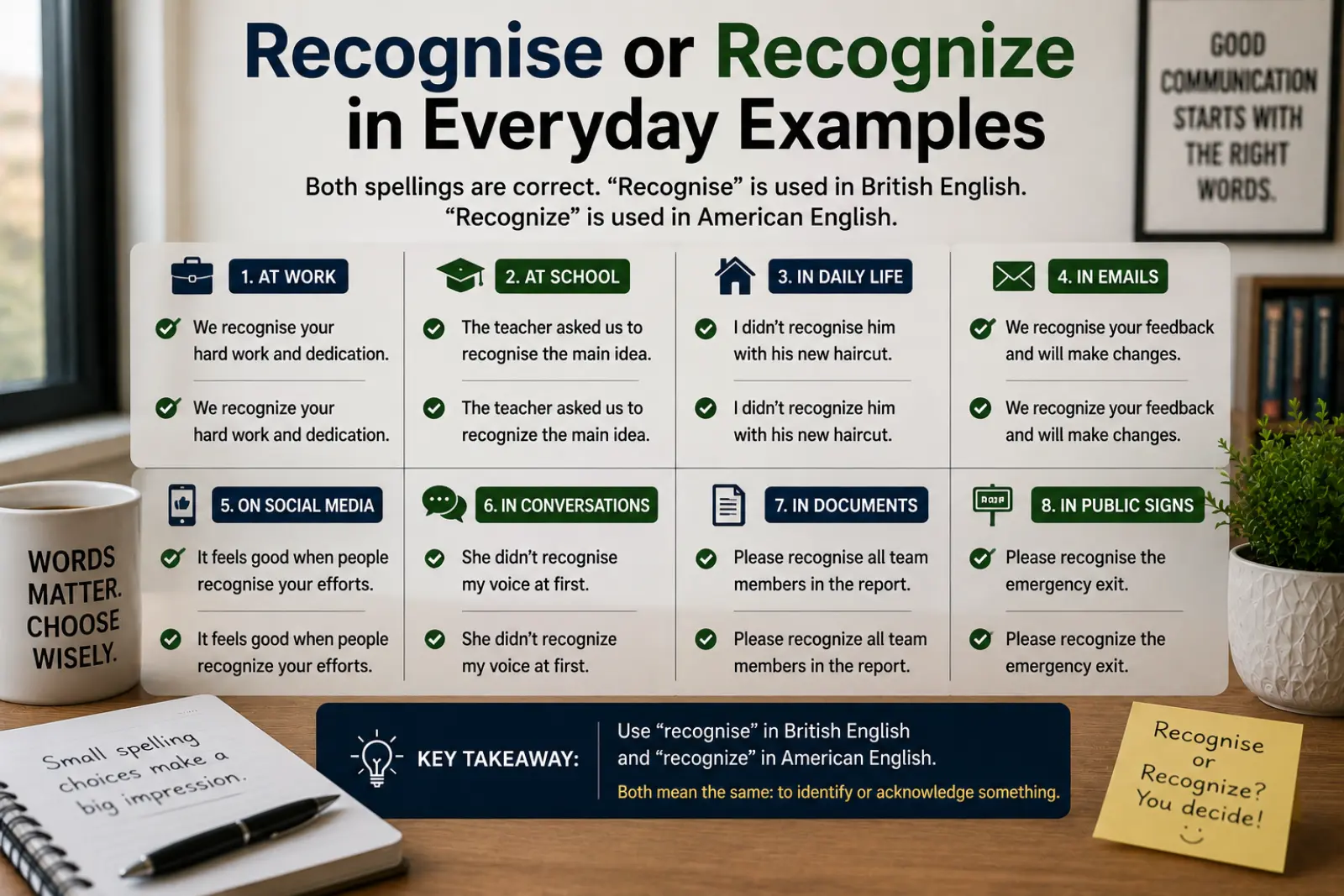
School
“My teacher recognised my improvement.”
“My teacher recognized my improvement.”
Workplace
“Our manager recognized everyone’s hard work.”
Social Media
“I recognize that place from your photos.”
Daily Life
“I recognised her voice immediately.”
“We recognize your valuable contribution.”
Conversation
“Do you recognize this song?”
Recognise or Recognize in Different Contexts
Education
Students should follow the spelling style required by their school or exam board.
Business
Companies usually choose one spelling for branding and official documents.
Writing
Authors should stay consistent throughout books, blogs, and articles.
Communication
Using the correct regional spelling makes your writing look more natural.
Google Trends & Usage
People search for recognise or recognize because they want to know:
- Which spelling is correct
- British vs American English differences
- Grammar rules
- Pronunciation
- Writing examples
This search is especially popular in the United States, United Kingdom, Canada, Australia, India, and Pakistan, where English learners often compare spelling styles.
Comparison Table
| Feature | Recognise | Recognize |
|---|---|---|
| Correct | ✅ Yes | ✅ Yes |
| Meaning | Same | Same |
| Pronunciation | Same | Same |
| British English | Preferred | Accepted by some publishers |
| American English | Rare | Preferred |
| Professional Writing | Yes | Yes |
| Common Confusion | Medium | Medium |

Recognise or Recognize in Professional Life
Professional writing should always match your audience.
For example:
- A UK company may use recognise.
- A US company will usually use recognize.
Using one spelling consistently helps build trust and keeps your documents professional.
Recognise or Recognize for Students
Many beginners think one spelling is wrong because spell check changes it.
Remember:
- British English → Recognise
- American English → Recognize
Neither spelling changes the meaning.
Common Uses of Recognise or Recognize
You can use these words when you:
- Identify a person
- Remember a place
- Appreciate someone’s work
- Accept a fact
- Officially acknowledge an achievement
- Recognize a brand or logo.
What Is Another Word for “Recognize”?
The best synonym for recognize depends on how the word is used. Sometimes it means to identify someone or something, while in other cases it means to accept, admit, or praise. Choosing the right synonym makes your writing more natural and precise.
Common Synonyms for Recognize
| Synonym | Best Used When |
|---|---|
| Identify | Finding out who or what someone or something is |
| Acknowledge | Accepting or admitting something is true |
| Notice | Seeing or becoming aware of something |
| Detect | Discovering something that is not obvious |
| Spot | Seeing something quickly |
| Discern | Recognizing something through careful observation |
| Perceive | Becoming aware of something through the senses |
| Distinguish | Telling the difference between two things |
| Appreciate | Valuing or recognizing someone’s efforts |
| Honor (UK: Honour) | Giving praise or special recognition |
Recognize Meaning “Identify”
When recognize means to know someone or something because you have seen it before, these synonyms work best:
- Identify
- Spot
- Detect
- Notice
- Discern
Example:
- I recognized my teacher in the crowd.
- I identified my teacher in the crowd.
Recognize Meaning “Accept or Admit”
When recognize means to accept a fact or admit something is true, use:
- Acknowledge
- Accept
- Admit
- Confirm
Example:
- She recognized her mistake.
- She acknowledged her mistake.
Recognize Meaning “Praise or Reward”
When recognize refers to giving credit or appreciation, these synonyms are appropriate:
- Appreciate
- Commend
- Reward
- Honor (Honour)
- Celebrate
Example:
- The company recognized his hard work.
- The company appreciated his hard work.
How to Choose the Right Synonym
Always choose a synonym based on the meaning of the sentence.
- Use identify when talking about people or objects.
- Use acknowledge when admitting a fact or achievement.
- Use appreciate or honor when giving praise.
- Use notice or spot when referring to seeing something.
Simple Trick to Remember Recognise or Recognize
Easy Memory Rule
- S = British Style
- Z = American Style
Think of it this way:
If you’re writing for London, recognise fits naturally.
If you’re writing for New York, recognize is usually the better choice.
Expert Tips
Many international companies, software platforms, and technology websites prefer recognize because American English is widely used online.
If you’re writing for a UK audience or following British English rules, recognise is the better option.
The most important tip is to stay consistent throughout your writing.
What Is a Better Word for “Recognized”?
There is no single word that is always better than recognized. The best replacement depends on the meaning of your sentence. In some cases, identified is the best choice, while in others acknowledged, noticed, or appreciated may fit better.
Common Alternatives to “Recognized”
| Alternative | Best Used When |
|---|---|
| Identified | You knew who or what something was. |
| Acknowledged | You accepted or admitted something. |
| Noticed | You became aware of something. |
| Detected | You discovered something difficult to see. |
| Spotted | You saw something quickly. |
| Appreciated | You valued someone’s efforts. |
| Honored (UK: Honoured) | You gave someone praise or recognition. |
| Confirmed | You verified that something was true. |
| Distinguished | You told one thing apart from another. |
| Perceived | You understood or became aware of something. |
When to Use Each Alternative
Use Identified
Choose identified when talking about recognizing a person, object, or place.
Example:
- The police recognized the suspect. ✅
- The police identified the suspect. ✅
Use Acknowledged
Choose acknowledged when someone accepts a fact, mistake, or achievement.
Example:
- She recognized her mistake. ✅
- She acknowledged her mistake. ✅
Use Noticed
Choose noticed when someone simply becomes aware of something.
Example:
- I recognized a strange smell. ❌
- I noticed a strange smell. ✅
Use Appreciated
Choose appreciated when talking about giving credit or valuing someone’s work.
Example:
- The company recognized her hard work. ✅
- The company appreciated her hard work. ✅
Example Sentences
- I recognized my old friend at the airport. → I identified my old friend at the airport.
- She recognized the problem immediately. → She noticed the problem immediately.
- The school recognized his achievements. → The school honored his achievements.
- He recognized his mistake. → He acknowledged his mistake.
Final Tip
The “better” word depends on your meaning:
- Identified → for people or objects.
- Acknowledged → for facts or mistakes.
- Noticed → for becoming aware.
- Appreciated or Honored → for praise and recognition.
Choosing the synonym that matches the context will make your writing clearer and more natural.
Related Searches People Also Ask
People also ask:
- Is recognise correct in British English?
- Is recognize American English?
- Why are there two spellings?
- How do you pronounce recognize?
- Which spelling should students use?
- Is recognize accepted in the UK?
- What is the difference between recognise and recognize?
- Can I use both spellings in one document?
- Which spelling is better for business writing?
- Why does spell check change recognise to recognize?
FAQs
Is recognise correct?
Yes. It is the preferred British English spelling.
Is recognize correct?
Yes. It is the standard American English spelling.
Do they have different meanings?
No. Both words mean exactly the same thing.
Which spelling is more common?
Recognize is more common worldwide because American English is widely used online.
Which spelling should I use?
Use the version that matches your audience or style guide.
Is pronunciation different?
No. Both are pronounced the same way.
Can I mix both spellings?
No. Choose one style and use it consistently.
Is recognize accepted in Britain?
Yes. Some British publishers and organizations also use -ize, although recognise is more common in everyday British English.
Final Verdict
Both recognise and recognize are correct. The only real difference is the regional spelling.
- 🇬🇧 Recognise = British English
- 🇺🇸 Recognize = American English
The best choice depends on your audience. Once you choose one spelling, use it consistently throughout your writing.
Easy memory trick: S for British Style, Z for American Style. This simple rule will help you remember the difference every time.
Conclusion
Both recognise and recognize are correct spellings of the same verb, meaning to identify, acknowledge, or realize something. The difference comes down to the type of English you use. Recognize is the standard spelling in American English and is also accepted by many international style guides, while recognise is the preferred spelling in British English and other regions that follow British spelling conventions.
If you’re writing for a U.S. audience, use recognize. If your readers are in the UK, Australia, or other countries that follow British English, recognise is the more natural choice. Whichever spelling you choose, stay consistent throughout your writing to maintain clarity and professionalism.

Camila Green is an English language writer who specializes in confusing word comparisons and spelling explanations. She creates simple, beginner-friendly guides on topics like “niece or neice” and other common English mistakes. Her writing focuses on clarity, real-life examples, and easy learning. At VerrsaPick, she helps readers improve their English with practical and engaging content.