You are writing a birthday card, sending a message, or posting something online when you suddenly stop. Is it suprise or surprise? This tiny spelling question can make even confident English speakers hesitate.
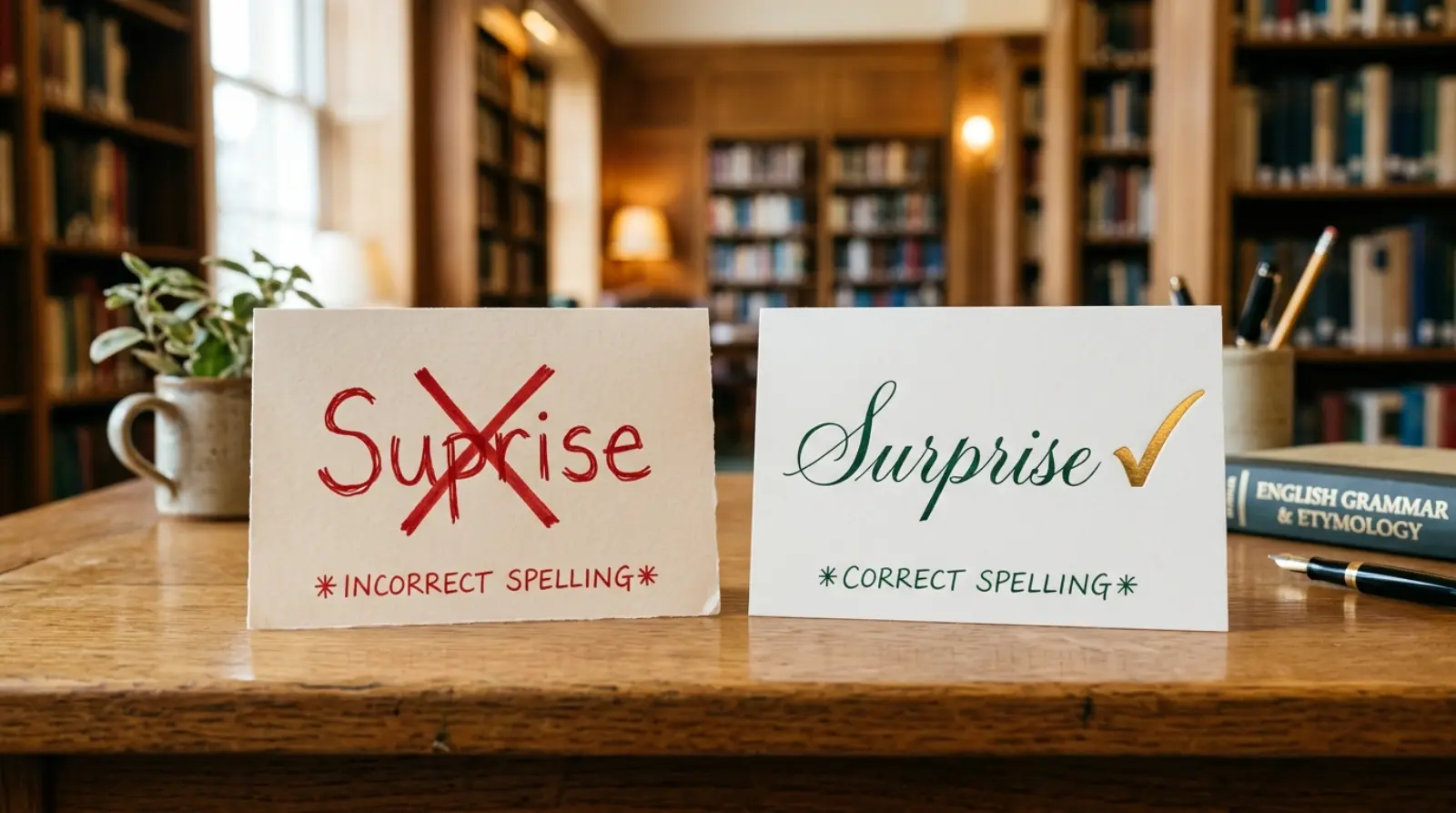
The correct spelling is surprise, with an r after the first u. Suprise is a common misspelling and should be avoided in standard English.
The word surprise is used every day. You may see it in school, workplace emails, social media, text messages, business writing, entertainment, and daily conversations. It can describe an unexpected event, a sudden feeling, or something done to make another person happy.
People usually search for: the suprise or surprise correct spelling, meaning, pronunciation, examples, usage, definition, and spelling difference. Many learners make this mistake because the letters in surprise do not always feel easy to place when the word is written quickly.
The good news is that there is a simple way to remember it. Surprise starts with “sur,” not “su.” Once you learn that pattern, the correct spelling becomes much easier.
In this guide, you’ll learn the meaning, pronunciation, examples, usage, grammar rules, common mistakes, expert tips, and simple explanations in easy English.
Suprise or Surprise Quick Answer
👉 Surprise = correct spelling
👉 Suprise = incorrect spelling
Surprise can be a noun, verb, or adjective related to something unexpected.
Examples
- What a wonderful surprise! ✅
- I wanted to surprise her with a gift. ✅
- His visit was a complete surprise. ✅
- The news surprised everyone. ✅
Simple Rule
👉 Remember SUR + PRISE = SURPRISE.
The word contains an r after the first u.
Surprise ✅
Suprise ❌
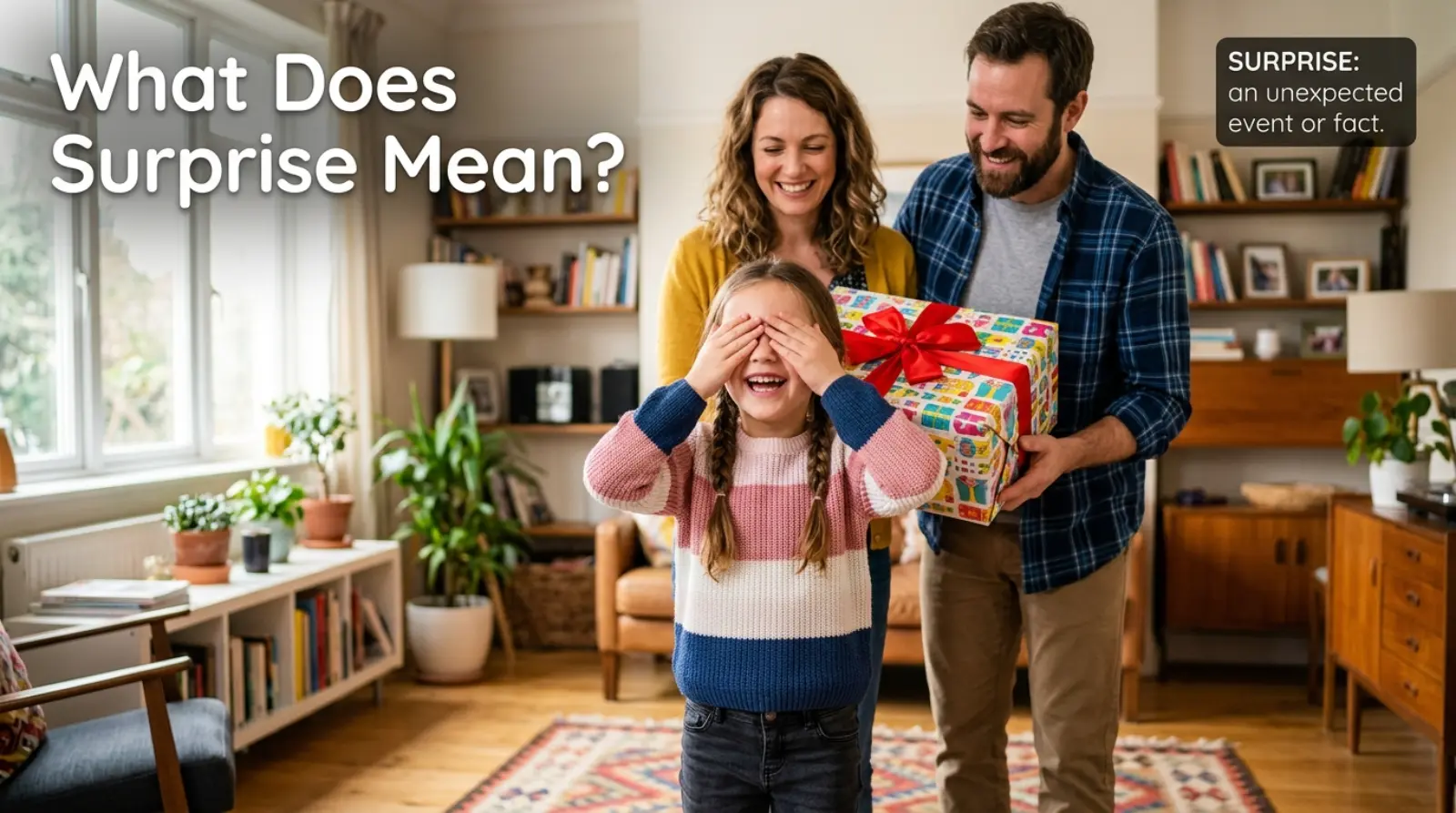
What Does Suprise or Surprise Mean?
The correct word surprise describes something unexpected.
The party was a big surprise.
I want to surprise my sister.
As an adjective in phrases such as surprise party, it describes something planned secretly to create an unexpected moment.
We are planning a surprise party.
Synonyms
Depending on the context, synonyms include:
- shock
- amazement
- astonishment
- unexpected event
- wonder
Opposites
Possible opposites include:
- expectation
- predictability
- certainty
- anticipation
Related Terms
- surprised
- surprising
- surprisingly
- surprise party
- surprise visit
- surprise gift
- surprise announcement
The Origin of Surprise
The word surprise entered English through French and ultimately traces back to Latin roots connected with the idea of taking unexpectedly.
Over time, the meaning developed around something unexpected or something that catches a person unaware.
Today, surprise has many uses. It can describe a happy event, shocking news, an unexpected visit, or simply something that was not expected.
The spelling has remained surprise, making the extra r an important part of the word.
How to Pronounce Surprise
Surprise is commonly pronounced:
ser-PRIZE
It has two syllables:
sur + prise
The second syllable receives the main stress.
Easy speaking trick
Say:
ser-PRIZE
Then remember that the spelling begins with sur.
A common mistake is to let the pronunciation influence the spelling too much. The first part can sound softer than it looks.
British English vs American English Usage
British and American English use the same spelling: surprise.
| Feature | British English | American English | Notes |
|---|---|---|---|
| Correct spelling | surprise | surprise | Same |
| Incorrect spelling | suprise | suprise | Avoid |
| Meaning | Unexpected event or feeling | Unexpected event or feeling | Same |
| Pronunciation | Similar | Similar | Accent may vary |
| Surprise party | Common | Common | Same |
There is no major British American spelling difference for surprise.
Which One Should You Use?
Use surprise in all standard English writing.
It is correct for:
- school assignments
- academic writing
- professional emails
- business communication
- social media
- text messages
- websites
- greeting cards
- everyday conversations
Quick usage table
| Form | Correct? | Example |
| surprise | ✅ Yes | It was a surprise. |
| suprise | ❌ No | Avoid this spelling. |
| surprised | ✅ Yes | I was surprised. |
| surprising | ✅ Yes | That was surprising. |
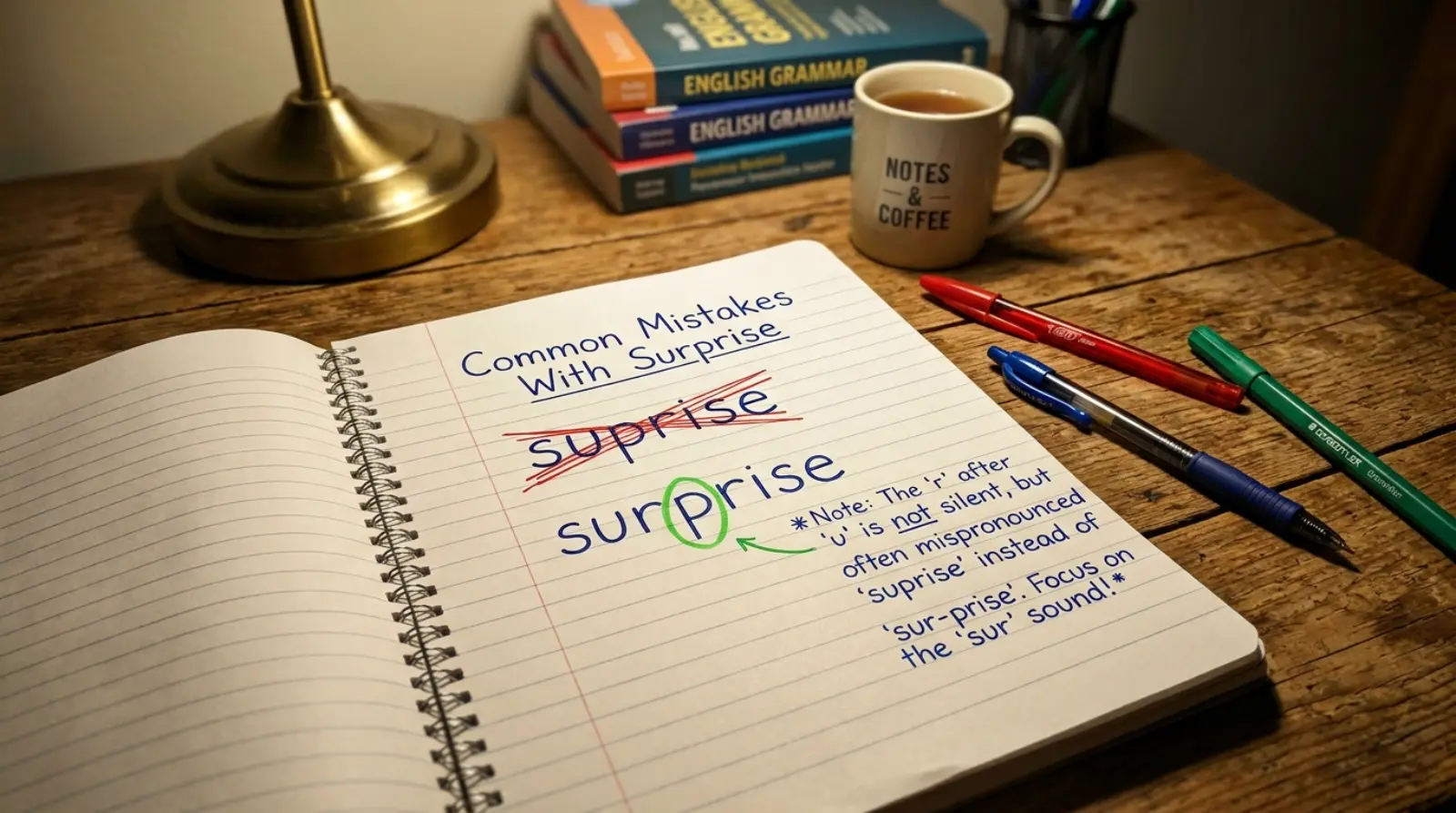
Common Mistakes With Suprise or Surprise
Mistake 1
❌ What a suprise!
✔ What a surprise!
Explanation: The word needs an r after the first u.
Correction tip: Remember SURPRISE starts with SUR.
Mistake 2
❌ I have a suprise for you.
✔ I have a surprise for you.
People often leave out the r because they type the word quickly.
Mistake 3
❌ She was suprised by the news.
✔ She was surprised by the news.
The same spelling pattern applies to the past tense.
Mistake 4
❌ It was very suprising.
✔ It was very surprising.
Remember that surprising also keeps the r.
Mistake 5
❌ We are planning a suprise party.
✔ We are planning a surprise party.
The correct spelling is especially important on invitations and event announcements.
Mistake 6
❌ The result was a big suprise.
✔ The result was a big surprise.
The missing r is a spelling error, not a different English word.
Suprise or Surprise in Everyday Examples
Work
“The announcement came as a complete surprise.”
School
“Our teacher gave us a surprise quiz.”
Social Media
“She surprised everyone with the announcement.”
Daily Life
“I have a surprise waiting for you.”
“We have a surprise planned for the team.”
Text Message
“Guess what? I have a surprise! 🎁”
Online Content
“The final result was a surprise to many viewers.”
Conversation
“Did you know about the party?”
“No! It was a total surprise.”
Suprise or Surprise in Different Contexts
Education
Students may see surprise in reading, writing, and vocabulary exercises.
The surprise test caught everyone off guard.
Business
Businesses use surprise when discussing unexpected results, announcements, gifts, or events.
The company made a surprise announcement.
Relationships
The word often appears when someone plans an unexpected gift, visit, or celebration.
He planned a surprise date for her.
Social Media
People commonly use surprise when sharing unexpected news or reactions.
Surprise! We are getting married!
Marketing
Brands may use surprise as part of promotions or customer experiences.
Customers received a surprise gift with their order.
Writing
Writers use the word to create excitement or describe unexpected events.
To her surprise, the door opened.
Suprise or Surprise Google Trends and Usage
People search for suprise or surprise mainly because the missing r is an easy spelling mistake.
Common related searches include:
- suprise or surprise
- how to spell surprise
- surprise spelling
- surprise meaning
- surprise pronunciation
- surprise definition
- surprised spelling
- surprising spelling
- surprise examples
- is suprise a word
The question can appear among English learners and students in the US, UK, India, Pakistan, Canada, and Australia.
Voice searches may include:
“How do you spell surprise?”
or:
“Is suprise or surprise correct?”
The answer is surprise.
Comparison Table for Suprise or Surprise
| Feature | Suprise | Surprise |
| Correctness | ❌ Incorrect | ✅ Correct |
| Meaning | Intended meaning of surprise | Unexpected event or feeling |
| Spelling | Missing r | Correct spelling |
| Pronunciation | Intended same sound | ser-PRIZE |
| Academic use | Avoid | Recommended |
| Professional use | Avoid | Recommended |
| Social media | Common typo | Correct |
| Texting | May appear as a typo | Correct |
| Main issue | Missing r | None |
Suprise or Surprise in Professional Life
Correct spelling is important in workplace communication.
You might use surprise in:
- company announcements
- customer emails
- event invitations
- marketing campaigns
- employee messages
- presentations
- business reports
For example:
“The team prepared a surprise celebration for the retiring employee.”
Using suprise in a professional document can make the writing look rushed or careless.
Suprise or Surprise for Students and Beginners
The biggest problem is remembering where the r belongs.
Many learners see or hear the word as something like “sur-prize” but may forget the r while writing.
Try breaking it into two parts:
SUR + PRISE
Then say it:
surprise
Beginner shortcut
Write the first four letters slowly:
S U R P
Once you remember SUR, the rest becomes much easier.
Signs, Characteristics, and Common Uses of Surprise
The word surprise commonly appears when:
- something unexpected happens
- someone receives an unexpected gift
- news arrives suddenly
- a person visits unexpectedly
- an event is planned secretly
- a result is not expected
- someone reacts with amazement
Common phrases include:
- a big surprise
- a pleasant surprise
- a surprise party
- a surprise visit
- a surprise gift
- a surprise announcement
- to my surprise
- much to my surprise
Simple Trick to Remember Suprise or Surprise
Think of the word as:
👉 SUR + PRISE = SURPRISE
Not:
❌ SU + PRISE
Think of it this way:
Imagine the word wearing an extra R like a little reminder:
SURPRISE 🎁
That R is part of the word.
Memory shortcut
Surprise starts with SUR.
If you remember SUR, you are much less likely to write suprise.
Expert Tips for Spelling Surprise
- Remember the first four letters.
They are SURP. - Say the word slowly.
Think sur + prise. - Connect it with surprised.
Both forms keep the r. - Connect it with surprising.
The r stays there too. - Use visual memory.
Write SURPRISE 🎁 several times. - Proofread invitations carefully.
“Surprise party” is a very common phrase.
Related Searches People Also Ask
How do you spell surprise?
The correct spelling is surprise.
Is suprise a word?
Suprise is a common misspelling. The standard word is surprise.
How do you spell surprised?
The correct spelling is surprised.
How do you spell surprising?
The correct spelling is surprising.
What does surprise mean?
It means something unexpected or the feeling caused by something unexpected.
How do you pronounce surprise?
It is commonly pronounced ser-PRIZE.
Is surprise a noun or verb?
It can be both a noun and a verb.
What is a surprise party?
It is a party secretly planned for someone who does not know about it.
Why do people spell surprise as suprise?
The r is easy to miss because of the word’s pronunciation and letter pattern.
Is surprise spelled the same in British and American English?
Yes. Both normally use surprise.
FAQs About Suprise or Surprise
Is it suprise or surprise?
Surprise is correct. Suprise is a misspelling.
Why is surprise spelled with an r?
The standard spelling of the English word is surprise, which preserves the r in its first part.
What is the meaning of surprise?
A surprise is something unexpected or a feeling caused by something unexpected.
Is surprise a verb?
Yes. For example, “I want to surprise my friend.”
Is surprise a noun?
Yes. For example, “The gift was a surprise.”
What is an example of surprise?
“The surprise party made her very happy.”
How do you remember the spelling?
Remember SUR + PRISE = SURPRISE.
Is suprise ever correct?
No, not as the standard spelling of the English word surprise.
What is the past tense of surprise?
The past tense is surprised.
What is the adjective form?
Surprising describes something that causes surprise, while surprised describes how someone feels.
Final Verdict
Surprise is the correct spelling.
👉 Surprise = correct
👉 Suprise = incorrect
The easiest memory rule is:
SUR + PRISE = SURPRISE
Always keep the r after the first u.
Conclusion
The answer to suprise or surprise is simple: surprise is the correct spelling.
This common mistake happens because the r is easy to forget when typing or writing quickly. The best way to remember it is to break the word into SUR + PRISE.
You can use surprise when talking about unexpected news, gifts, parties, visits, feelings, or events.
So next time you write the word, remember:
🎁 SURPRISE has an R.
That small spelling trick can help you get it right every time.

Camila Green is an English language writer who specializes in confusing word comparisons and spelling explanations. She creates simple, beginner-friendly guides on topics like “niece or neice” and other common English mistakes. Her writing focuses on clarity, real-life examples, and easy learning. At VerrsaPick, she helps readers improve their English with practical and engaging content.