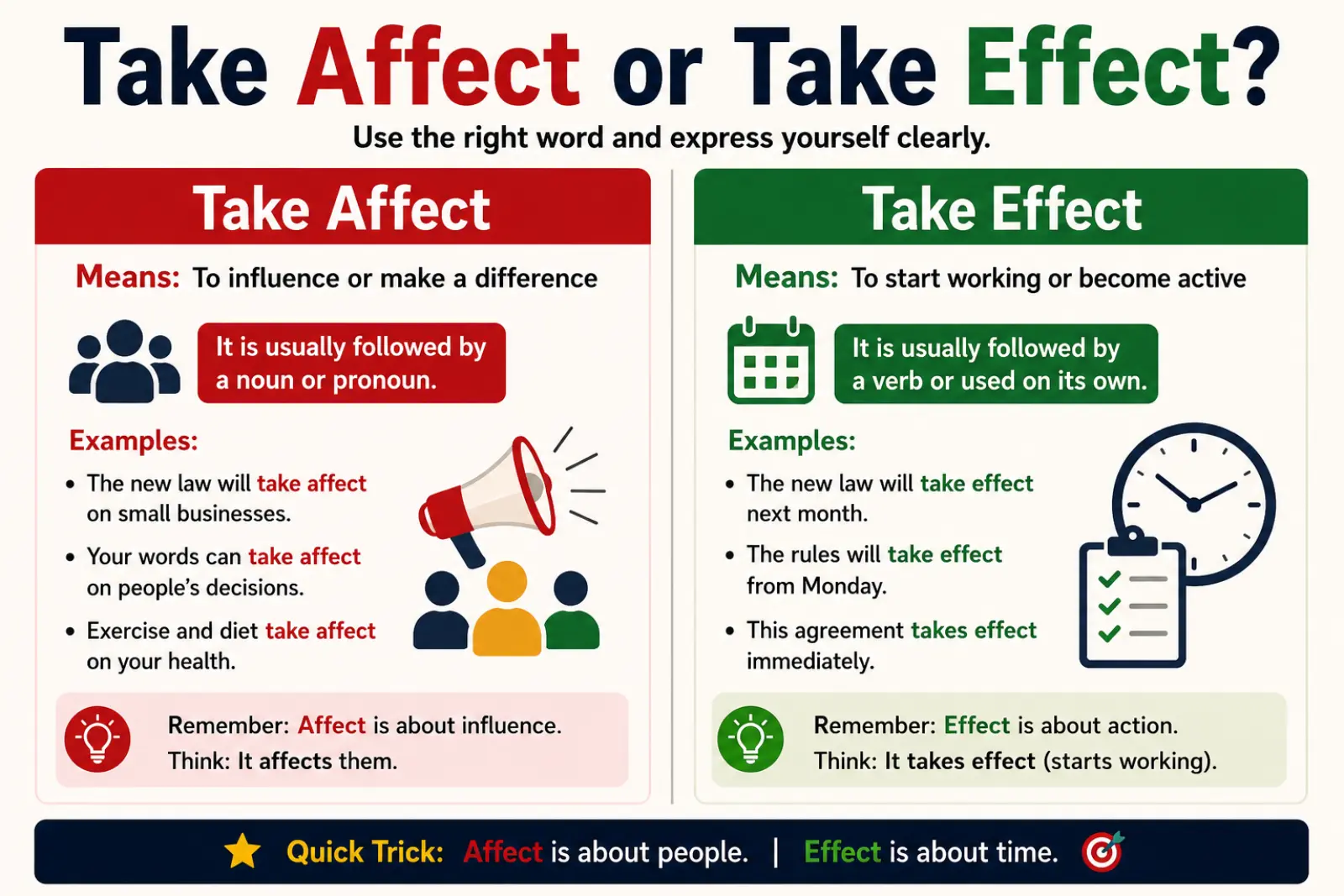
Have you ever written a sentence like, “The new rule will take affect next month,” and then stopped to wonder if take affect or take effect is correct? This is a very common English mistake. The two words look almost identical, sound similar, and both connect to ideas about change and influence.
The good news is that the answer is simple. In standard English, the correct phrase is take effect. It means something starts working, becomes active, or begins producing a result. Cambridge Dictionary defines “take effect” as producing or achieving the intended results.
You may see this phrase at school, at work, in business documents, in emails, in news stories, on websites, and in everyday conversations. Laws take effect, medicines take effect, policies take effect, and changes take effect.
People usually search for:
- take affect or take effect meaning
- take affect or take effect correct spelling
- take effect definition
- take effect examples
- take effect pronunciation
- take affect vs take effect grammar difference
- is it take affect or take effect?
The confusion usually comes from affect vs effect. Learning this small difference can make your writing much clearer.
In this guide, you’ll learn the meaning, pronunciation, examples, usage, grammar rules, common mistakes, expert tips, and simple explanations in easy English.
Take Affect or Take Effect – Quick Answer
👉 Take effect = correct. It means to start working, become active, or begin producing a result.
👉 Take affect = incorrect in standard English. It is normally a mistaken form of “take effect.”
Examples:
- The new law will take effect next month. ✅
- The medicine should take effect soon. ✅
- The new policy will take effect on Monday. ✅
- The discount will take effect immediately. ✅
- The changes have finally taken effect. ✅
Simple Rule:
👉 If you mean “start working” or “become active,” use “take effect.”
An easy memory trick is:
Effect = result → take effect = start producing a result.
Cambridge also lists “take effect” for rules, salary increases, and other changes that begin to operate.
What Does Take Affect or Take Effect Mean?
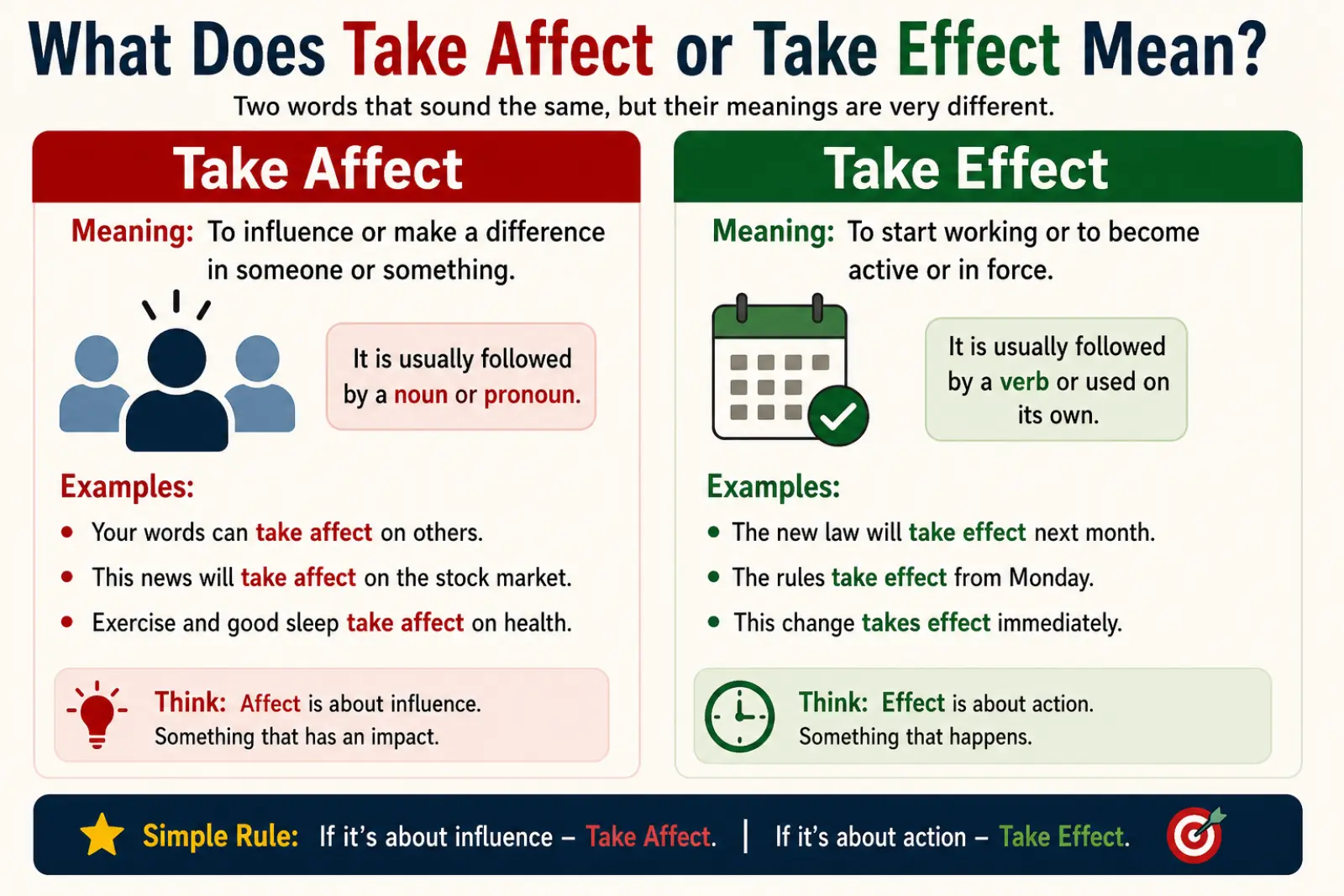
Take effect is a fixed English phrase. It means that something begins to work, becomes active, or starts producing its intended result.
For example:
The new school policy will take effect in September.
This means the policy will officially start being used in September.
You can use take effect with many subjects:
- laws
- rules
- policies
- decisions
- medicines
- treatments
- changes
- agreements
- plans
- safety measures
- business decisions
The word effect is usually a noun meaning a result or outcome. In “take effect,” it also appears in the established expression meaning “become active” or “start working.”
Affect is usually a verb meaning “to influence.”
Example:
The weather can affect your mood.
So:
Affect = influence
Effect = result
Synonyms
Common alternatives to take effect include:
- become active
- start working
- become effective
- begin
- come into force
- become operative
- produce results
Opposites
Depending on the context, possible opposites include:
- stop working
- become inactive
- expire
- end
- cease
Related Terms
You may also see:
- come into effect
- be in effect
- put into effect
- bring into effect
- effective
- affected
- effective date
The Origin of Take Affect or Take Effect
The confusion between affect and effect is not new. Both words have Latin roots and developed different roles in English.
Affect comes from Latin afficere, connected with influencing or acting upon something.
Effect comes from Latin effectus, connected with accomplishment, result, or outcome.
Over time, English developed different common uses for the two words. Affect became strongly associated with the idea of influencing something, while effect became strongly associated with a result.
That distinction helps explain the phrase take effect. Something “takes effect” when it begins producing a result or becomes active.
The phrase is now firmly established in modern English dictionaries.
How to Pronounce Take Affect or Take Effect
Take effect is pronounced approximately:
tayk ih FEKT
IPA:
/teɪk ɪˈfekt/
Break it into three simple parts:
take + i + fect
The important point is that effect has the stressed second syllable:
ef-FECT
Common learners may pronounce “effect” too quickly or confuse it with “affect.”
A useful speaking trick is to connect effect with result:
take effect = start producing a result
British English vs American English Usage
There is no British versus American spelling difference here. Both varieties use take effect.
| Feature | British English | American English | Notes |
|---|---|---|---|
| Correct phrase | Take effect | Take effect | Same |
| Incorrect phrase | Take affect | Take affect | Standard usage avoids it |
| Meaning | Become active | Become active | Same |
| Pronunciation | Similar | Similar | No major difference |
| Formal writing | Take effect | Take effect | Correct in both |
For example:
UK: The new rules will take effect tomorrow.
US: The new rules will take effect tomorrow.
The phrase is also common in international English.
Which One Should You Use?
Use take effect when you mean something starts working or becomes officially active.
Formal writing
The new regulations will take effect on January 1.
Academic writing
The treatment began to take effect after several weeks.
Workplace communication
The updated policy will take effect next Monday.
Business writing
The new pricing structure will take effect immediately.
Texting
The new rule takes effect tomorrow.
Social media
The changes finally took effect today.
You should avoid take affect in standard professional, academic, and everyday writing.
Common Mistakes With Take Affect or Take Effect
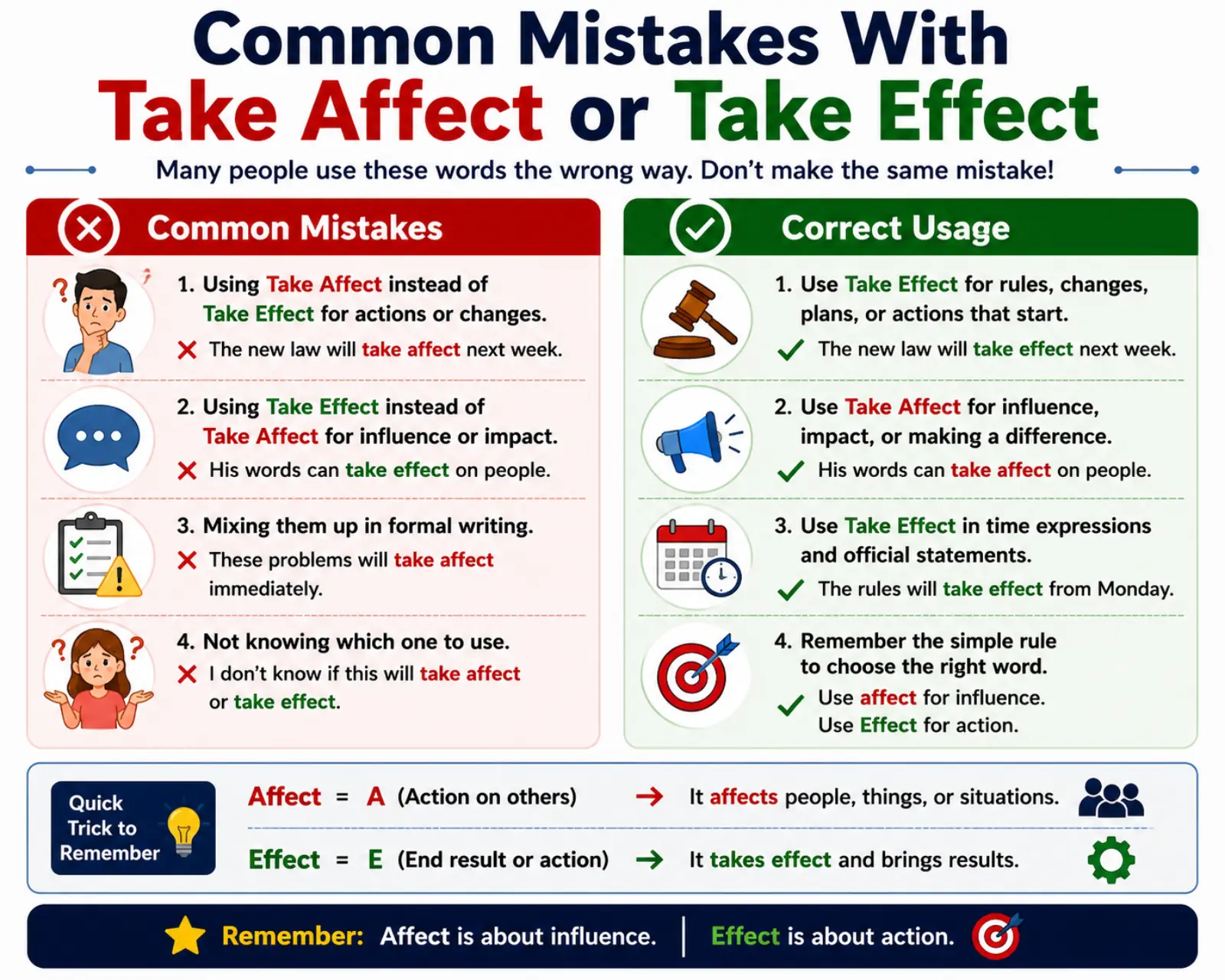
Mistake 1: Using “take affect”
❌ The new policy will take affect tomorrow.
✔ The new policy will take effect tomorrow.
Why? The standard phrase is take effect.
Tip: Remember “effect” when something starts producing a result.
Mistake 2: Confusing affect with effect
❌ The new medicine will take affect soon.
✔ The new medicine will take effect soon.
Why? “Affect” usually means influence.
The medicine may affect your sleep.
But:
The medicine will take effect soon.
Mistake 3: Using “effect” when you need the verb “affect”
❌ The loud noise will effect my concentration.
✔ The loud noise will affect my concentration.
Here, affect means influence.
Mistake 4: Writing “take effects”
❌ The changes will take effects next week.
✔ The changes will take effect next week.
The phrase normally uses singular effect.
Mistake 5: Confusing “take effect” with “have an effect”
Both phrases are correct, but they are used differently.
The new rule will take effect Monday.
The new rule will have an effect on employees.
The first means the rule becomes active. The second focuses on its result or impact.
Mistake 6: Assuming “affect” is always a verb
Affect has some specialized noun uses, especially in psychology, but that does not make take affect the normal phrase.
For ordinary writing, remember:
Affect = influence
Effect = result
Take Affect or Take Effect in Everyday Examples
Work:
The new office hours will take effect next week.
School:
The updated attendance policy will take effect in August.
Social Media:
The platform’s new rules will take effect tomorrow.
Daily Life:
The pain medicine should take effect soon.
Email:
Please note that the new schedule will take effect on Monday.
Text Message:
The discount takes effect at midnight.
Online Content:
The website changes will take effect after the update.
Conversation:
“When will the new rule take effect?”
These examples show why the phrase appears so often in real life.
Take Affect or Take Effect in Different Contexts
Education: Schools often use “take effect” for attendance rules, grading policies, schedules, and academic changes.
The new grading system will take effect next semester.
Business: Companies use it for prices, policies, contracts, benefits, and workplace rules.
The new pricing plan will take effect next month.
Government: Laws and regulations commonly use the phrase.
The new law will take effect on July 1.
Healthcare: Doctors and patients use it to describe medicine or treatment beginning to work.
The medication should take effect within an hour.
Technology: Software updates and system changes can also take effect.
The security update will take effect after you restart the device.
Take Affect or Take Effect – Google Trends & Usage Data
The exact search volume for take affect or take effect changes over time, and Google Trends reports relative interest rather than a permanent number. The continued appearance of recent grammar guides and dictionary examples shows that this remains a recurring English usage question.
The phrase also appears frequently in current news and public writing. Recent examples include laws, tariffs, salary changes, and government policies that are described as taking effect.
Searchers in the US, UK, India, Pakistan, Canada, and Australia may encounter the same confusion because the standard phrase is shared across these varieties of English.
Common long-tail searches include:
- Is it take affect or take effect?
- Does take effect mean start?
- How do you use take effect in a sentence?
- What is the difference between affect and effect?
- Is take affect grammatically correct?
- When should I use take effect?
- Take effect meaning in simple English
Comparison Table for Take Affect or Take Effect
| Feature | Take Affect | Take Effect |
|---|---|---|
| Standard English | ❌ Incorrect | ✅ Correct |
| Meaning | No standard meaning in this phrase | Start working or become active |
| Grammar | Incorrect phrase | Established phrase |
| Pronunciation | Usually confused with effect | tayk ih FEKT |
| Professional use | Avoid | Common |
| Academic use | Avoid | Correct |
| Legal use | Avoid | Very common |
| Business use | Avoid | Common |
| Everyday use | Usually a mistake | Correct |
| Example | ❌ The rule will take affect | ✅ The rule will take effect |
Take Affect or Take Effect in Professional Life
This distinction matters in professional writing because take effect is common in policies, contracts, announcements, employee communications, legal documents, and business updates.
For example:
The new benefits will take effect on January 1.
The revised contract will take effect after approval.
The price increase will take effect next quarter.
Using take affect in these situations can make a sentence look careless. The mistake is small, but correcting it makes your writing more polished and professional.
Take Affect or Take Effect for Students and Beginners
Beginners often struggle because affect and effect are pronounced similarly and differ by only one letter.
Use this simple shortcut:
Affect = Act on something
Effect = End result
Then remember:
Take effect = start producing a result.
If you are writing an essay, email, school assignment, or report, pause whenever you see take affect. In normal standard English, change it to take effect.
Signs and Common Uses of Take Effect
You probably need take effect when the sentence talks about:
- a new law starting
- a policy becoming active
- a medicine beginning to work
- a rule becoming official
- a price change starting
- a decision being implemented
- a schedule changing
- a treatment producing results
- a system update becoming active
A useful pattern is:
Subject + will + take effect + time
The new rule will take effect tomorrow.
Simple Trick to Remember Take Affect or Take Effect
Think of effect as a result.
If something starts working, it starts creating a result.
So:
Take + effect = start producing a result.
Think of it this way:
Imagine turning on a lamp. You flip the switch, and the light begins working.
The light has taken effect.
Another quick trick:
A = Affect = Action on something
E = Effect = End result
So if you mean “start working,” choose effect.
Expert Tips for Remembering Take Effect
Here are a few easy proofreading tricks:
- Replace the phrase with “start working.”
- If the meaning fits, use take effect.
- Remember effect = result.
- Do not choose a word only because it sounds right.
- In professional writing, check affect and effect carefully.
- Remember that come into effect is also correct.
For example:
The new law will take effect tomorrow.
You could also say:
The new law will come into effect tomorrow.
Both are standard expressions.
Related Searches People Also Ask
Is take affect or take effect correct?
Take effect is correct in standard English.
What does take effect mean?
It means to start working or become active.
Why is take affect wrong?
Because the established phrase uses the noun effect.
Can I say take effect for medicine?
Yes. A medicine can take effect when it starts working.
Can a law take effect?
Yes. Laws and regulations commonly take effect on a specific date.
Is come into effect correct?
Yes. It has a similar meaning to take effect.
What is the difference between affect and effect?
Affect usually means influence, while effect usually means result.
Does take effect have a hyphen?
No. Write it as two words: take effect.
Can I use take effect in formal writing?
Yes. It is very common in formal and professional writing.
What is an easy way to remember effect?
Think: effect = result.
FAQs About Take Affect or Take Effect
Is “take affect” ever correct?
In standard modern English, take effect is the normal correct phrase. “Take affect” is generally a mistake.
Is “take effect” one word?
No. Write take effect as two separate words.
What is the meaning of “take effect”?
It means to become active, start working, or begin producing a result.
Can I say “the medicine takes effect”?
Yes. This is a natural and correct sentence.
Can a new law take effect?
Yes. This is one of the most common uses.
What is the difference between affect and effect?
Affect usually means to influence. Effect usually means a result or outcome.
Is “come into effect” correct?
Yes. “Come into effect” means to become active or start being used.
Is take effect used in American English?
Yes. It is standard American English and is also used in British English.
Can I use take effect in an email?
Yes. It works well in both formal and everyday emails.
What is the easiest memory trick?
Remember: Effect = result. Take effect = start producing a result.
Final Verdict on Take Affect or Take Effect
The correct phrase is take effect.
❌ Take affect = incorrect in standard English
✅ Take effect = correct
Use take effect when a law, rule, medicine, policy, decision, change, or other action starts working or becomes active.
The easiest rule is:
Affect = influence.
Effect = result.
Take effect = start producing a result.
Conclusion
The take affect or take effect question looks confusing at first, but the answer is actually simple. In standard English, use take effect when you mean something becomes active, starts working, or begins producing results.
You can use it for laws, rules, medicines, policies, business decisions, technology updates, and everyday changes.
The best memory trick is to connect effect with result. If something starts producing a result, it takes effect.
So the next time you pause over the spelling, remember:
Affect influences. Effect produces a result. Changes take effect.

Camila Green is an English language writer who specializes in confusing word comparisons and spelling explanations. She creates simple, beginner-friendly guides on topics like “niece or neice” and other common English mistakes. Her writing focuses on clarity, real-life examples, and easy learning. At VerrsaPick, she helps readers improve their English with practical and engaging content.