You are writing an email about a new project, preparing a sports article, or making a meeting schedule, and suddenly you stop: should it be kickoff or kick-off? Both forms appear online, so the confusion is completely understandable.
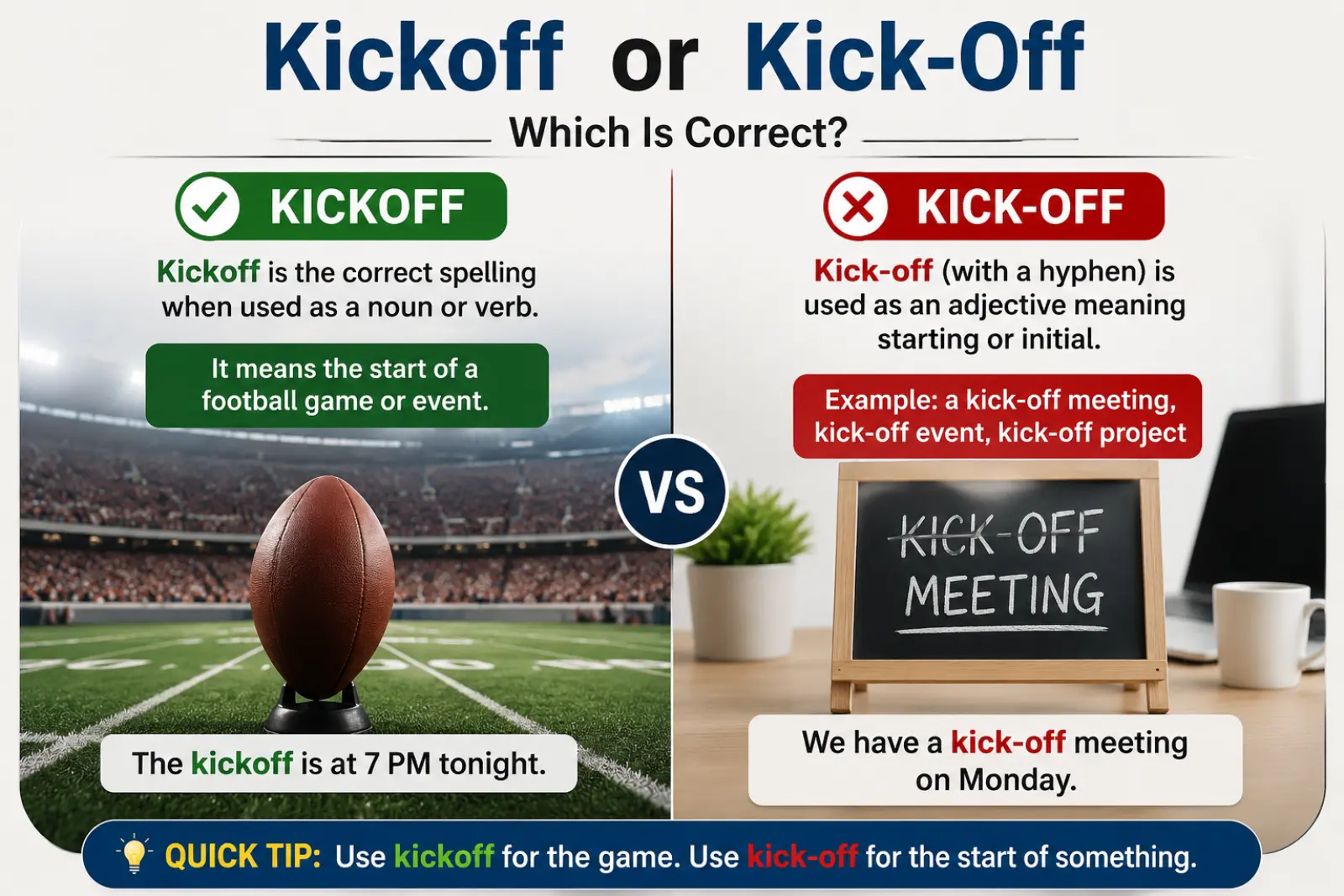
The good news is that both kickoff and kick-off can be correct, but modern English often prefers kickoff when the word is used as a noun or adjective. Kick off is normally used as a verb.
People usually search for the kickoff or kick-off meaning, correct spelling, pronunciation, examples, usage, definition, and grammar difference because the word is common in sports, business, meetings, projects, marketing, and everyday conversation.
You may see it in phrases such as a project kickoff meeting, football kickoff, event kickoff, or kick off the meeting. In American English, kickoff is especially common as a noun and adjective. The hyphenated kick-off is also found, especially in some British English writing and style systems.
In this guide, you’ll learn the meaning, pronunciation, examples, usage, grammar rules, common mistakes, expert tips, and simple explanations in easy English.
Kickoff or Kick-Off – Quick Answer
Kickoff = usually the preferred noun or adjective form.
Kick-off = a hyphenated noun or adjective form that is also used, depending on the style guide or variety of English.
Kick off = the verb form.
Examples
- The kickoff meeting starts at 9 a.m. ✅
- The kick-off meeting starts at 9 a.m. ✅
- We will kick off the project tomorrow. ✅
- The football kickoff is at 7 p.m. ✅
- The event will kick off at noon. ✅
Simple Rule
👉 One word = noun/adjective: kickoff
👉 Two words = verb: kick off
The hyphenated kick-off can also work as a noun or adjective, but kickoff is often the simplest choice.
What Does Kickoff or Kick-Off Mean?
Kickoff means the beginning or official start of something. In sports, it can also mean the act of starting a game by kicking the ball.
For example:
- The project kickoff is Monday.
- The game kickoff is scheduled for 8 p.m.
- We had a successful kickoff meeting.
As a verb, kick off means to begin something:
- We will kick off the campaign next week.
- The meeting will kick off at 10 a.m.
Related Terms
- launch — the start of something
- beginning — the point where something starts
- start — to begin
- opening — the beginning of an event
- kick off — to begin an activity
The Origin of Kickoff and Kick-Off
The expression comes from the literal idea of kicking something to start an activity. It became strongly connected with sports, especially games where a kick begins play.
Over time, the expression gained a wider meaning. Today, people use kickoff far beyond sports.
Businesses use it for:
- project kickoff meetings
- marketing campaign kickoffs
- product launches
- team meetings
- business events
This is why kickoff has become a common word in modern workplace English.
How to Pronounce Kickoff or Kick-Off
Kickoff and kick-off have the same pronunciation.
A simple pronunciation is:
KICK-off
There are two parts:
- kick
- off
The stress is usually clear on the first part: KICK-off.
The verb kick off is pronounced the same way.
British English vs American English Usage
The main difference is often style and spelling preference, not meaning.
| Feature | British English | American English |
|---|---|---|
| Noun | kickoff / kick-off | kickoff |
| Verb | kick off | kick off |
| Meaning | Same | Same |
| Sports usage | Both forms appear | Kickoff is common |
| Business usage | Both forms appear | Kickoff is very common |
American English strongly favors kickoff as one word when it functions as a noun or adjective.
British English may use kick-off more often in some publications and style systems.
Which One Should You Use?
For most modern writing, this simple approach works well:
- Use kickoff as a noun: “The kickoff was successful.”
- Use kickoff before another noun: “We attended the kickoff meeting.”
- Use kick off as a verb: “We will kick off the meeting.”
- Use kick-off if your organization, publication, or style guide prefers the hyphenated form.
Mini Usage Table
| Sentence | Correct? |
|---|---|
| The kickoff meeting starts soon. | ✅ |
| The kick-off meeting starts soon. | ✅ |
| We will kick off the meeting. | ✅ |
| We will kickoff the meeting. | ❌ |
| The game kickoff is tonight. | ✅ |
Common Mistakes With Kickoff or Kick-Off
Mistake 1: Using kickoff as a verb
❌ We will kickoff the meeting.
✔ We will kick off the meeting.
Why? The verb is normally written as two words.
Tip: If you can replace it with begin, use kick off.
Mistake 2: Thinking kick-off is always wrong
❌ Kick-off is never correct.
✔ The kick-off meeting begins at 10.
The hyphenated form is used in English, especially under certain style preferences.
Mistake 3: Confusing the noun and verb
❌ The project will kickoff tomorrow.
✔ The project will kick off tomorrow.
Here, the phrase describes an action, so kick off is the better choice.
Mistake 4: Using a hyphen everywhere
❌ We will kick-off the campaign.
✔ We will kick off the campaign.
The verb normally does not need a hyphen.
Mistake 5: Forgetting the space in the verb
❌ The event will kickoff at noon.
✔ The event will kick off at noon.
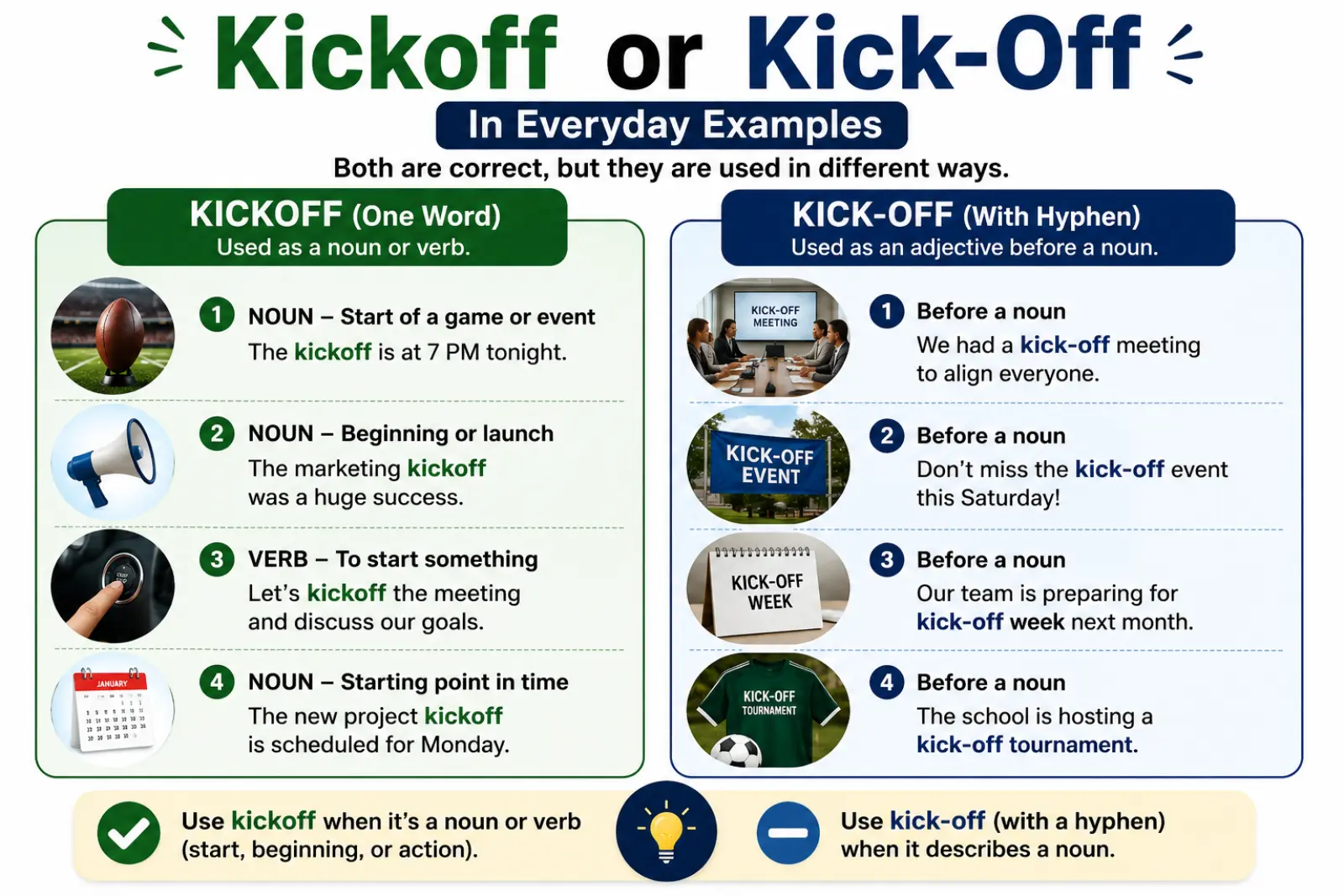
Kickoff or Kick-Off in Everyday Examples
Work:
“Our project kickoff meeting is on Tuesday.”
School:
“The school football kickoff starts at 4 p.m.”
Social Media:
“We are ready for the campaign kickoff!”
Email:
“Here are the details for tomorrow’s kickoff meeting.”
Text Message:
“What time does the game kick off?”
Business:
“The sales team will kick off the new campaign next week.”
Conversation:
“Let’s kick off the meeting with a quick introduction.”
Kickoff or Kick-Off in Different Contexts
Business and Workplace
Kickoff is extremely common in professional communication.
Examples include:
- project kickoff
- team kickoff
- campaign kickoff
- client kickoff
- kickoff meeting
Example:
“The client kickoff meeting will cover the project goals and timeline.”
Sports
In sports, kickoff refers to the start of a game or the action that begins play.
Example:
“The football kickoff is at 7:30 p.m.”
Marketing
Marketing teams often use campaign kickoff to describe the beginning of a campaign.
Example:
“The campaign kickoff is scheduled for next Monday.”
Education
Teachers and students can use kickoff for the beginning of a project, event, or school activity.
Example:
“The science fair kickoff will take place in the main hall.”
Kickoff or Kick-Off Comparison Table
| Feature | Kickoff | Kick-off | Kick off |
|---|---|---|---|
| Form | One word | Hyphenated | Two words |
| Main role | Noun/adjective | Noun/adjective | Verb |
| Meaning | Start | Start | Begin |
| Business use | Very common | Also used | Very common |
| Sports use | Common | Also used | Common as verb |
| Example | kickoff meeting | kick-off meeting | kick off the meeting |
Kickoff or Kick-Off in Professional Life
Choosing the right form can make workplace writing look cleaner.
Use kickoff in phrases such as:
- project kickoff
- kickoff meeting
- kickoff event
- kickoff call
- kickoff presentation
Use kick off when describing an action:
- “We will kick off the project.”
- “The meeting will kick off at 9.”
- “The team will kick off the campaign.”
A useful professional writing trick is to check what role the phrase plays before you type it.
Kickoff or Kick-Off for Students and Beginners
Beginners often struggle because English has many compound words that change form over time.
The easiest way to understand this word is to focus on the grammar role.
If kickoff names a thing or event, use the noun form.
“The kickoff was exciting.”
If kick off describes an action, use the verb form.
“We will kick off the event.”
This same pattern appears with other English expressions, so learning the difference can improve your overall writing.
Simple Trick to Remember Kickoff or Kick-Off
Think of it this way:
👉 Kickoff = the start
👉 Kick off = start something
Imagine a football game.
The kickoff is the start of the game.
The players kick off the game.
Memory Shortcut
Thing/event → kickoff
Action → kick off
Examples:
- The kickoff is at 8. ✅
- We kick off at 8. ✅
Expert Tips for Using Kickoff Correctly
- Check the grammar role first. Is it a thing or an action?
- Use kickoff for common noun phrases such as kickoff meeting.
- Use kick off when it works as a verb.
- Follow your company’s style guide if it prefers kick-off.
- Keep the spelling consistent throughout the same document.
- In formal business writing, avoid switching randomly between forms.
Related Searches People Also Ask
- Is kickoff one word?
Yes. Kickoff is a standard noun and adjective form. - Is kick-off correct?
Yes. The hyphenated form is also used, depending on style and regional preference. - Is kick off two words?
Yes. Kick off is normally the verb form. - Is kickoff one word or two?
As a noun, kickoff is commonly one word. - Should I write kickoff meeting or kick-off meeting?
Both are used, but kickoff meeting is widely accepted and common in American English. - What does kickoff mean in business?
It means the official beginning of a project, campaign, or activity.
FAQs About Kickoff or Kick-Off
Is kickoff one word or two?
Kickoff is one word when used as a noun or adjective. Kick off is two words when used as a verb.
Is kick-off grammatically correct?
Yes. Kick-off is an accepted hyphenated form for the noun or adjective in some styles.
Which is better: kickoff or kick-off?
Kickoff is a simple and widely used modern choice, especially in American English.
Is kick off a verb?
Yes. Kick off means to begin something.
Should I say kickoff meeting or kick-off meeting?
Both can be found in English. Kickoff meeting is a very common modern form.
Is kickoff formal?
Yes. Kickoff is suitable for professional, academic, and business writing when used correctly.
What is the difference between kickoff and kick off?
Kickoff is generally a noun or adjective. Kick off is a verb.
Can kickoff refer to sports?
Yes. In sports, kickoff can mean the start of a game or the action that starts play.
Final Verdict
Kickoff and kick-off can both be correct as noun or adjective forms, but kickoff is often the preferred modern spelling.
Remember the most important difference:
👉 Kickoff = the start
👉 Kick off = to start
For example:
The project kickoff is tomorrow. ✅
We will kick off the project tomorrow. ✅
Conclusion
The confusion around kickoff or kick-off becomes much easier once you look at how the word is being used.
For a noun or adjective, kickoff is a strong, modern choice. Kick-off is also used, especially in styles that prefer the hyphen. For the verb, use kick off as two separate words.
So, before submitting an email, article, assignment, or business document, ask one simple question: Am I naming the start, or am I describing the action of starting?
If you are naming the start, think kickoff. If you are describing the action, think kick off.
Easy memory trick: The kickoff is the start; you kick off something.

Camila Green is an English language writer who specializes in confusing word comparisons and spelling explanations. She creates simple, beginner-friendly guides on topics like “niece or neice” and other common English mistakes. Her writing focuses on clarity, real-life examples, and easy learning. At VerrsaPick, she helps readers improve their English with practical and engaging content.