Imagine dropping a small stone into a bowl of water. It quickly goes down. Then you place a plastic bottle on the water, and it stays on top. You may naturally ask, will this sink or float?
The phrase sink or float is mainly used in science and everyday learning to describe what happens when an object is placed in a liquid, especially water. It is one of the first science ideas children learn because it is simple to see but teaches an important lesson about density, buoyancy, mass, volume, and water displacement.
You may see sink-or-float activities in classrooms, science experiments, children’s books, educational videos, and online learning. Parents and teachers often use simple objects such as coins, pencils, stones, plastic toys, paper clips, and empty bottles to help children make predictions.
People usually search for the sink or float meaning, what makes something sink or float, sink or float examples, why objects float in water, and how to explain sinking and floating to beginners.
The basic idea is easy: an object tends to float when it is less dense than the liquid and tends to sink when it is more dense than the liquid. However, shape and the amount of water displaced also matter, which is why a large metal ship can float even though metal itself is denser than water.
In this guide, you’ll learn the meaning, pronunciation, examples, usage, science rules, common mistakes, expert tips, and simple explanations in easy English.
Sink or Float – Quick Answer
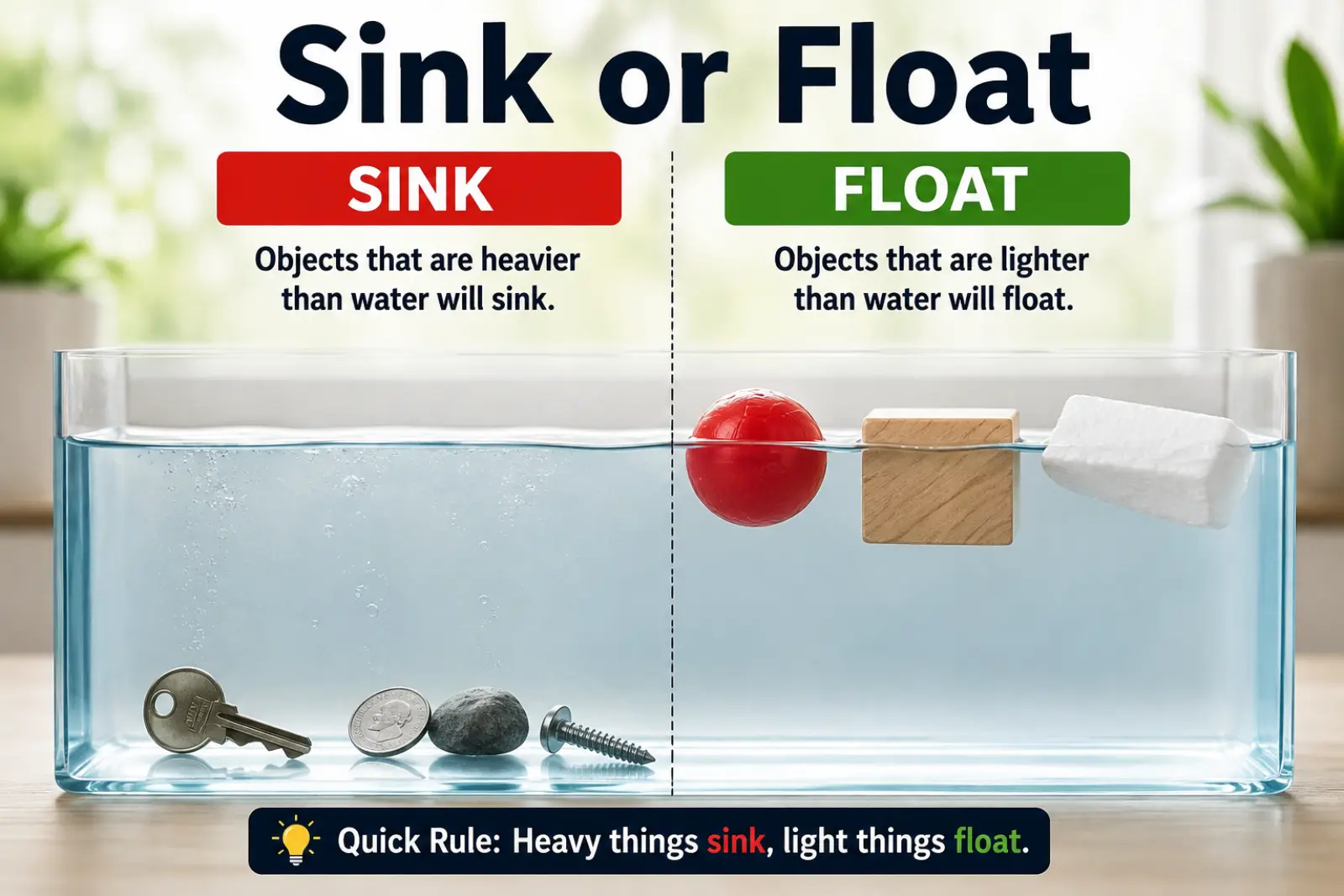
👉 Sink = move down into the water or liquid.
👉 Float = stay on the surface of the water or liquid.
Simple Examples
- A rock usually sinks in water.
- A dry wooden block usually floats.
- A coin sinks.
- An empty plastic bottle can float.
- A metal ship can float because of its shape and the water it displaces.
Simple Rule
👉 Less dense than water → usually floats.
👉 More dense than water → usually sinks.
A useful memory trick is:
Heavy for its size often sinks; light for its size often floats.
What Does Sink or Float Mean?
Sink or float is a simple phrase used to describe an object’s behavior in a liquid.
If an object moves downward and becomes submerged, it sinks.
If an object stays on the surface, it floats.
The idea is connected to density and buoyancy. Water pushes upward on objects placed in it. This upward force is called buoyant force.
Related Terms
- Sink: move downward in liquid
- Float: remain on or near the surface
- Density: how much matter is packed into a certain space
- Buoyancy: the upward force from a fluid
- Displacement: the amount of liquid pushed aside by an object
The Science Behind Sink or Float
The most important concept is density.
Water has a density of about 1 gram per cubic centimeter. An object with a lower average density than water can float. An object with a higher average density tends to sink.
For example, a small piece of wood may float because its average density is lower than water.
A solid iron nail sinks because iron is much denser than water.
But there is an interesting exception: shape matters.
A solid ball of metal may sink, while a hollow metal boat can float. The boat contains a lot of air and spreads its mass over a larger volume. Its overall average density can be low enough for the boat to stay afloat.
How to Pronounce Sink or Float
The phrase is easy to pronounce:
Sink → sink
Float → floht
There is one syllable in each word.
The i in sink sounds like the vowel in sit.
The oa in float sounds like the long o sound in boat.
Example:
Will this object sink or float?
British English vs American English Usage
There is no major British-American spelling difference for sink or float.
| Feature | British English | American English | Notes |
|---|---|---|---|
| Sink | Sink | Sink | Same |
| Float | Float | Float | Same |
| Meaning | Same | Same | No major difference |
| Science use | Common | Common | Used in education |
| Pronunciation | Very similar | Very similar | Accent may vary |
The phrase is understood in standard English around the world.
Which One Should You Use?
Use sink when an object moves downward in a liquid.
Use float when an object stays on the surface.
Examples:
- The stone will sink.
- The leaf will float.
- The coin sank to the bottom.
- The boat floated across the lake.
For science writing, you can also use terms such as density, buoyant force, and water displacement.
Common Mistakes With Sink or Float
Mistake 1: Thinking heavy objects always sink
❌ Every heavy object sinks.
✔ A heavy ship can float.
Why? Weight alone does not determine floating. Average density and water displacement matter too.
Mistake 2: Thinking all metal sinks
❌ Metal objects always sink.
✔ Some metal objects, such as ships, can float.
The shape and trapped air can change an object’s average density.
Mistake 3: Thinking size decides everything
❌ Bigger objects always sink.
✔ Size alone does not decide whether something floats.
A large piece of wood can float, while a tiny metal coin can sink.
Mistake 4: Confusing float with being weightless
❌ A floating object has no weight.
✔ A floating object still has weight.
The upward buoyant force balances its weight.
Mistake 5: Forgetting the liquid matters
An object can behave differently in different liquids because liquids have different densities.
Sink or Float in Everyday Examples
| Object | Usually in Water | Reason |
|---|---|---|
| Rock | Sinks | Higher density |
| Coin | Sinks | Higher density |
| Wooden block | Floats | Lower average density |
| Leaf | Floats | Low average density |
| Empty plastic bottle | Floats | Contains air |
| Metal spoon | Sinks | Higher density |
| Ice cube | Floats | Ice is less dense than liquid water |
| Metal ship | Floats | Shape and displacement |
These are useful examples for school science activities.
Sink or Float in Different Contexts
Education
Teachers often use sink-or-float experiments to introduce density and buoyancy.
Students can predict what will happen before testing an object. This makes science more interactive.
Home Learning
Parents can place safe household objects in a container of water and ask:
Do you think it will sink or float?
The child makes a prediction and then tests it.
Science Experiments
A basic experiment can include:
- Fill a container with water.
- Choose several safe objects.
- Predict what each object will do.
- Place each object in the water.
- Record the result.
- Discuss why it happened.
This simple activity teaches observation and scientific thinking.
Sink or Float – Usage and Common Patterns
The phrase appears in questions such as:
- Will it sink or float?
- Does this object sink or float?
- Which objects sink?
- Which objects float?
- Why does this float?
- Why does this sink?
- What makes something float?
- What makes something sink?
It is especially common in elementary science, educational worksheets, experiments, and beginner science lessons.
Sink or Float for Students and Beginners
The easiest way to learn this topic is to start with familiar objects.
Think about a rock and a piece of wood.
The rock usually sinks because its average density is greater than water.
The wood usually floats because its average density is lower than water.
Then think about a metal ship. It may seem strange that metal can float. The answer is its hollow shape. The ship pushes aside enough water to create enough buoyant force to support its weight.
This shows why science is more interesting than simply saying heavy sinks and light floats.
Simple Trick to Remember Sink or Float
Think of it this way:
Imagine water is giving an object an upward push.
If the object can get enough upward support from the water, it floats.
If its weight is greater than the upward support, it sinks.
Memory Shortcut
👉 Float = stays up
👉 Sink = goes down
For density:
👉 Lower average density → float
👉 Higher density → sink
Expert Tips for Understanding Sink or Float
- Do not judge an object only by its weight.
- Think about density.
- Think about how much water the object displaces.
- Remember that shape can change floating behavior.
- Compare the object’s average density with the liquid.
- Use real objects to test your prediction.
- Record observations instead of guessing.
A good science question is not only What happened? but also Why did it happen?
Related Searches People Also Ask
Why do some objects float in water?
They float when the upward buoyant force can support their weight.
Why do rocks sink?
Most rocks have a higher density than water, so they sink.
Why does wood float?
Many types of wood have a lower average density than water.
Why does ice float?
Ice is less dense than liquid water, so it floats.
Can metal float?
Yes. A metal object can float if its overall shape and volume allow it to displace enough water.
What makes something sink?
An object tends to sink when its average density is greater than the liquid.
What makes something float?
An object tends to float when its average density is lower than the liquid.
Is buoyancy the same as floating?
Not exactly. Buoyancy is the upward force a fluid applies to an object. Floating happens when the forces allow the object to remain supported.
FAQs About Sink or Float
What does sink or float mean?
It describes whether an object moves down into a liquid or stays on its surface.
What is the main rule for sink or float?
Objects with lower average density than water usually float, while objects with higher average density usually sink.
Does a heavy object always sink?
No. A large or hollow object can float even if it is heavy.
Does a small object always float?
No. A small coin, for example, can sink.
Why does a ship float if it is made of metal?
Its hollow shape gives it a lower average density and allows it to displace enough water.
What is buoyancy?
Buoyancy is the upward force a liquid or gas applies to an object.
What is density?
Density describes how much matter is packed into a certain amount of space.
What is an easy sink-or-float experiment?
Place safe objects in water, predict what will happen, test them, and record the results.
Final Verdict
Sink means an object goes down into a liquid.
Float means an object stays on or near the surface.
The most important science idea is density, but buoyancy, shape, and water displacement also matter.
Conclusion
The phrase sink or float may sound like a simple children’s science question, but it introduces important ideas about density, buoyancy, gravity, mass, volume, and displacement.
A rock usually sinks because its density is higher than water. Wood often floats because its average density is lower. A metal ship can also float because its shape helps it displace enough water to support its weight.
So remember the easiest rule:
Lower average density → float.
Higher average density → sink.
And when you are unsure, do not judge an object only by its size or weight. Think about density and how the object interacts with the water.

Camila Green is an English language writer who specializes in confusing word comparisons and spelling explanations. She creates simple, beginner-friendly guides on topics like “niece or neice” and other common English mistakes. Her writing focuses on clarity, real-life examples, and easy learning. At VerrsaPick, she helps readers improve their English with practical and engaging content.